Liberation and Restoration
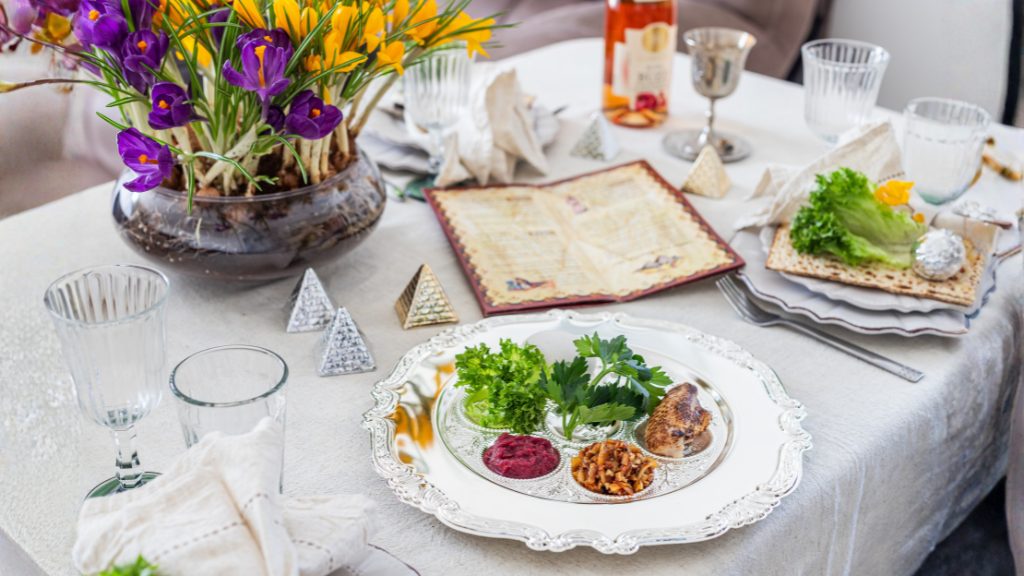 Table served for Passover Seder (Pesach). | Photo: Shutterstock
Pesach celebrates the liberation from the bondage of Egypt. The People of Israel were slaves of the Pharao in Egypt (Exodus 1). But the Lord heard their cry and delivered them from Egypt and brought them to the land that He had promised to their forefathers (Exodus 6).
The exodus from Egypt is the foundational experience of the People of Israel. It is remembered every year, not just as an event in the past, important as it may be, but as a personal experience of every Jew in every generation. One of the rules of telling the story on Pesach is that each person must see himself or herself as if they had personally left Egypt. And so, in many communities it is customary to share personal experiences of liberation at the Seder table (Seder, lit. ‘order’, is the Hebrew term for the Passover banquet on the first evening of Pesach: families gather around the dinner table, tell together the stories of the exodus according to the Haggadah, i.e. the texts that comprise the liturgy of the evening, and share the meal, including the matzah—unleavened bread—and four cups of wine).
The Pesach experience is expressed in many ways in the liturgy. Pesach lasts seven days; the first and the last days are ‘holy convocations’. It is remarkable that, on the Shabbat falling in the intermediate days of the feast, in the synagogue service, the Haftarah (reading from the Prophets) is Ezekiel 37:1–14—the vision of the valley of the dry bones. Obviously, the plain meaning of the prophecy is about the restoration of Israel after the Babylonian exile. People had lost all their hope (verse 11). If hope is lost, all is lost. They felt like being dead in a foreign land, far from the holy city and the temple. In that situation, Ezekiel was bringing a message of hope, because God would interfere and return the exiles to Jerusalem—a new Pesach experience.
However, it has also always been understood, both in Judaism and in Christianity, as a prophecy of the resurrection of the dead. The ancient rabbis in the Talmud discussed the question whether the vision is to be understood literally (‘in truth’) or as a parable. The answer should be: yes! It is both. As concluded in the Talmud: ‘In truth, it was a parable.’ Jewish understanding never separates the spiritual from the material. The liberation from Egypt is both physical and spiritual. It is going from the land of bondage to the land of freedom; from slavery to serving the Lord. The return from the exile in Babylon is designated as life from the dead (Romans 11:15). The restoration of Israel thus becomes a metaphor for the resurrection of the dead. And conversely, in the end of time, the resurrection of the dead will be a sign of the final restoration of Israel. In contemplating that, we also consider the absolute unity of Jesus with His people Israel. If the New Testament understands Jesus’ life and ministry, culminating in His death on the cross and His resurrection from the grave, in terms of the biblical history of Israel, then His resurrection is also proleptic of the restoration of Israel. Or in other words, in His resurrection, the restoration of Israel is vindicated.
Today, I believe, we cannot read this chapter on the resurrection of the dry bones without bearing in mind the Shoah and the establishment of the State of Israel, three years after the Shoah, as a new Pesach experience in our times. Yad Vashem, the Holocaust Memorial in Jerusalem, has an artwork that connects the Shoah to the prophecy of the dry bones. The mass graves of Europe were opened, and the bones were collected and brought to life in the newborn State of Israel. “Our hope is not lost”! is a key line in the national anthem of Israel, which is aptly titled ‘Hatikvah’, the hope—a true reversal of the hopelessness of the exiles in Babylon.
Israel is coming home, again. No war or hostile treatment of the nations can stop that. Messiah is gathering His people, restoring them to the Land, and to God’s covenant.

Why Israel? by Rev. Willem Glashouwer
Order the book