Akunis invites Mamdani to see Oct. 7 footage at Israeli consulate event

New York City Mayor Zohran Mamdani, who has accused the Jewish state of “genocide” and who campaigned on having the Israeli prime minister arrested, might change his tune if he takes the time to watch footage of the Hamas-led Oct. 7 attacks.
That’s why Ofir Akunis, Israeli consul general in New York, told about 1,000 people at Congregation Kehilath Jeshurun, an Orthodox synagogue on Manhattan’s Upper East Side, on Monday evening that he was inviting the mayor to attend a screening of footage of the attacks.
“In less than 48 hours, on Oct. 7, we will screen in New York City the 47-minute footage compiled by the IDF documenting the atrocities of Oct. 7,” Akunis said. “I invite Mr. Zohran Mamdani, the mayor, to come and watch the film.”
“For the first time, he will be able to see what the people he supports actually did, and perhaps he will stop his relentless incitement, hatred and blood libels against the State of Israel,” the Israeli envoy said.
Akunis previously told JNS that Mamdani is “the biggest liar ever, who actually served this city as a mayor.”
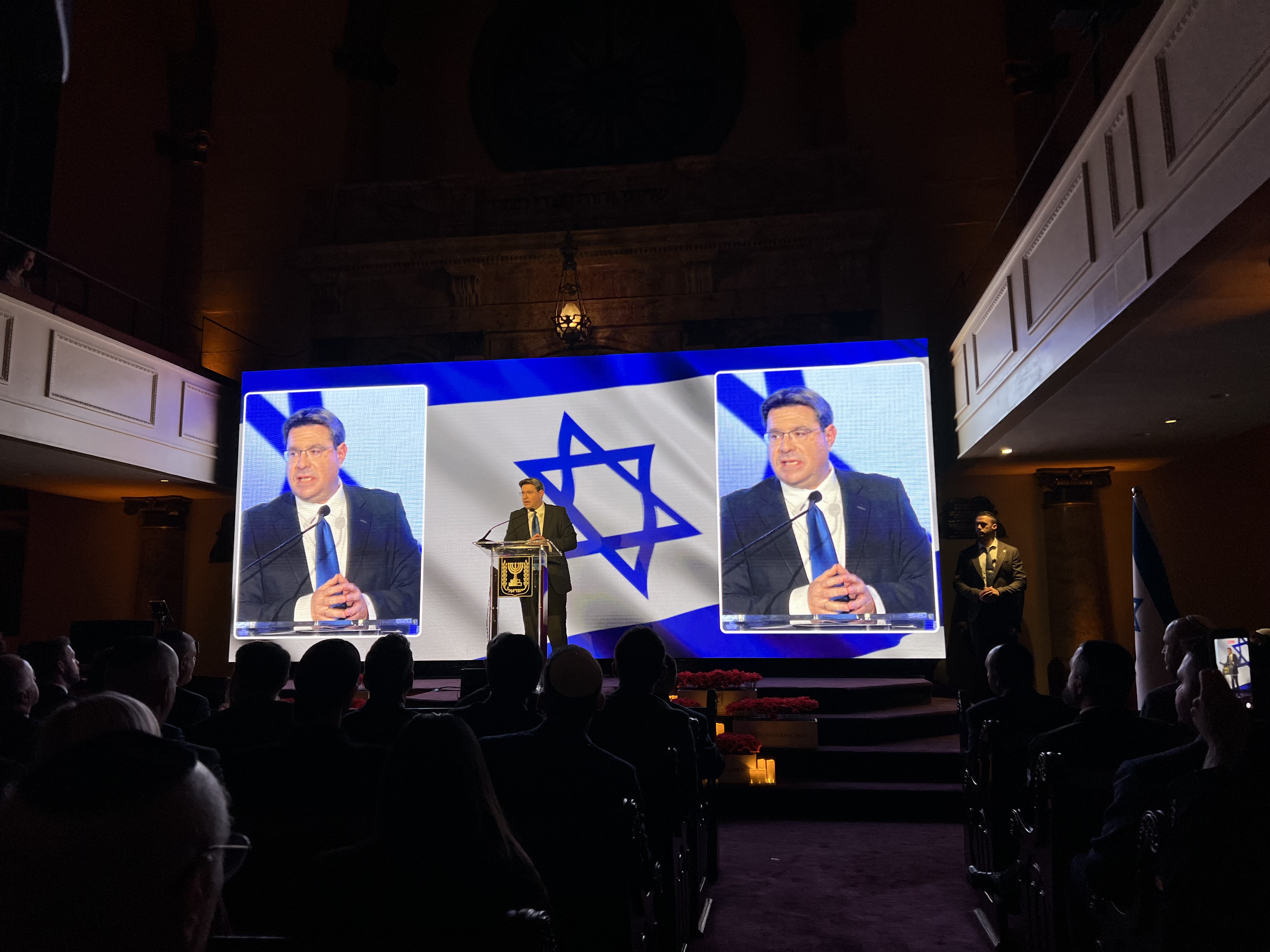
Soft music played at the beginning of the event at the synagogue, which drew consuls general, elected officials, rabbis and Jewish communal leaders and marked three years since Oct. 7.
The music gave way to a moment of silence, for which the audience stood. A video then played on a screen, depicting the brutality of Oct. 7. Throughout the evening, recordings from the attacks were played between speeches, bringing the voices and sounds of the massacre into the sanctuary.
Akunis recalled being awakened by hundreds of rockets on Oct. 7 and seeing the first images emerging from the kibbutzim, the Nova festival and military bases. He visited families of fallen Israeli soldiers, recalling sitting in their homes and listening to parents and grandparents share stories about their children.
“I’m still thinking of them,” he told attendees. “I would salute each and every one of them until the last day of my life.”
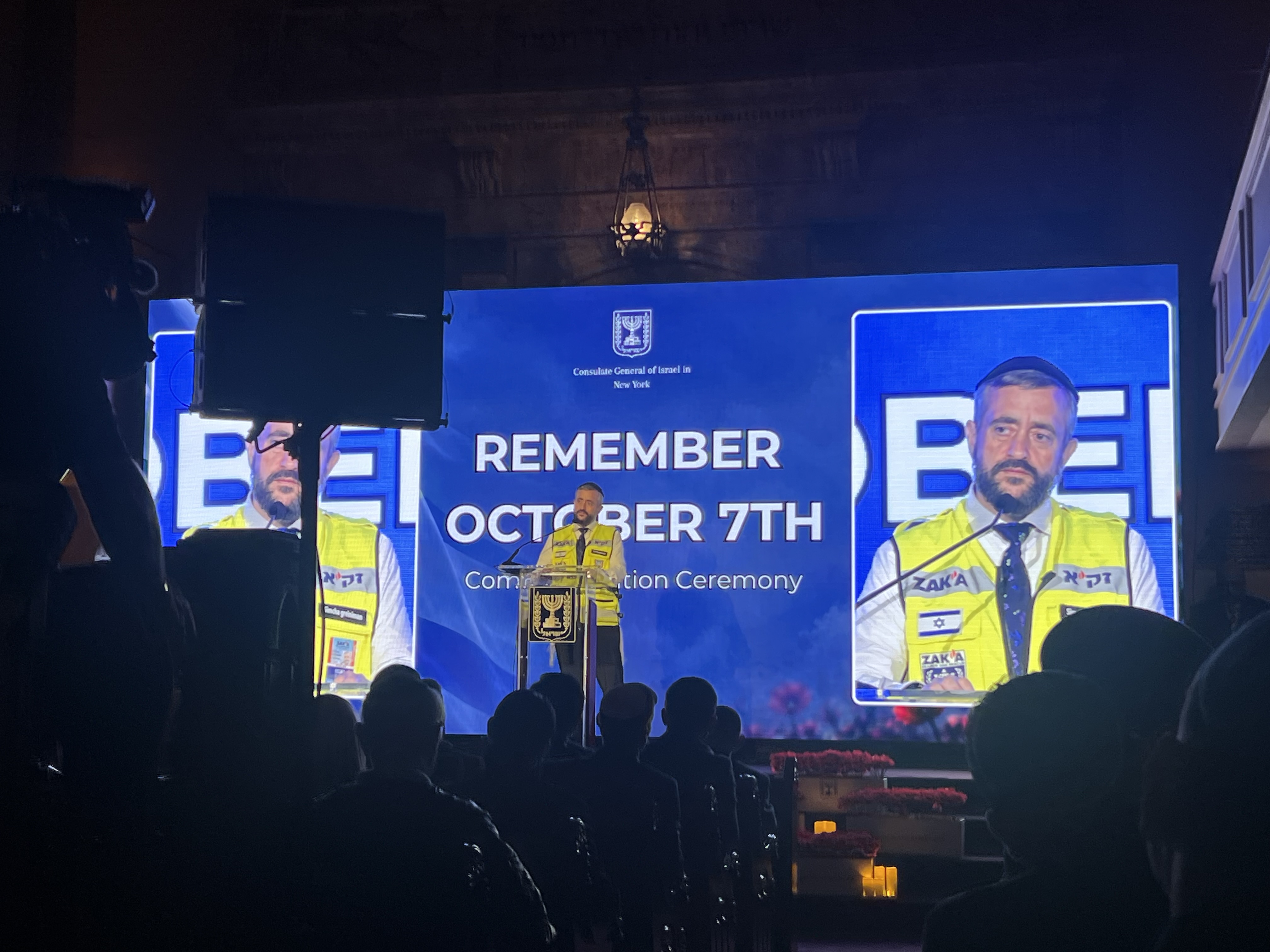
Simcha Greiniman, a volunteer at ZAKA, which painstakingly collects and preserves bodies and fragments of bodies, attended the event at the synagogue. He responded to the Oct. 7 attacks and spent weeks helping recover remains of victims.
“I’m the voice of the victim,” he told JNS. “You can’t be silent. The only thing that we can do for them is to continue speaking.”
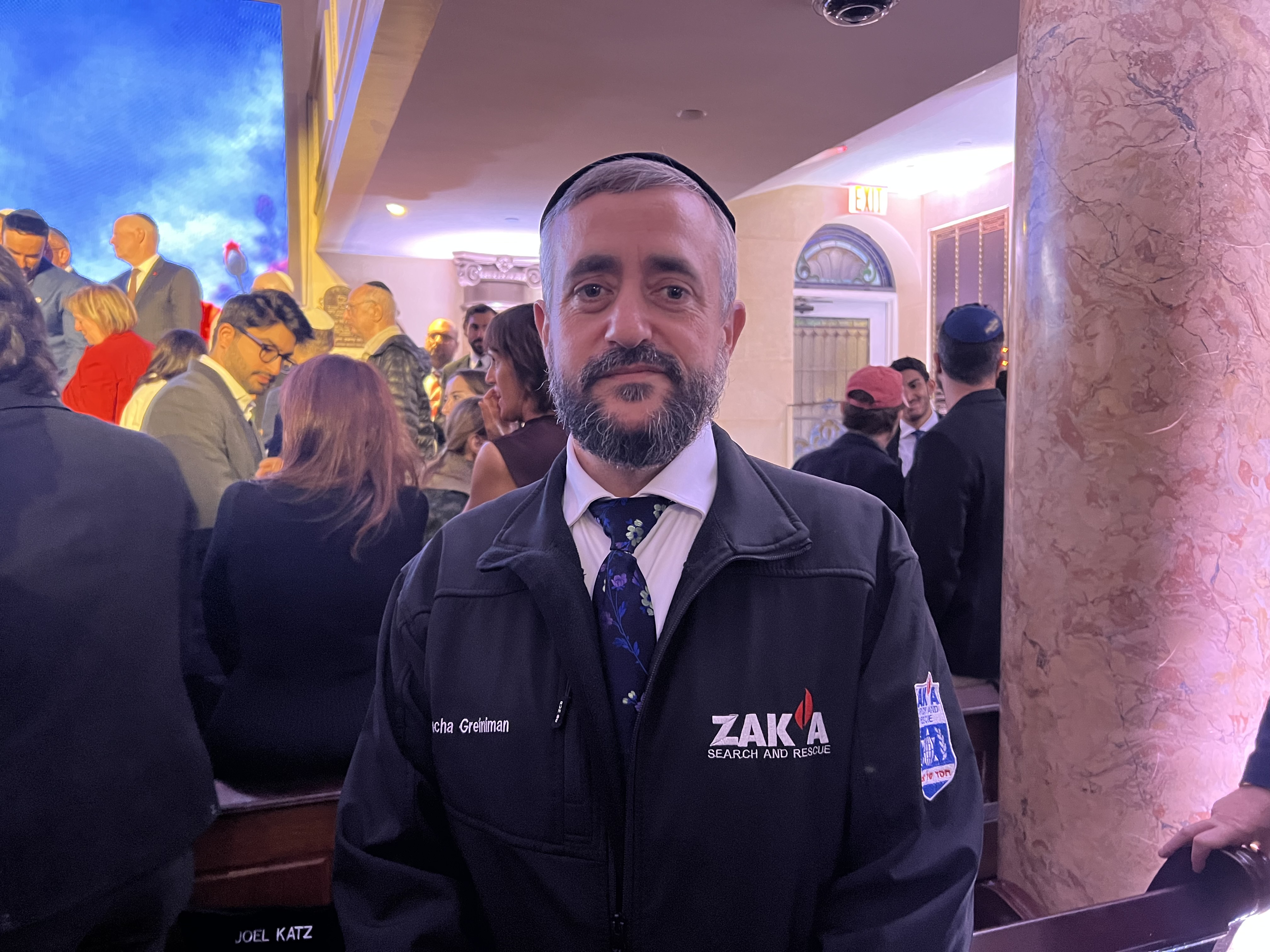
He said that he and others who are preserving the stories and memories of Oct. 7 victims are akin to the numbers tattooed on the arms of Holocaust survivors.
“We are the number,” he told JNS.
Rabbi Chaim Steinmetz, senior rabbi of Kehilath Jeshurun, told attendees that at about 8:15 a.m. on Oct. 7, 2023, a neighbor knocked on his door and told him there had been an attack in Israel. It was a holiday, so the Orthodox rabbi couldn’t use anything electronic to check the news.
At first, he didn’t grasp the scale. “He looked at me, and he said, ‘Rabbi, you don’t understand. This was a big attack,’” Steinmetz said.
Then the rabbi learned that hundreds had already been killed. “My life was turned upside down,” he said.
Steinmetz reminded attendees about how the U.S. Jewish community mobilized in the days and months that followed, raising money, packing supplies, traveling to Washington and advocating for Israel amid rising antisemitism.
“We stand with Israel,” he said. “We are there with you.”
Rabbi Ayelet Cohen, dean of the rabbinical school and religious leadership division at Jewish Theological Seminary, the flagship organization of Conservative Judaism, attended the event.
“We are all gathering to mourn the tragedy of Oct. 7, to remember the horrors, to honor the horrific loss of life that day, all of those who have suffered,” she told JNS.
“Never again” means hoping that such a tragedy will never happen again and working toward a world “where violence is not met with more violence,” she said.
Akunis, the Israeli envoy, said that the third anniversary of Oct. 7 presents a chance “to ask world leaders, presidents, heads of government, elected officials and mayors who continue to criticize us: What would you have done if those same savages had invaded your country or your city and brutally murdered innocent civilians?”
“What would you have done if a member of your own family, your son or your daughter, had been burned alive before your eyes?” he said. “We are done listening to your empty criticism, and I say this loud and clear. ‘We are not impressed by your cowardly actions, your hypocrisy, or your weakness. We are not impressed by an approach designed to appease your new political base.’”
Sagi Gabay, a survivor of the Nova festival attack, told attendees that at first he thought he was looking at a beautiful sky on Oct. 7, only to realize that thousands of rockets were flying overhead.
He and a friend fled by car and took shelter before running through open fields as Hamas terrorists attacked. He and the friend walked for about five hours toward safety, as rockets flew overhead and nearby villages burned.
Three years later, the experience has changed him fundamentally.
“Pain is part of life, but suffering is a choice,” he told attendees. He said that resilience means choosing light and gratitude, despite what he endured.
As the evening drew to a close, the tone in the sanctuary shifted, and a montage played of released hostages reuniting with relatives. Many in the room were moved to tears.
Rabbi Haskel Lookstein, rabbi emeritus of the synagogue, led a prayer for Israel’s safety. All those in the sanctuary then rose to sing “Hatikvah,” the Israeli national anthem.
Why Israel? by Rev. Willem Glashouwer
Order the book