The art of disguise

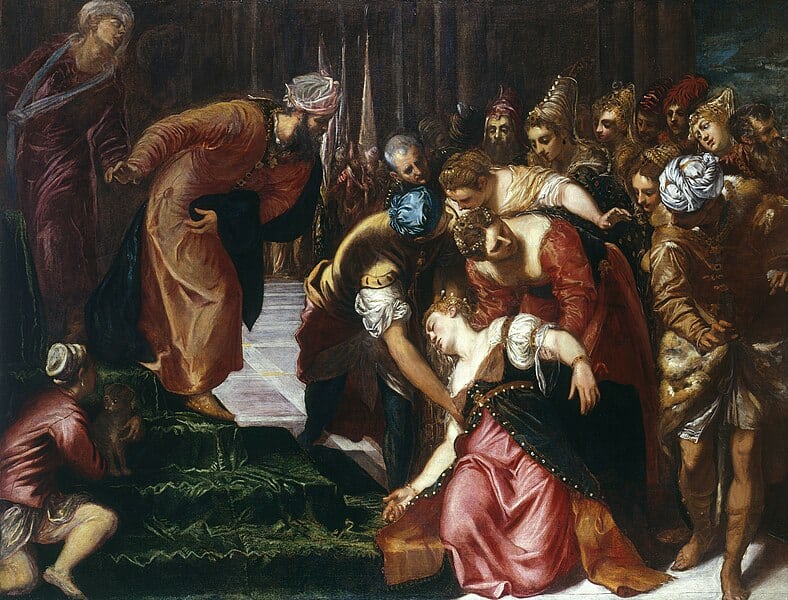
Purim is a celebratory holiday of hiddenness, disguises and fantasy; the one day in the Jewish religion when people are encouraged to try on different identities and pretend to be someone else. It is a commemoration of the bravery of Mordechai and his niece, Queen Esther of Persia, in 479-478 B.C., who revealed her true identity to King Ahasuerus and saved the Jewish people.
Today, in modern-day Persia, modern-day Esthers have been risking their lives to rise up and protest against their totalitarian regime. After the death of 22-year-old Mahsa Amini in Iran in September 2022 at the hands of police for not properly wearing her head covering, women and girls launched a protest. It was put down, like most were in the years since the Islamic Revolution of 1979, but it helped lead to the protests of the past two months against a brutal regime.
Now, after the U.S.-Israeli airstrikes and the elimination of the Supreme Leader, Ayatollah Khamenei, this weekend, the country in some ways harkens the ancient Purim story as the holiday approaches on the night of March 2 and lasts through March 3, with Shushan Purim starting right afterwards for walled cities like Jerusalem from March 3 to March 4.
Rabbi Abraham Cooper, associate dean and director of global social action at the Simon Wiesenthal Center, told JNS that both the current state of Iran and the Book of Esther show that “there is good and evil in the world.” He compared Khamenei, who at 86 years old was killed on Feb. 28, to the villain in the Esther story, Haman, who issued a decree to kill all the Jews.
As the story goes, when King Achashverosh, the ruler of the Persian Empire, hosted a 180-day royal feast, the partygoers had to bow down to Haman, to whom Achashverosh gifted his signet ring—a symbolic gesture that gave Haman the authority to act on the King’s behalf.
In an act of defiance and rebellion against the Jews, Achashverosh drank wine from sacred vessels stolen from the Holy Temple in Jerusalem that was destroyed by the Babylonians. An excess of alcohol blurred the lines between fantasy and reality for guests. Cooper explained that at the king’s parties, “you were supposed to drink and be merry until the point where you couldn’t tell the difference between the good guys and the bad guys.”
Mordechai, Queen Esther’s uncle and spiritual adviser, warned the other Jews not to attend the King’s debauched festivities. He was the sole Jewish leader who would not bow down to Haman, resulting in Haman becoming enraged and ordering him to be hung in the gallows; the very place where, in a twist of fate, Haman and his 10 sons were eventually hanged.
Cooper explained that the Megillah exemplifies how people should not make excuses with regard to not confronting evil. He said Mordechai “gives a lesson in courage, in faith and in leadership.” He knew, according to Cooper, that “God would find a way to make sure the Jewish people will continue to exist.”
The majority of the other Jews viewed Mordechai as a troublemaker. Cooper said, “I don’t think Mordechai is the person who looked to pick a fight, but he’s not the kind of guy who’s taking off his yarmulke,” he said. “When you blend in, that’s the beginning of the end.”
Mordechai warned Queen Esther that she would not be free from persecution if she hid in the king’s palace and continued to keep her Jewish identity a secret. He famously stated,
“For if you persist in keeping silent at a time like this, relief and deliverance will come to the Jews from another place, while you and your father’s house will perish. And who knows whether it was just for such a time as this that you attained your position” (Esther 4:14).
Esther asked Mordechai and the Jews in Shushan to pray and fast for her before she went against the rules and approached her husband without having been summoned by him. Esther’s name means “hidden.” Had she not unveiled herself by telling Ahasuerus that she was Jewish and requesting that Haman and his sons be killed, “That would have been the first full-blown genocide,” Cooper said.
Relating Esther to the people of Iran, he said, “There was acquiescence because of the fear, but you reach a certain point when you get rid of your fear.”
The Book of Esther is one of the only books in the Bible that does not mention God’s name, but many say there is a hidden, protective hand Divinely orchestrating events as they unfold behind the scenes. Cooper stated, “If God revealed Himself in every situation, that’s not freedom of choice.”
He noted that we all hide our true selves sometimes, but “only God knows what’s inside … there’s no mask.”

‘It makes them uninhibited’
Sharon Abeles, a fine-arts photographer as well as an art and play therapist, captured on camera revelations of different personas that emerge when people are masked and disguised for Purim. She spent 12 years photographing people celebrating this holiday for her book, Purim in Costume, published in 2025.
Abeles observed how dressing up played a big part in the Megillah. Ahasuerus wore garments of the high priest at his parties, and when Mordechai was promoted by the king, he was draped in royal robes. It was as though a certain power was infused in the clothes.
Abeles elaborated on how a costume can “touch on wishful thinking and role-playing … and also allow journeying to new places to feel the personality of the one they choose to emulate.” She told JNS that photographing often transforms and projects an air of strength and confidence in others when asked to pose. Abeles described how “she took her scepter, held it up while she was standing on a rock, and she really looked like a queen.”
Abeles noted that masks both hide and reveal aspects of someone’s inner self. She has a “treasure chest of costumes” and has incorporated wearing masks into her therapy practice for over 25 years, especially during Purim. She treats mostly children and adolescents, and explained that for children holding secrets, wearing a costume can provide “a hidden way to emerge. … It allows the person freedom to be.”
A mask can make people feel safe to express how they really feel. “Sometimes, new characters appear,” Abeles said. “No one will know that it’s them, because they’re wearing a mask; it makes them uninhibited.”
The fanciful elements of Purim can make it appear like the world is a stage. Abeles amusingly relayed how people would compliment her on her costume as a photographer or ask if she was a spy when they saw her taking pictures.
‘When to stop hiding’
Paul Goldenberg, a global criminal and security strategist who advises governments and law enforcement worldwide, compared his experiences as an undercover agent to being in costume. He told JNS that when “in deep cover, you didn’t play a role, you became the role. The danger wasn’t forgetting who the criminals thought you were. The danger was forgetting who you used to be.”
Goldenberg relayed how he went undercover in the 1990s as a high roller in Las Vegas to take down organized crime families that had infiltrated the Bingo industry. “I had to take on this whole persona that was absolutely contrary to who I really was,” he said.
He notes that actors get to leave the stage, but he never did, as his job was intertwined with a false identity. Like Esther, he learned that one of the greatest risks is “knowing exactly when to stop hiding.”
Highlighting the importance of being vigilant during these volatile times, Goldenberg said that “on Purim, we wear masks to remember that survival sometimes depends on disguise.”
And yet, he offered a cautionary warning to Jews, particularly in the West, “the day that we no longer wear our symbols of our religious faith proudly, our Stars of David, our mezuzahs, in America, is going to be a day where America is not going to have long to exist.”

‘The art of concealment’
Greg Schneider, a security and intelligence specialist who has gone on undercover missions to obtain information for government and private sectors, said that he used to keep his religious identity under the radar. Since taking classes at his local Chabad House in 2019, he has started observing Shabbat, keeping kosher and wearing his Star of David publicly.
A former lone soldier in the Golani Brigade of the Israel Defense Forces and a Krav Maga instructor, Schneider said he now feels comfortable proudly being open about his Jewish identity—not because of his expertise in self-defense, but because of his faith in God.
He told JNS, “If you have emunah (‘faith’) and bitachon (‘trust’) that God runs the world, a belief that He is the conductor, then you have faith that what’s happening to you, good or bad, is for the best. There is some higher purpose to what has happened, like in the story of Esther.”
In his own profession, Schneider has “used the art of concealment to keep people safe.” He commented that God was concealed in the Story of Purim, and that people dress up “to honor the concealed miracles that God performed.”
Rabbi Dov Greenberg, CEO and executive director at the Roger Chabad House at Stanford University in Stanford, Calif., reported that many Jewish students learned “the discipline of disappearance” about a decade ago, when antisemitism started seeping onto college campuses in the United States.
“They became 21st-century Marranos. They were hiding not from the state, but from their peers,” he said. He believes this was a result of students being taught not to see the world in terms of good and evil, but as one pitted between oppressors and the oppressed.
“And then they force Jews into the wrong column,” he said.
Greenberg compared antisemitism to alcoholism because they both “destroy judgment, corrode society and punish the innocent.” He called antisemitism a form of “moral dyslexia” that “turns victims into villains,” cannot be reasoned with and can only be responded to with moral courage.
He stressed—just days before Jews around the world will celebrate Purim—that the Megillah teaches us to be like Mordechai and never bow down.
He spoke of the Hamas-led terrorist attacks in southern Israel on Oct. 7, 2023, as a turning point. It put identity on the line, at least at many American universities. Some understandably became more fearful. Others looked at the situation and challenged what they saw as a moral inversion—a masking of the issues, so to speak.
And so, the continued, many of the same students who once concealed their faith put their mezuzahs back up and started wearing their Star of David necklaces again. They chose to highlight their Jewish identity. Attendance at the Stanford Chabad has “at least doubled,” since then, he noted.
Referring to this change as “Purim courage,” Greenberg said these students realized that hiding doesn’t buy you safety or acceptance. He cautioned never to jump to conclusions and write any Jew out of Jewish history because you never know when that person will rise up like a lion. “The Jewish soul will always surprise us in beautiful ways, as Esther did,” said the rabbi.
Greenberg told JNS that these students took off their masks and defended their people: “They became mini-Esthers and mini-Mordechais.”
The post The art of disguise appeared first on JNS.org.
Why Israel? by Rev. Willem Glashouwer
Order the book