Will the US make a deal with the enemy – or is Trump bluffing?
This week Israeli and US air forces continued to pummel targets across Iran. The Israel Defense Forces have neutralized well over 70% of Iran’s ballistic missile stockpile and launchers, while maintaining a 92% interception rate against more than 400 missiles fired at the Israeli home front since the war began, according to military figures. This week Israeli and US air forces continued to pummel targets across the country.
Nevertheless, Iranian missiles continue to cause damage and death throughout Israel. This week missiles directly hit civilian areas in Arad and Dimona, leading to more than 100 injuries. The ongoing Iranian attacks include the heavy use of cluster munitions.
According to IDF International Spokesperson Lt. Col. Nadav Shoshani, military data continues to indicate a highly effective air-defense array, with only four direct hits recorded since the start of the war out of hundreds of missiles fired. The hits occurred in Tel Aviv, Beit Shemesh, Arad and Dimona.
The Iranian regime has focused on targeting civilian communities, reflected in the fact that all casualties from ballistic missile attacks in the current war are civilians. “Cluster munitions fired toward large cities, covering wide areas, are designed to hit civilians,” Shoshani said.
Yaakov Lappin at JNS writes:
- “When an Iranian ballistic missile deploys its cluster payload at an estimated altitude of just under 10 kilometers, lower-tier interception systems appear to lose effectiveness against the scattered submunitions. Consequently, the defense architecture relies on upper-tier interceptors such as Arrow 2 and Arrow 3 to destroy the primary warhead prior to the dispersal of the cluster munitions. Interception prior to deployment eliminates the threat.
- When an Iranian cluster munition disperses successfully, the submunitions have a destructive capacity roughly equivalent to standard 122 mm rockets. The Iranian defense industry also appears to place cluster payloads on older Chinese-manufactured rocket models previously encountered during the 2006 Second Lebanon War.
- Meanwhile, the danger to civilians from interception debris means the Home Front Command keeps civilians in secure locations until the risk has passed. Hundreds of tons of shrapnel have fallen on the home front since the start of the war, but the fragments cannot penetrate safe rooms or bomb shelters.
- Iran has been firing several types of ballistic missiles in the current conflict, including the Khorramshahr-4, an older model featuring a heavy warhead, and a limited number of Sejjil two-stage solid-fuel missiles.”
Will Trump Abandon Israel?
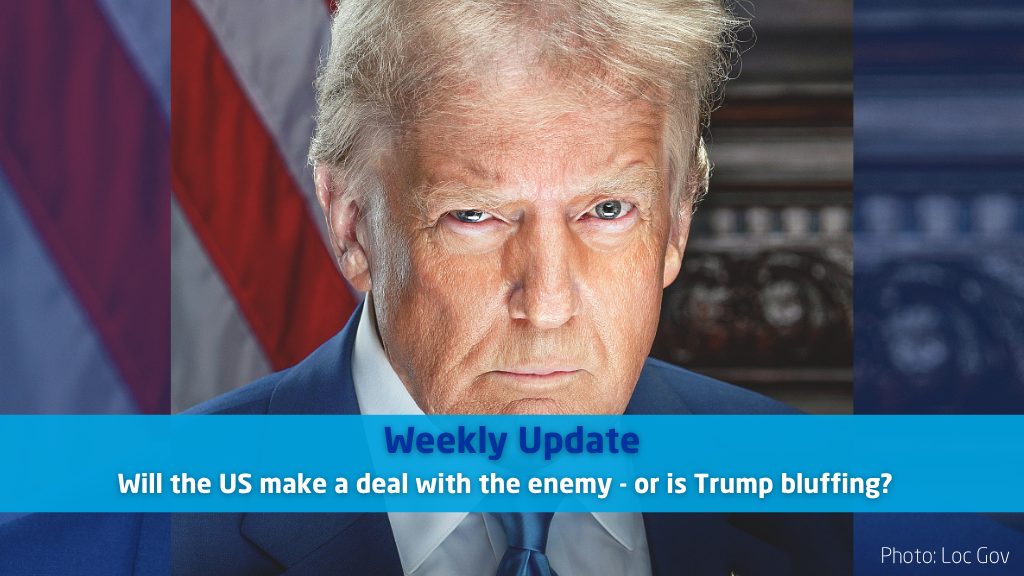
U.S. President Donald Trump faces an enormous decision the coming days. Will the Administration invest huge military resources, including ground personnel, to remove Iranian assets that prevent naval passage through the Strait of Hormuz, or will it broker a deal with the remnants of the regime in Tehran to bring the war to an end, even though the regime has not been fully defeated.
As Melanie Phillips reports:
- “Washington is reportedly chewing over the likely costs to its own forces if it tries to seize Kharg Island to gain control over Iran’s oil production or free the Straits of Hormuz. Trump is likely weighing up the damage to his own political future from a domestically unpopular war that may start drawing American blood.
- The stakes are enormous. If the Iranian regime isn’t totally defanged but survives to recover and rearm, it will not only continue to menace the region. Such an outcome will also advertise that the leader of the free world is a paper tiger.
Trump yesterday extended the deadline he set earlier this week for possible strikes on Iranian energy infrastructure. Earlier this week he indicated that the US is engaged in discussions with the Iranian leadership on a possible diplomatic resolution to the war.
Trump announced Thursday that he would delay action against Iranian energy facilities until April 6, following what U.S. officials described as a renewed diplomatic outreach to Tehran through international mediators.
- “As per Iranian Government request, please let this statement serve to represent that I am pausing the period of Energy Plant destruction by 10 Days to Monday, April 6, 2026, at 8 P.M., Eastern Time,” Trump wrote on Truth Social, adding that “talks are ongoing and … are going very well.”
According to JNS, “the U.S. administration has been working through Pakistan, Egypt and Turkey to encourage Iran to participate in high-level negotiations on an American proposal aimed at ending the conflict.”
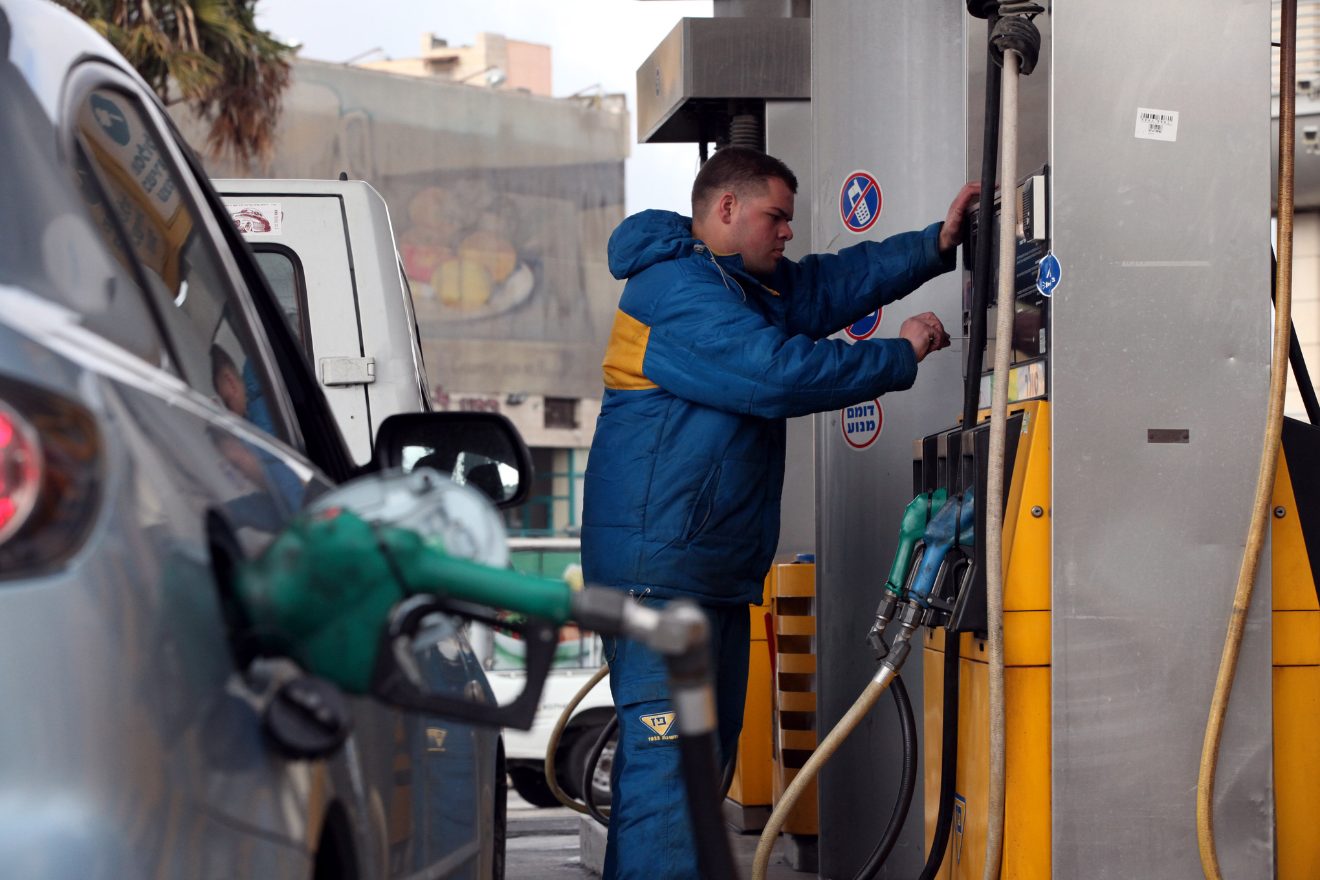
A worker fills benzene, at a gas station in Jerusalem | Photo: Yossi Zamir/FLASH90
Energy market crisis?
The International Energy Agency has warned that the Iran war has set off “the largest supply disruption in the history of the global oil market.” Reports predict a global energy crisis. The Trump administration has been criticized for underestimating the war’s impact on oil supply.
Neither the doomsday scenarios nor the White House critics are correct, said Elai Rettig, assistant professor in the Department of Political Studies at Israel’s Bar-Ilan University, and a senior researcher at the Begin-Sadat Center for Strategic Studies (BESA Center), who specializes in energy policy.
The Trump administration is doing an excellent job keeping oil prices in check, and was fully aware that Iran would try to close the Strait of Hormuz, a key chokepoint through which transits 20% of the world’s oil supply, he said.
- “The headlines allude to this idea that the Trump administration was completely caught off guard; that it didn’t know the Strait of Hormuz was going to be closed. That doesn’t make any sense,” Rettig told JNS. “Every war simulation I’ve ever been in—at the INSS [Institute for National Security Studies], at the BESA Center, in the United States—they all had the Strait of Hormuz as one of the key developments, especially because Iran itself kept saying, ‘We will close the Strait once we are attacked.’”
- War simulations forecast $200-a-barrel oil (the very number an Iranian military spokesman quoted on March 11 when warning of the damage Iran would visit on the world economy in retaliation for the U.S.-Israel attack), he said. No one predicted three weeks into a closure of the Strait that prices would still hover around $100, he added. “If the war continues on schedule, more or less six to eight weeks, then the U.S. has succeeded beyond the dreams of war planners,” he said. “People don’t appreciate just how great this war is going.”
This week, let us pray for the leaders of all countries involved in this conflict. Pray especially for the leaders of Iran, Israel and the United States – that they will act with restraint yet take whatever action is necessary to eliminate evil. Let us pray above all for the speedy coming of the Messiah of Abraham, Isaac and Jacob.

IDF reports ‘significant’ progress against Iranian military targets as campaign enters fourth week
JNS: Army says strikes on missile production, air defenses and naval assets have reduced the Islamic Republic’s capacity to attack.
Doomsday scenarios miss mark: Inside Trump’s strategy to stabilize oil prices
JNS: “If the war continues on schedule, more or less six to eight weeks, then the U.S. has succeeded beyond the dreams of war planners,” he said. “People don’t appreciate just how great this war is going.”
Finish the Job, Mr. President!
Melanie Phillips: “The West also fails to grasp something Israel has been forced to accept for decades. The Iranian regime may be outgunned by America’s superior military might, but it can outfox it through its use of “asymmetric warfare,” which refuses to recognize the conventions of war laid down by the international community.”
Palestinian Authority security forces are ‘building offensive force for surprise attack’
New Regavim report warns that P.A. has 65,000-strong ‘shadow army’ threatening Israel.
SCRIPTURE FOR THE WEEK:
Psalm 21 Why do the nations conspire and the peoples plot in vain?
2 The kings of the earth take their stand and the rulers gather together against the LORD and against his Anointed One.
3 "Let us break their chains," they say, "and throw off their fetters." Psalms
4 The One enthroned in heaven laughs; the LORD scoffs at them.
5 Then he rebukes them in his anger and terrifies them in his wrath, saying,
6 "I have installed my King on Zion, my holy hill."
7 I will proclaim the decree of the LORD : He said to me, "You are my Son ; today I have become your Father.
8 Ask of me, and I will make the nations your inheritance, the ends of the earth your possession.
9 You will rule them with an iron scepter ; you will dash them to pieces like pottery."
10 Therefore, you kings, be wise; be warned, you rulers of the earth.
11 Serve the LORD with fear and rejoice with trembling.
12 Kiss the Son, lest he be angry and you be destroyed in your way, for his wrath can flare up in a moment. Blessed are all who take refuge in him.