Are Israel and the US Permitted to Attack Targets in Iran?
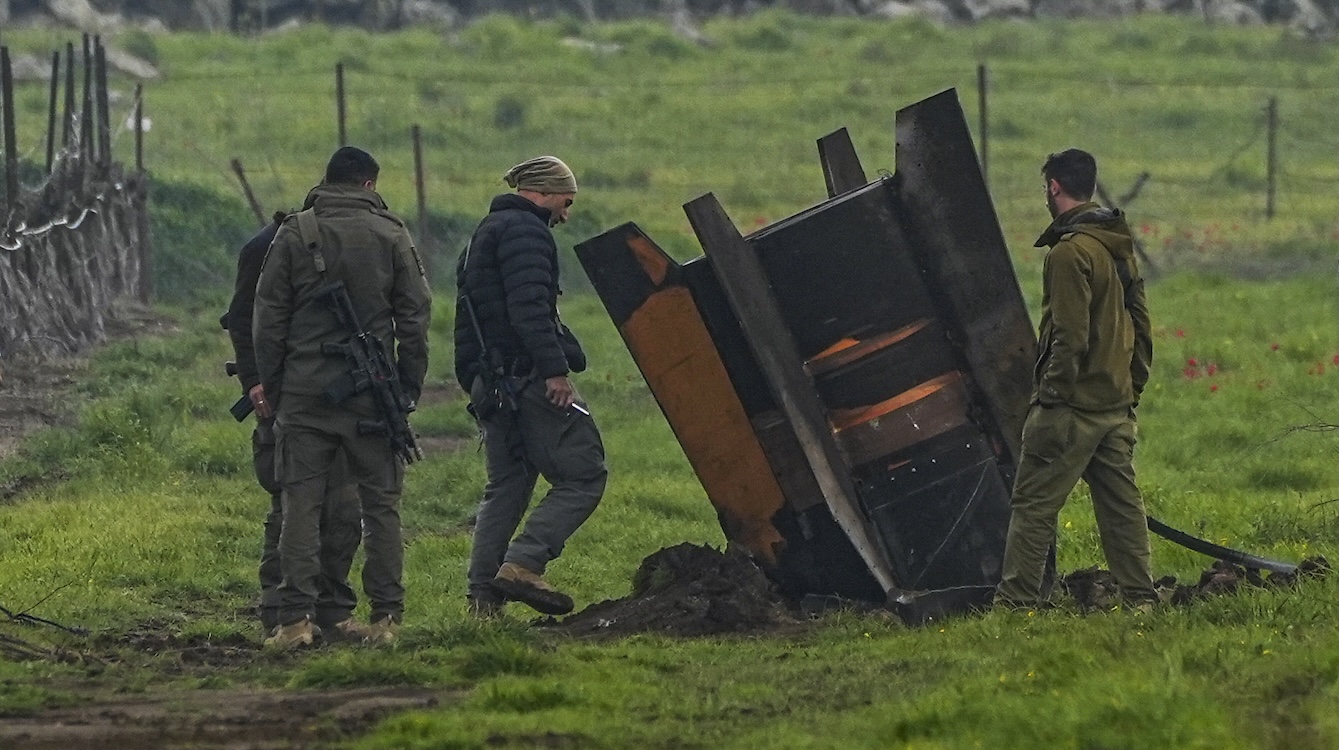 Israeli security forces near a fragment of a missile fired from Iran toward Israel, intercepted by Israeli air defense systems, seen lodged in the ground in the Golan Heights, March 19, 2026. Photo by Ayal Margolin/Flash90
On the morning of Saturday 28 February 2026, the US (Operation Epic Fury) and Israel (Operation Lion’s Roar) launched coordinated air strikes on Iranian military targets. These operations are primarily aimed at destroying Iran’s missile, air force, naval and commando infrastructure. The attacks followed the failure of recent negotiations between the US and Iran regarding the Iranian nuclear programme.
Whilst some countries support these operations, there is also much criticism. Many international legal scholars believe that the actions of the US and Israel contravene Article 2.4 of the UN Charter, which prohibits the use or threat of force against the territorial integrity or political independence of another state.
“Some countries support these operations, there is also much criticism”
Their reasoning is that there was no threat of an ‘imminent armed attack’ by Iran—a prerequisite for invoking the right to individual or collective self- defence as recognised in Article 51 of the UN Charter. In their view, the other exceptions to the prohibition on the use of force—consent from the state concerned or authorisation by the Security Council—have also not been satisfied: they were either absent (consent) or were considered meaningless due to the deadlock in the Security Council (authorisation).
Professor Dr Geert-Jan Knoops rejects this conclusion. According to Knoops, it is simply impossible at this stage to determine whether or not Israel and the US faced a threat of an ‘imminent armed attack’ by Iran when Israel and the US launched their operations. We simply do not know what evidence the US and Israel had at that time. It is quite possible that, despite the attack by the US and Israel in June 2025, they had evidence a few weeks ago that Iran is now indeed capable of carrying out an attack in the foreseeable future using nuclear weapons, and that Iran was threatening to carry out such an attack.
Other experts, such as Professor Geoffrey Corn of Texas Tech University —one of the world’s leading experts on the law of war—argue that it is irrelevant whether there was an imminent attack by Iran. They believe that the actions of the US and Israel are legally justified because they form part of an existing and long-standing armed conflict between the US/Israel and Iran.
According to Corn, this armed conflict with Iran did not begin two weeks ago, or even a year ago. It began many years ago. Iran’s long history of aggression— beginning with the occupation of the US embassy in Tehran in 1979, followed by the bombing of the naval barracks in 1983, the continued use of proxies (Hezbollah, Houthis, Hamas) and the pursuit of nuclear weapons, and the support for Hamas’s attack on Israel in October 2023—all bear witness to an ongoing aggressive agenda. This, he argues, confirms the ongoing nature of the armed conflict.
“Iran’s long history of aggression all bear witness to an ongoing aggressive agenda”
In an ongoing armed conflict, Corn argues, there is no requirement for a new threat assessment prior to each attack. Each state has the right to neutralise the other’s capacity to continue posing a threat—provided they adhere to the laws of war. One of the principles of the laws of war is that each party may only target legitimate military objectives. Military infrastructure, command and control capabilities, missile launch and regrouping sites, and the leadership of the IRGC are all legitimate targets in this context. Targets such as oil production and refinery facilities are legally more complex; here, a clear demonstration of their significant contribution to the enemy’s war effort and a clear military advantage in their destruction is required.
According to Corn, most legal scholars are too ‘formalistic’ in their approach. They fail to sufficiently recognise the complex reality of modern state security interests and the changing nature of threats posed by non-state actors and hybrid warfare. Professor Corn and his colleagues advocate a more pragmatic interpretation of international law that recognises the reality of ongoing, intense armed conflicts.
At the same time, Corn emphasises that state actors must articulate their legal rationale consistently and clearly. Professor Corn criticises the inconsistent rhetoric of the US government. President Trump’s inconsistent statements, including references to the ‘imminent threat’ posed by the Iranian regime, weaken the legal basis of Operation Epic Fury. In contrast, he praises Israel’s ‘unapologetic’ and coherent strategic communication, which emphasises the existence of a ‘protracted armed conflict’ with clear operational objectives.
The Hague Initiative for International Cooperation (thinc.) is a Netherlands-based think-tank specialising in international law and policy. https://thinc-israel.org/

Why Israel? by Rev. Willem Glashouwer
Order the book