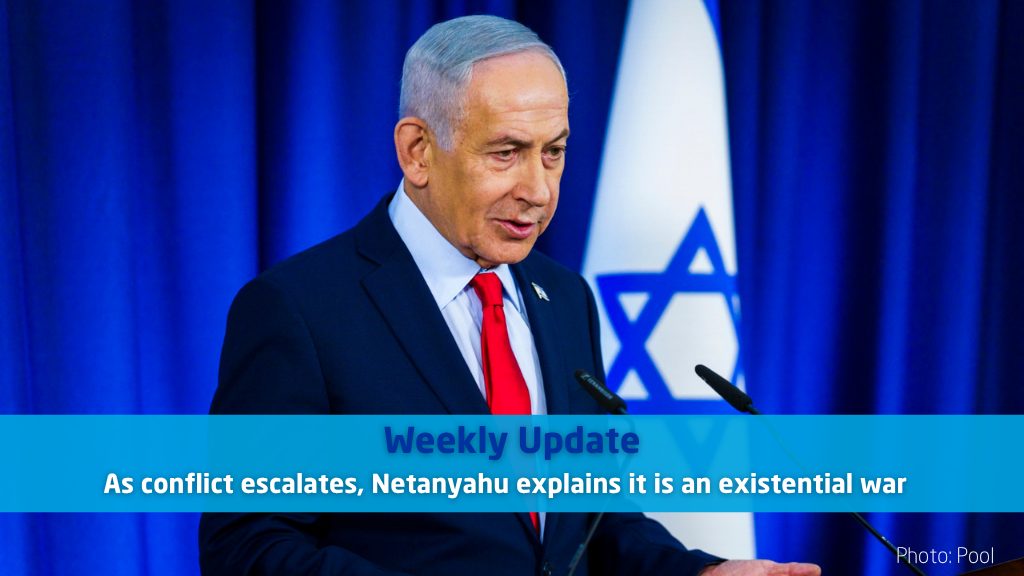
As conflict escalates, Netanyahu explains it is an existential war
This round of the war against the revolutionary and apocalyptic Islamist regime in Tehran is now in its 21st day. This past week there have been some very significant developments
Israel assassinated Ali Larijani, perhaps the most important leader left in the Islamic Republic. It also took out leaders of the brutal Basij force. Mohammad Bagher Qalibaf, Iran’s parliament speaker and a veteran of the Islamic Revolutionary Guard Corps, has now emerged as the highest-profile political figure in the Islamic Republic after the killing of its leaders. A pillar of the Iranian establishment for some three decades and one of the Islamic Republic’s most prominent non-clerical figures, Qalibaf, 64, now appears to be playing a key role in spearheading the war effort.
The Israeli military says it struck Syrian military positions in southern Syria in response to an alleged attack on Druze civilians in the Sweida area yesterday. The strikes hit a headquarters and weapons at several Syrian army camps, the IDF says.
Iran executed three people on Thursday convicted of killing police officers and carrying out operations in favor of the United States and Israel during unrest earlier this year, the judiciary said.
Iran’s Islamic Revolutionary Guard Corps (IRGC) announced a new wave of missile and drone attacks on US bases and central and southern Israel, including Tel Aviv, Haifa, and Jerusalem.
Iranian missiles continue to reach Israel. At least 21 people, all noncombatants, have been killed by Iranian ballistic missile attacks targeting civilians in the Jewish state since the start of the war.
Prime Minister Netanyahu’s press conference
The Israeli Prime Minister gave his first English language press conference during this current conflict yesterday. He explained the war’s necessity and its goals:
- “Under President Trump’s visionary leadership, America and Israel are acting together in Iran with great determination and unprecedented strength. Operation [Roaring] Lion is designed to remove the existential threats posed by the Ayatollah regime, the regime that has waged war against America and Israel and the people of Iran for 47 years. It chants, “Death to America, death to Israel.” And it delivers death to its own people.
Our goals are three. One, removing the nuclear threat. Second, removing the ballistic missile threat, and removing both of these threats before they’re buried deep underground and become immune from aerial attack. And third, this means creating the conditions for the Iranian people to grasp their freedom, to control their destiny.`’
Regarding the current status of the operations, he said:
- “We are winning, and Iran is being decimated. Iran’s missile and drone arsenal is being massively degraded and will be destroyed. Hundreds of their launchers have been destroyed. Their stockpiles of missiles are being hit hard, and so are the industries that produce them. That’s important. In Rising Lion, we destroyed missiles and we destroyed a lot of the nuclear infrastructure. But what we’re destroying now are the factories that produce the components to make these missiles and to make the nuclear weapons that they’re trying to produce. We’re wiping out their industrial base in a way that we didn’t do before. Iran’s air defenses have been rendered useless. Their navy is lying at the bottom of the sea. Today, we hit the other part of their navy, in the Caspian Sea. Their air force is nearly destroyed. Iran’s command and control structure is in utter chaos. And I can tell you that there’s still more work to do, and we’re going to do it.”
Addressing the criticism that it was not necessary to act now, Netanyahu referred to Winston Churchill who famously warned that democracies often lack foresight and fail to act against threats until "self-preservation strikes its jarring gong".
- “Well, you’re hearing the jarring gong of danger. The jarring gong of danger is: Iran gets nuclear weapons and ballistic missiles. That’s not a jarring gong. That is an apocalypse. Don’t let it happen.”
What do you think would have happened if America did not act now? Just imagine what would have happened. In a few months’ time, no more than a year, Khamenei, still alive, would have ordered the beginnings of the new nuclear program, and the reconstructed ballistic missile program, to move underground. Now, it’ll take them a little time, maybe a few years, but you can’t reach those programs. And they develop intercontinental ballistic missiles, okay? That means missiles that can hit Chicago and New York and Florida and Texas and California. Oh, but they don’t have it yet, that’s what people say. Right, let’s wait. Just let them do it, you know, just wait, wait and let them do it.”
Netanyahu said that freedom is precious. It comes with a price. We must be prepared to pay that price.
- We are, we have to be strong. We have to be armed. We have to be more powerful than the barbarians, or they will not be merely at the gate. They’ll crash our gates and destroy our societies. That’s what Israel is doing now with the United States. And I’m very proud of the fact that the Israeli people are standing strong, that the Israeli army is standing strong.
We rose from October 7th. Our people, our soldiers, rose like lions. But in protecting ourselves and in joining with our great American friends, we’re also protecting the entire world.”
Netanyahu compared the current situation with the rise of Nazis in Germany in the 1930s. Have we learned nothing in the last 80 years? No, he said “I refuse to believe we are clueless. I speak with dozens of leaders and they all agree (though they may not say it) – we understand why us and israel are doing this”. He continued –
- “Because at the end, what is the task of leaders if you’re a leader? The most important thing, the most important thing, is to assure the security of your people. And that means identifying danger in time. And acting against it. That is a prerequisite for the survival of any biological organism. You have to identify danger in time and act in time against it. You either fight or flight. These are the two options you have. Where can you flee? Nowhere, because Iran can reach any part of the world. So you have to, at a certain point, fight. And this is the juncture where we’ve reached — in time. Not too late, but in time.”
Asked whether assassination of leaders in Iran will lead to regime change, he responded:
- “So I think the question is, Will the conditions be created for such a change? I think it’s too early to say, and I think in the final account, as I said, it’s up to the Iranian people to show that — to choose the moment, and to rise to the moment. We can create the conditions, but they have to, you know, they have to exploit those conditions at a certain point.
It is often said that you can’t win, you can’t do revolutions from the air. That is true. You can’t do it only from the air. You can do a lot of things from the air, and we’re doing, but there has to be a ground component as well. There are many possibilities for this ground component, and I take the liberty of not sharing with you all those possibilities.”
Asked whether there are there any signs that the Iranian regime is cracking, he responded:
- “A lot of signs. I wish I could divulge all of them, but I see that. But will I tell you, will I commit right now that it’s going to collapse? I can tell you that we’re working to create the conditions for it to collapse, but it may survive, it may not. If it survives, it’ll be a lot weaker. There’s no comparison. It’ll be at its weakest point, shorn of industries that it built over decades, death industries, shorn of many other capabilities that they have, and equipped with the experience, with the knowledge, that if they try it again, they’ll be hit again even harder.”
He continued:
- “You know, it’s sort of like a hollowed-out, rotten piece of wood that’s holding on the outside, but there’s a lot of rot inside. We’re seeing some defections. We’re seeing fear and trepidation in the IRGC units that are manning the ballistic missiles. You know why? Because they’re afraid to die. They’re not all suicidal. In fact, most of them are not. So we’re seeing cracks, but we’re going to hit them again and again.
The minimum thing we want to do is, again, erase the industrial capacity that they had to produce these weapons. They’ll have to build it from a start, and that’s very hard. It’s very hard to do underground. So they’re not going to be able to just take the pieces and move them below the earth. It’s going to be a lot harder for them. But ideally, if it cracks enough, and with some other things that I won’t get into, yes, the regime could change. Is it guaranteed? No. And is it up to the Iranian people in the final accounting to make use of the conditions that we’re doing, weakening this regime? We’ll see. I cannot tell you.”
Netanyahu responded to the criticism that Israel dragged USA into this war.
- “Does anyone really think that someone can tell President Trump what to do? Come on. President Trump always makes his decisions on what he thinks is good for America, and may I add, I think what is also good for future generations… This canard that we dragged the United States into it, is not just a canard, it’s ridiculous. It’s just ridiculous. I mean, I think President Trump said it best, and I said it as well many times: There’s always a danger in acting, but in conditions of existential threats, there’s a much greater danger in not acting.”
Conflict escalates as regional energy infrastructure is hit
A very important development is the expansion of the conflict to include attacks on energy infrastructure – by the US and Israel in Iran, and by Iran in the Gulf States.
Times of Israel reports that for the first time, the Israeli Air Force struck Iranian gas infrastructure in the country’s south on Wednesday, in a coordinated effort with the United States that experts warned would send ripples through the global economy and further expand the regional conflagration. The strikes, launched on the 18th day of the US-Israeli offensive against the Iranian regime, targeted Iran’s massive offshore South Pars natural gas field, located in the Bushehr Province. Iranian state media reported additional strikes targeting oil facilities in Asaluyeh.
It marked the first time that Israel attacked natural gas facilities in Iran during the ongoing campaign, after the US struck the Islamic Republic’s oil export hub on Kharg Island over the weekend, although it said it hit only military sites on the island. A US defense official confirmed to the Axios news site that the South Pars strike was coordinated with and approved by Washington. Speaking at the Pentagon, US Defense Secretary Pete Hegseth called the strike on South Pars “a warning” and urged Iran to stop its retaliatory strikes on energy sites across the Gulf, which have sent oil prices soaring.
Gulf nations slammed the move as “dangerous and irresponsible.”
Iran warned that it would retaliate by targeting energy installations across Saudi Arabia, the United Arab Emirates and Qatar, whose own North Field gas field is connected to South Pars.
Iran hit Qatar’s key Ras Laffan LNG facility, cutting about 17 percent of output for as long as five years, the CEO of QatarEnergy has said. With Qatar supplying 20 percent of global LNG, disruptions are expected, with force majeure likely on some contracts to Belgium, Italy, South Korea, and China. Diplomatically, Qatar’s prime minister and Turkiye’s foreign minister held a joint news conference condemning the act of sabotage as a “dangerous escalation” by Iran. On Thursday, Qatar’s defense forces again reported ballistic missile attacks.
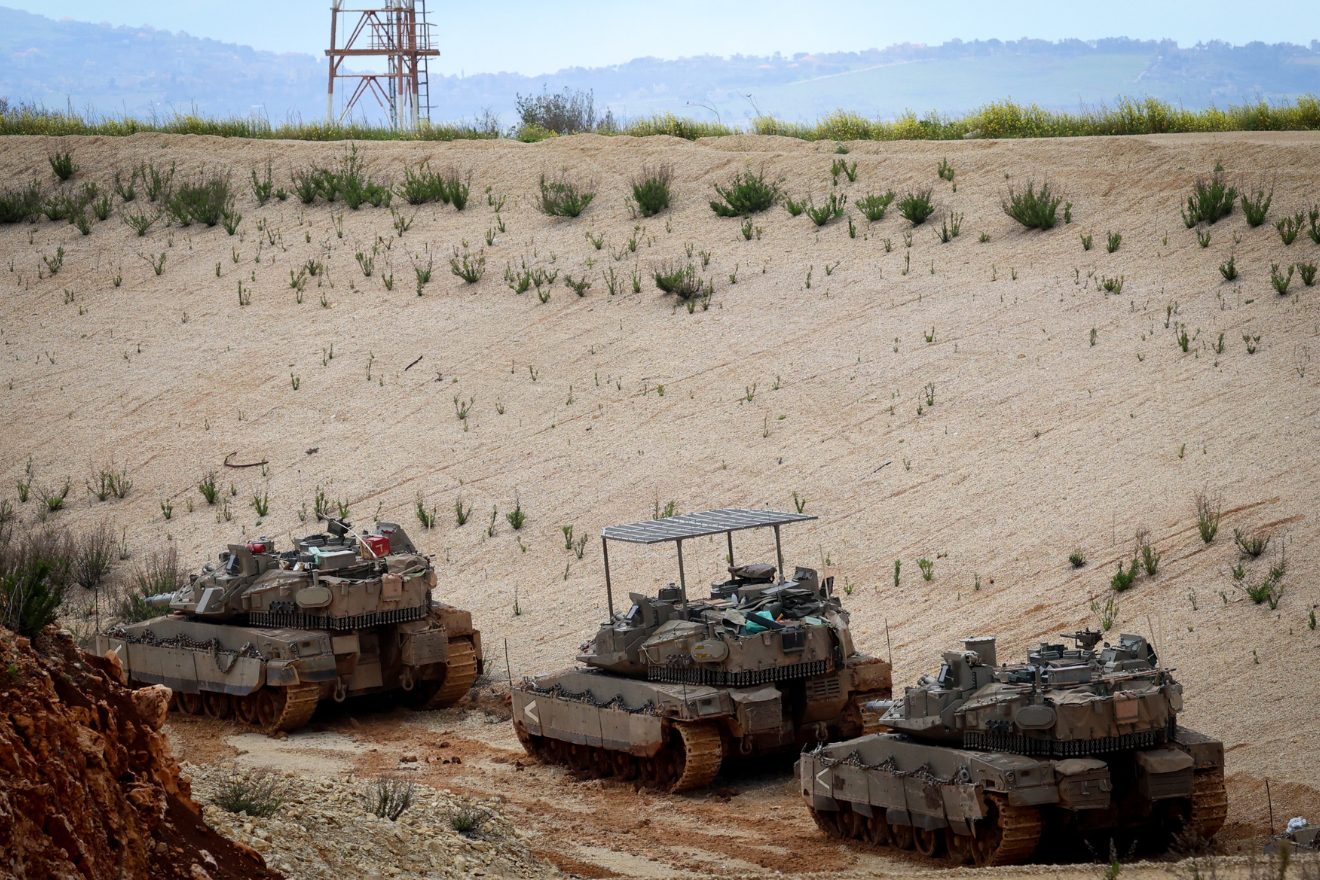
Israeli army on the Northern Israeli border with Lebanon | Photo: David Cohen/FLASH90
Israel goes deeper in Lebanon
Israel is penetrating deeper into Lebanon, as it seeks to remove the threat posed by Iran’s proxy Hezbollah. Netanyahu explained in his press conference:
- “Obviously, Hezbollah is not what Hezbollah had been. They had thousands of Radwan terrorists right next to our fence, underground, ready to invade. We knocked them back. We destroyed the bulk of their missile capacity in six hours. We knocked out Nasrallah. We destroyed all the Hamas, or rather all the Radwan, infrastructure right next to our border. We now have a security corridor, a security zone, that is there that prevents this kind of invasion. And we have plans for the future. Obviously, our number one effort is geared towards Iran. If the regime goes, you know that Hezbollah goes. But in any case, we’re devising our plans in such a way that we could remove this threat as well.
The Strait Of Harmuz
As Iran threatens to close the Strait of Harmuz, energy prices have spiked worldwide. About one fifth of all global oil and gas supplies flow through the Strait. President Trump called on other countries to join the fight to keep the Strait open. So far his calls have landed on deaf ears in the West.
The European Council issued a weak statement Thursday calling for the stabilization of energy shipments and “de-escalation and maximum restraint” from warring parties. But no Western state has agreed to commit troops or materiel to assist the US and Israeli efforts.
France, Germany, Italy, and the Netherlands, alongside the United Kingdom and Japan, issued a joint statement welcoming “the commitment of nations who are engaging in preparatory planning” for securing the key oil route, and demanding Iran “cease immediately” its drone and missile attacks and other attempts at blocking it.
Developments in The Hague
Germany announced this week that it will not formally intervene in the genocide case that South Africa brought against Israel before the International Court of Justice. Germany said in early 2024 that it would file a third-party intervention in South Africa’s case against Israel in the wake of the Hamas-led Oct. 7 terror attacks. At the time, Berlin rejected South Africa’s claims as “baseless” and a “political instrumentalization” of the Genocide Convention, while supporting Israel’s right to self-defense.
Multiple German government officials said this week that the country will not intervene in the South Africa case, as Berlin defends itself in a separate case that Nicaragua brought before the International Court of Justice. Nicaragua alleges that Germany is violating international law, including the Genocide Convention, by supporting Israel politically, financially and militarily in its war against Hamas. Germany argues that the court cannot logically make a determination on its actions until it decides the case against Israel. An intervention on behalf of Israel could serve to undermine Germany’s reasoning.
This week, let us continue to pray for the people of Iran, that they will be freed – physically and spiritually – from the tyranny of the current regime. Pray for the leaders of Israel and the United States and all nations affected by this crisis – that they will act with restraint yet take whatever action is necessary to eliminate evil. Pray above all for the speedy coming of our Lord and Savior: the Messiah of Abraham, Isaac and Jacob.

The Iranian Regime, Its Proxies and the War in the Middle East
The people in Israel are again in bomb shelters, sirenes are heard in the streets of Jerusalem, Tel Aviv, Haifa. Another war with Iran is currently taking place.
To help us understand more about the conflict we have Raouf Leeraar in the studio to help us understand the situation in the Middle East.
Caroline Glick: Why we went back to war in Iran
In a special wartime episode, PM Netanyahu’s international adviser explains why the US and Israel decided to launch another campaign against Tehran, and what they aim to achieve
Winning the tactical war, risking the global economy
Maj. Andrew Fox on Substack: Tactical brilliance against Iran means nothing if the Strait of Hormuz stays closed and the global system starts to fracture.
The US-Israeli strategy against Iran is working. Here is why
Every aspect of Iran’s ability to project regional power is being successfully degraded.
Wimps and Warriors
Melanie Philips: at JNS: The war with Iran is clarifying who is for civilization against barbarism—and who is not
Larijani’s elimination signals potential turning point in Iran
Fiamma Nirenstein at JNS: Israel’s successful strike on key regime figure may mark the start of a new era.
SCRIPTURE FOR THE WEEK:
Isaiah 61Arise, shine, for your light has come, and the glory of the LORD rises upon you. 2 See, darkness covers the earth and thick darkness is over the peoples, but the LORD rises upon you and his glory appears over you. 3 Nations will come to your light, and kings to the brightness of your dawn. 4 “Lift up your eyes and look about you: All assemble and come to you; your sons come from afar, and your daughters are carried on the hip. 5 Then you will look and be radiant, your heart will throb and swell with joy; the wealth on the seas will be brought to you, to you the riches of the nations will come. 6 Herds of camels will cover your land, young camels of Midian and Ephah. And all from Sheba will come, bearing gold and incense and proclaiming the praise of the LORD. 7 All Kedar’s flocks will be gathered to you, the rams of Nebaioth will serve you; they will be accepted as offerings on my altar, and I will adorn my glorious temple. 8 “Who are these that fly along like clouds, like doves to their nests? 9 Surely the islands look to me; in the lead are the ships of Tarshish, bringing your children from afar, with their silver and gold, to the honor of the Lord your God, the Holy One of Israel, for he has endowed you with splendor. 10 “Foreigners will rebuild your walls, and their kings will serve you. Though in anger I struck you, in favor I will show you compassion. 11 Your gates will always stand open, they will never be shut, day or night, so that people may bring you the wealth of the nations— their kings led in triumphal procession. 12 For the nation or kingdom that will not serve you will perish; it will be utterly ruined. 13 “The glory of Lebanon will come to you, the juniper, the fir and the cypress together, to adorn my sanctuary; and I will glorify the place for my feet. 14 The children of your oppressors will come bowing before you; all who despise you will bow down at your feet and will call you the City of the LORD, Zion of the Holy One of Israel. 15 “Although you have been forsaken and hated, with no one traveling through, I will make you the everlasting pride and the joy of all generations. 16 You will drink the milk of nations and be nursed at royal breasts. Then you will know that I, the LORD, am your Savior, your Redeemer, the Mighty One of Jacob. 17 Instead of bronze I will bring you gold, and silver in place of iron. Instead of wood I will bring you bronze, and iron in place of stones. I will make peace your governor and well-being your ruler. 18 No longer will violence be heard in your land, nor ruin or destruction within your borders, but you will call your walls Salvation and your gates Praise. 19 The sun will no more be your light by day, nor will the brightness of the moon shine on you, for the Lord will be your everlasting light, and your God will be your glory. 20 Your sun will never set again, and your moon will wane no more; the LORD will be your everlasting light, and your days of sorrow will end. 21 Then all your people will be righteous and they will possess the land forever. They are the shoot I have planted, the work of my hands, for the display of my splendor. 22 The least of you will become a thousand, the smallest a mighty nation. I am the LORD; in its time I will do this swiftly.”