Focusing on the Positive
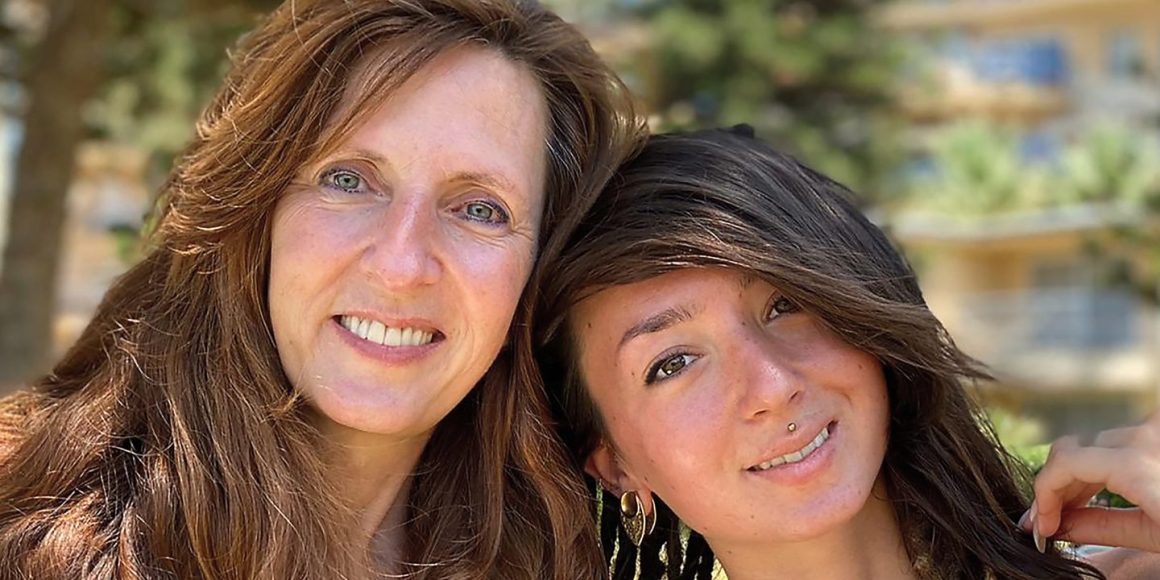 Ricarda Louk with her daughter Shani. Photo: private
Ricarda Louk lost her daughter on 7 October 2023. The family had to watch as Shani was driven through the Gaza Strip, half-naked and motionless, surrounded by cheering terrorists. Two years later, Ricarda speaks about how her family is coping with the loss.
How does a family cope with the fact that their daughter, their sister, was brutally murdered by Hamas terrorists? “Compared to other families, we are doing relatively well today. We are looking ahead, keeping ourselves busy, moving on.” Ricarda Louk radiates inner peace and at the same time deep pain as she tells her story.
“On that ‘Black Shabbat’, their daughter Shani was taken from them. Their “little girl who was so full of life and love””
She and her husband have been travelling constantly for two years. It is important to them that what happened on 7 October 2023, in Israel and in their lives, is not forgotten. On that ‘Black Shabbat’, their daughter Shani was taken from them. Their “little girl who was so full of life and love”. Talking about this tragic loss is like therapy.
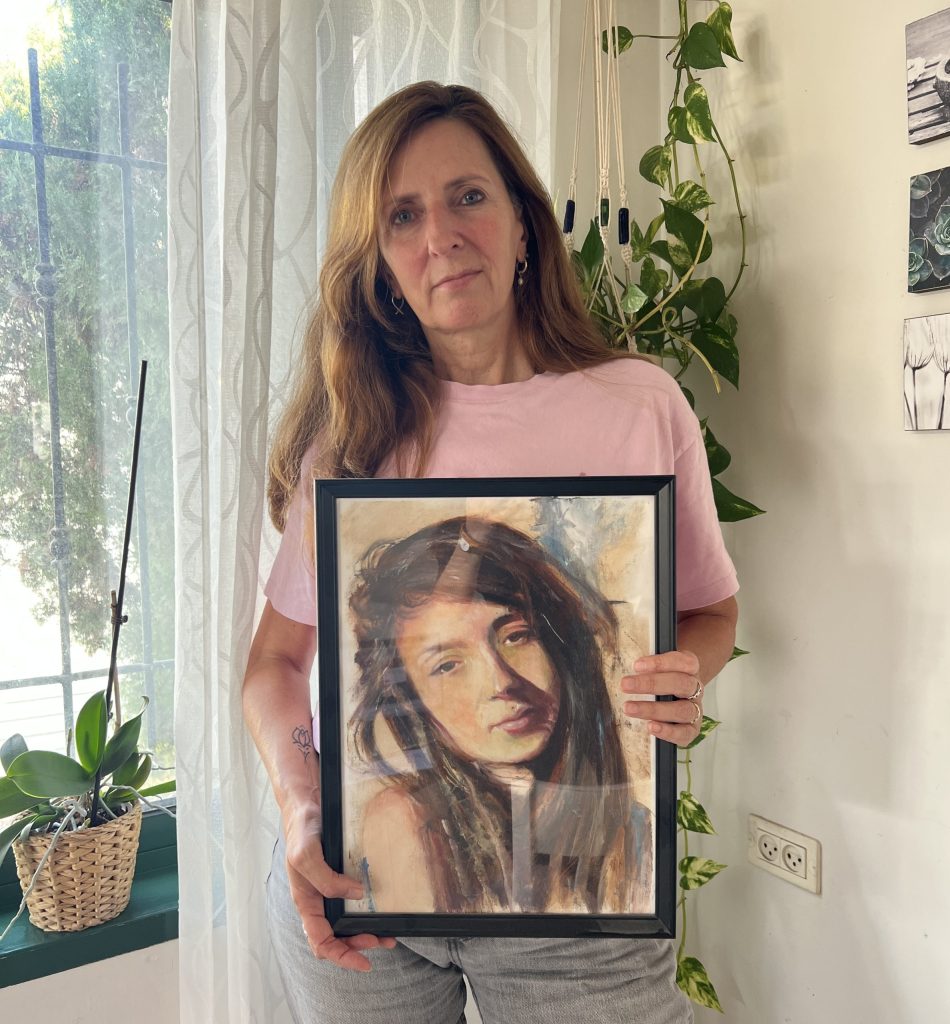
Ricarda Louk fought day and night for the release of her daughter Shani, who had been abducted by Hamas in the Gaza Strip. | Photo: Private
Not Everyone Manages to Return to Normal Life
In the months following the Hamas attack, the Louk family was in close contact with other relatives of hostages. Ricarda remembers the strong solidarity among the families. “We supported each other and built real friendships,” she says. Many organisations and government institutions also offered assistance. But not every family has managed to rebuild their lives.
My husband and I always said to ourselves, Shani isn’t coming back, we have to move on. We still have other children who need us now. So we tried to be strong, and that helped our family. Of course, the pain remains, but we can laugh together again. That’s what Shani would have wanted.”
Hope for Something Good
Above all the pain and the many questions, the Louk family has one great hope: that the many people who died on 7 October did not die in vain. “My husband always mentions the end of the Second World War. If someone had told the Jews who were led into the gas chambers, or the survivors at that time, that they would have their own state in four years, no one would have believed it. We have hope that things will get better; it can’t get much worse.”
Ricarda cannot say exactly where she finds the strength to carry on and not despair. “Somehow it’s in our family; we grew up with a positive attitude to life. But in difficult situations, you always find more strength than you could have imagined before.”
Ricarda, originally from Germany comes from a Catholic family. When she met her Israeli husband, she converted to Judaism. She would not describe her family as religious, but they do try to keep the Sabbath rules.
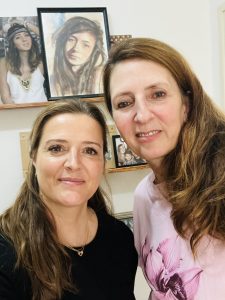
Dana Nowak (left) visits Ricarda Louk. Artwork behind them was
donated in memory of Shani. | Photo: C4I Germany
The ‘Black Sabbath’: “I thought It Was Fake News”
Ricarda recounts how she experienced 7 October 2023. “At 6.36am, the missile alarm went off and didn’t stop. We called Shani, who was at the Nova Festival in the south. Her boyfriend from Mexico had come to Israel with her. He was also murdered by Hamas.”
Shani answered the phone and told the family that she was on her way home. In the meantime, Ricarda’s family had heard on the news that terrorists from Gaza had invaded Israel. “At first, I thought it was fake news.
We called Shani again, but she didn’t answer. Around 10.30am, my son Amit received a video and was asked if Shani was in the clip.”
The video shows heavily armed terrorists in the back of a pickup truck. At their feet lies a half-naked woman face down. Her limbs are twisted unnaturally. One terrorist is pulling her hair. Others are placing their booted feet on her fragile body. The vehicle is surrounded by Palestinian civilians. They spit on the woman’s head, cheer and repeatedly shout “Allahu Akbar” (Allah is greatest).
“My son started screaming and crying, ‘That’s Shani! That’s Shani!’ We recognised her by her tattoos. I was sure it was my little girl! We didn’t know if she was dead or alive. We watched that terrible video over and over again to see if we could find any sign of life in her.”
In Israel, all the authorities were overwhelmed, and no one was available. So the Louks turned to the embassy in Germany. They hoped that they would get help more quickly there, as Shani had both and Israeli citizenship. “We thought that a German would have a better chance of getting out of Gaza than an Israeli.” The family also sent the video to the press. It quickly spread around the world. It was one of the first testimonies of the brutal massacre to become known beyond Israel’s borders.
The Knock We Feared, After Weeks of Waiting
The family lived in uncertainty for three weeks. “It was a terrible time. You’re on the go all day and in the evening, you sit there exhausted, trying to calm down, and then the brooding starts: What are they doing to her right now? At the same time, we could always hear the bombings in the Gaza Strip and were afraid that the hostages would be hit.”
Then one day there was a knock at the door. It was by military representatives and social workers. “When we saw them, we knew what it meant. They told us that a piece of skull bone had been found and identified as Shani’s. You can’t live without that bone. It was found on Israeli soil. So it can be assumed that Shani died instantly and the terrorists took her body to Gaza. She probably didn’t suffer. On the one hand, that was a great relief for us. But until then, we still hoped that she was alive. Now we knew she would never come back.”
It took seven months before the Louks were able to give their daughter a dignified funeral. In May 2024, Shani’s body was found in a tunnel in the Gaza Strip. It had been buried there, alongside the remains of five other hostages. “I always said we didn’t want soldiers to risk their lives to bring Shani’s body home. But it felt good when we were finally able to bury her. We were able to find closure.”
Doubts About Lasting Peace
Ricarda cannot imagine that the situation with the Palestinians in the Gaza will change. “Twenty years of Hamas rule and the associated hatred of Israel have left their mark on the people. Even small children grow up with such hatred towards Jews. In Israel, we live together with many Arabs. Many doctors, bus drivers and pharmacists are Arabs. They just want to live their lives.
Still, the events of 7 October changed something fundamental. “It was a huge breach of trust,” she says. “Now we don’t know whom we can trust anymore.”
“We want to look ahead, focus on the good things in life; anything else is pointless”
Concern About Radicalisation
Ricarda observes with concern that so many young people in particular are taking a one-sided stance in favour of the Palestinian side on social media and at universities worldwide. “They are so radical in their views. Young people see beautiful pictures of Shani on the internet. A girl who is happy and dancing, and then terrorists who kidnap this girl and torture her. It’s such a harsh contrast between good and evil. You would think that people would side with good, but there are so many supporters and followers of these very terrorists among young people. People need to find their way back to humanity.”
Shani had many international friends, including many Arabs. “She was so cosmopolitan. She always said that there are no bad people, only people who are suffering. Our wish is that people will find their way back to goodness.”
Ricarda and her family do not want to become bitter. “We don’t want to allow hatred to take hold, it only destroys you. The army has informed us that the four men in the pickup truck have all been found and are dead. But ultimately, that doesn’t help us either. We want to look ahead, focus on the good things in life; anything else is pointless.”

Why Israel? by Rev. Willem Glashouwer
Order the book