Israel Sits Out Round Two, Bitter Divisions in Israel
This week Israel watched Washington reopen the war on Iran without joining it. At home, the coalition used the same week to push through the most consequential change to Haredi conscription law in a generation — over the open objection of its own chief of staff.
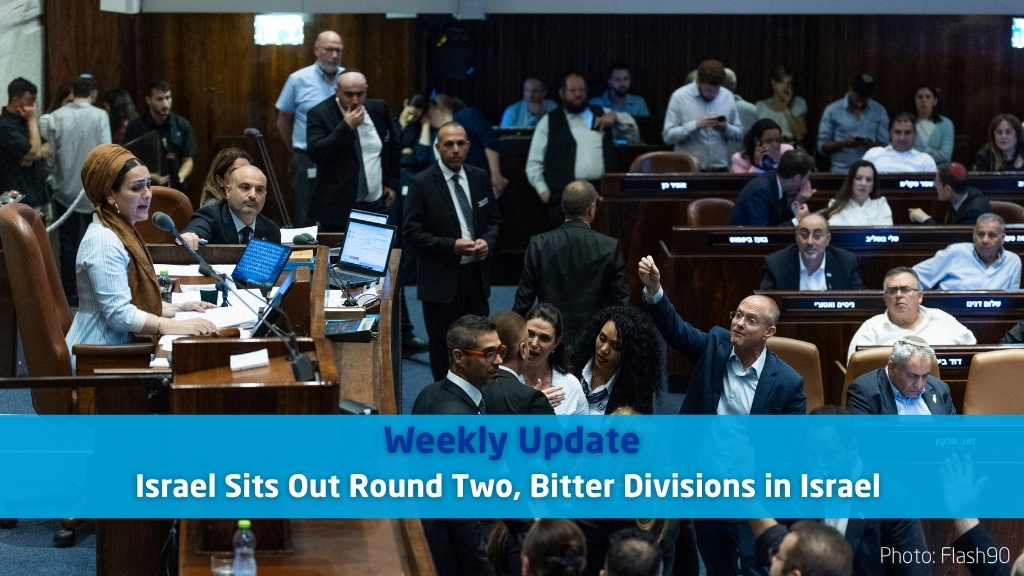
The Knesset enshrines Torah study — and freezes the draft-evader roundups
On Monday the Knesset passed, 63-52, a new Basic Law declaring Torah study a “foundational value” of the Jewish people and the State of Israel — the first time any value beyond human dignity and liberty has been given this quasi-constitutional status. A companion bill passed 58-54 temporarily bars the arrest or prosecution of Haredi men evading conscription, converting years of de facto mass non-enlistment into something close to statutory protection.
IDF Chief of Staff Eyal Zamir did not stay quiet. In a letter to Netanyahu and Defense Minister Katz, he called the legislation “clearly and unequivocally inconsistent with the IDF’s needs,” objecting in particular to a mechanism that would have army officers certify yeshiva students’ exemption status — a provision he said “undermines the legitimacy of and trust among those who serve.” It is a striking thing for a sitting chief of staff to say about his own government’s flagship legislation in the middle of a multi-front war. The High Court, for its part, signaled on July 13 that it is reluctant to intervene in the Knesset’s legislative process, framing the question as one of separation of powers rather than substance — leaving reservists’ groups and the opposition with little recourse beyond protest. A new poll shows the political cost already landing: Benny Gantz’s former colleague Gadi Eisenkot and his Yashar party now lead Netanyahu as preferred prime minister, the first time that has happened.
Deputy Foreign Minister Sharren Haskel resigned because of the law. “I feel that I can no longer support a government that harms the security of the country during wartime,” she told the press in the Knesset immediately after the passage of the law. Haskel was among the small group of lawmakers in the Coalition to vote against the bill.
The coalition frames this as a religious-liberty protection. Others see it as a wartime carve-out that shields the fastest-growing demographic in the country from a military that just fought a war that killed Khamenei and is currently bracing for whatever comes out of round two.
Israel opts out of round two with Iran
After President Trump declared the U.S.-Iran ceasefire “over” this week following Iranian strikes on commercial shipping in the Strait of Hormuz, the U.S. carried out its heaviest strikes on Iran since the June war — reports put the target count as high as 140 sites. Israel notably did not join. No IAF sorties have been reported, and Iran has not fired on Israel either, even as it struck at Gulf states allied with Washington.
The restraint looks deliberate rather than incidental. Israel already achieved its primary war aim in June — the killing of Khamenei and much of the IRGC’s senior command — at a cost of 39 soldiers and 23 civilians dead and roughly 7,700 injured. There is little appetite in Jerusalem to reopen that front to absorb the fallout of a fight between Washington and Tehran that Israel does not control and did not start this round.
The U.S.-Iran ceasefire collapses over the Strait of Hormuz
Iranian attacks on three commercial vessels near the Strait of Hormuz gave Trump the pretext to declare the ceasefire finished; the U.S. answered with strikes on roughly 90 targets inside Iran on Wednesday, followed by further strikes through the weekend — the third weekend in a row the two sides have exchanged fire. Iran retaliated against U.S. allies across the Gulf, triggering air-raid alerts in Qatar, Bahrain, Kuwait and Jordan. Brent crude climbed above $83 a barrel on the disruption to a waterway that carries roughly a fifth of the world’s oil.
Even so, both sides insist the door to talks is still open. Iranian officials have reportedly told Trump’s advisers privately that the shipping attacks were the work of an “errant” faction of hardliners trying to sabotage negotiations, not sanctioned policy — and Trump himself says the U.S. and Iran have agreed to keep talking despite the strikes. A ceasefire that both governments keep fighting through while calling the talks “still on” is not much of a ceasefire; it is a shooting war with a diplomatic track running in parallel.
Hamas dissolves its government, not its guns
On July 6, Hamas disbanded the “Emergency Committee” that has functioned as its civil government in Gaza, formally transferring administrative authority to the National Committee for the Administration of Gaza — a body of Palestinian technocrats assembled by the Trump administration. Conspicuously absent from the announcement: any mention of disarmament, the condition Israel and the Board of Peace have set for further withdrawal, reconstruction materials, and expanded aid.
The Board of Peace, through its high representative Nickolay Mladenov, has held the line on “one authority, one law, one weapon” — disarmament first, everything else after. Hamas has dismissed those terms as “the occupation’s conditions,” questioning whether a board chaired by Trump and staffed with Israel’s preferred demands can credibly call itself neutral. Reconstruction remains stalled regardless of who is right: Gaza now has a government in name that controls little, and an armed movement in fact that has surrendered nothing.
Anglican Church buys into historical and Biblical revisionism
The Church of England’s Synod (its lay legislative body) voted Monday 13 July to encourage churches across England to engage with a document produced by Palestinian Christians that accuses Israel of genocide despite requests from Jewish organizations and Britain’s chief rabbi to reject it.
The document is titled “Moment of Truth: Faith in a Time of Genocide” and is also known as Kairos II, after the Palestinian Christian movement Kairos Palestine that produced it. It describes Israel’s military campaign in Gaza as a genocide, states that Israel is a “colonial enterprise built on racism,” and says decades of “occupation,” “apartheid” and “settler colonialism” are at the heart of the Israeli-Palestinian conflict.
The vote does not adopt the accusations as church doctrine but says the church should hear the documents as “heartfelt expressions of the lived experience of Palestinian Christians,” and to engage with them in order to better understand the conflict.
Chief Rabbi of the United Kingdom Sir Ephraim Mirvis responded on X as follows:
“It is shameful that the Church of England General Synod has recommended engagement with Kairos II.
This is a document full of falsehood, which openly rejects dialogue, uses extreme rhetoric to challenge the very existence of Israel and objects to existing peace agreements in the region.
Though it poses as a route to understanding, Kairos II in fact functions as an egregious barrier to it, reducing one of the world’s most complex conflicts to a single, warped narrative, which can only harm the cause of peace.
This is a sad day for Jewish-Christian relations.”
EU approves funding of development in Gaza
The European Union launched a nearly $1 billion initiative on Monday to support Gaza’s early recovery after the Israel-Hamas war, combining new and previously pledged funding from more than a dozen countries and international financial institutions.
Dubravka Šuica, European commissioner for the Mediterranean, announced the “Team Gaza Initiative” at a meeting of the Palestine Donor Group in Brussels. It will finance debris removal, water and sanitation projects, healthcare restoration and other essential services.
Funding is backed by Belgium, Denmark, Finland, France, Germany, Italy, Japan, the Netherlands, Norway, Spain, Sweden, Switzerland, the European Commission, the World Bank and the European Investment Bank. Australia and Canada are expected to join.
“We now need the conditions on the ground that will allow the support to reach the people in Gaza,” Šuica said.
Prayer
Pray for Israel and her leaders, that wisdom and unity would prevail where division now reigns. Pray for the enemies of the Jewish people, that hearts of stone would be turned to flesh. Pray for the peace of Jerusalem, and for all who dwell within her borders — soldiers, reservists, hostage families, the displaced in the north and south alike.
And above all, pray for the speedy coming of the Messiah of Abraham, Isaac and Jacob, who alone can bring the peace no treaty, board, or ceasefire has yet managed to deliver.
‘The Weekly Update will return in mid-August after our summer break’

Trump: MoU with Iran was a ‘test’ Tehran failed
To the Iranian regime, “deals are made to be broken,” said the U.S. president.
Knesset passes contentious haredi-backed bill to enshrine Torah study in Israel’s Basic Law
The haredi-backed Basic Law passed its final Knesset votes after weeks of coalition tensions and warnings that it could encourage draft evasion.
Full text: IDF chief’s letter to Netanyahu, Katz against bill legitimizing Haredi non-enlistment
Zamir asks PM, defense minister, and chair of Knesset Foreign Affairs and Defense Committee to remove section from legislation that would require army to review who can skip service
EU launches nearly $1 billion Gaza recovery fund, ties aid to Hamas disarmament and PA reforms
“We now need the conditions on the ground that will allow the support to reach the people in Gaza,” European Commissioner Dubravka Šuica said.
Anglican Church buys into historical and Biblical revisionism
Church of England backs study of Palestinian Christian document accusing Israel of genocide The text “risks undermining decades of careful relationship-building” between Christians and Jews says Chief Rabbi
SCRIPTURE FOR THE WEEK: Zechariah 2:8-9
For this is what the LORD Almighty says: "After he has honored me and has sent me against the nations that have plundered you-for whoever touches you touches the apple of his eye- 9 I will surely raise my hand against them so that their slaves will plunder them. Then you will know that the LORD Almighty has sent me.
Why Israel? by Rev. Willem Glashouwer
Order the book