Do not put your trust in princes

It has been a week of political earthquakes. One week after Israelis went to the polls and failed to produce a clear winner, Americans have voted decisively to hand both houses of Congress to the Democrats. On the eve of that vote, President Trump announced that U.S. military aid to Israel will end this year. Meanwhile, the war against Iran and its proxies is far from over, and Israel’s prime minister is pressing Washington to resume strikes on Tehran.
Israel’s leaders have long relied on the friendship of American presidents and the support of the U.S. Congress. That friendship has been real, and it has been a blessing. But the events of this week remind us that the help of princes is fragile. In this Weekly Update we look at each of these developments, how they are connected, and how we can pray.
Do not put your trust in princes, in mortal men, who cannot save. Blessed is he whose help is the God of Jacob, whose hope is in the Lord his God,
(Psalm 146:3, 5)
1. The U.S. midterms – a vote about the war
Yesterday’s midterm elections delivered a sweeping victory for the Democrats. At the time of writing they hold at least 54 of the 100 Senate seats, having flipped seven Republican-held seats, including Texas, Ohio, North Carolina and Maine, and they have won a comfortable majority in the House, where Democrat Hakeem Jeffries is set to become Speaker.
Did the Middle East influence the elections? Very much so. Foreign policy usually plays only a minor role in American midterms. Not this time. According to NBC’s exit poll, 74% of voters said the war with Iran was a “crucial” or “major” factor in their vote, and 63% said the decision to use military force against Iran was the wrong one. Democrats won around 63% of the voters for whom the war mattered most. The eight-month war, the disruption in the Strait of Hormuz and the resulting rise in fuel prices fed directly into voters’ anger about the cost of living.
Israel itself was on the ballot in Michigan, where Abdul El-Sayed, who has campaigned against continued military aid to Israel, defeated Republican Mike Rogers in the Senate race, despite more than $40 million spent against him by AIPAC-linked groups in the primary and general elections.
How will a Democratic Congress affect U.S.-Israel relations?
Both Chuck Schumer and Hakeem Jeffries both have long records of support for Israel, though Schumer has openly criticized Netanyahu. In April Schumer was one of only seven Senate Democrats to vote against blocking certain arms sales to Israel, and in July Jeffries voted against a measure to end military aid that was backed by almost half his caucus. Some analysts argue that a larger majority actually dilutes the influence of Israel’s fiercest critics. But the direction of travel is clear. Congressional committees will now be in the hands of a party whose base is increasingly hostile to Israel. Expect hearings on the Iran war, conditions attached to arms sales and much closer scrutiny of Israeli operations. And a politically weakened President Trump will find it harder to give Israel the near-unconditional backing it has enjoyed over the past two years.
2. Trump: “By the end of this year we won’t be paying Israel”
On election morning, President Trump told Fox & Friends that the roughly $4 billion the U.S. gives Israel each year “gets cut off at the end of the year.” “They don’t need it,” he said. “If they did need it, I would say keep it going.” According to Trump, it was Netanyahu who raised the matter: “He brought it up,” telling him “I think it would be appropriate if we do not receive aid.” Israel, Trump added, “can buy whatever they want.” He dismissed the issue as “the best talking point that these lunatics have on the left.”
The announcement goes far beyond what had been agreed. The current Memorandum of Understanding (MOU), signed in 2016, provides $38 billion in military assistance for the years 2019–2028, about $3.8 billion a year. Netanyahu said in January that he wanted to taper U.S. aid down to zero over the coming decade, and in June he wrote to Congress that it was time for Israel to move “from aid recipient to partner.” Formal negotiations on a new MOU, led on the U.S. side by Ambassador Mike Huckabee, have focused on replacing grants with joint research, co-production and trade. But nobody was talking about ending aid in two months.
Israeli financial and security officials were reportedly caught off guard, and the Israeli government has not confirmed Trump’s timeline. It is also unclear how the White House could simply stop funding that is committed under the MOU and appropriated by Congress. Opposition politician Yair Golan warned that ending aid now, with Israel’s air defenses depleted after a long war, would seriously damage its security.
In principle, a self-reliant Israel, buying its weapons as an equal partner rather than as a dependent, is a healthy goal, and one Netanyahu himself has championed. But timing matters. Israel is still at war on several fronts and is rebuilding its stocks of interceptors. And the political context has shifted overnight: aid to Israel, once a bipartisan given, is now being questioned by a Republican president and by a growing wing of the party that controls Congress.
3. Israel’s coalition puzzle
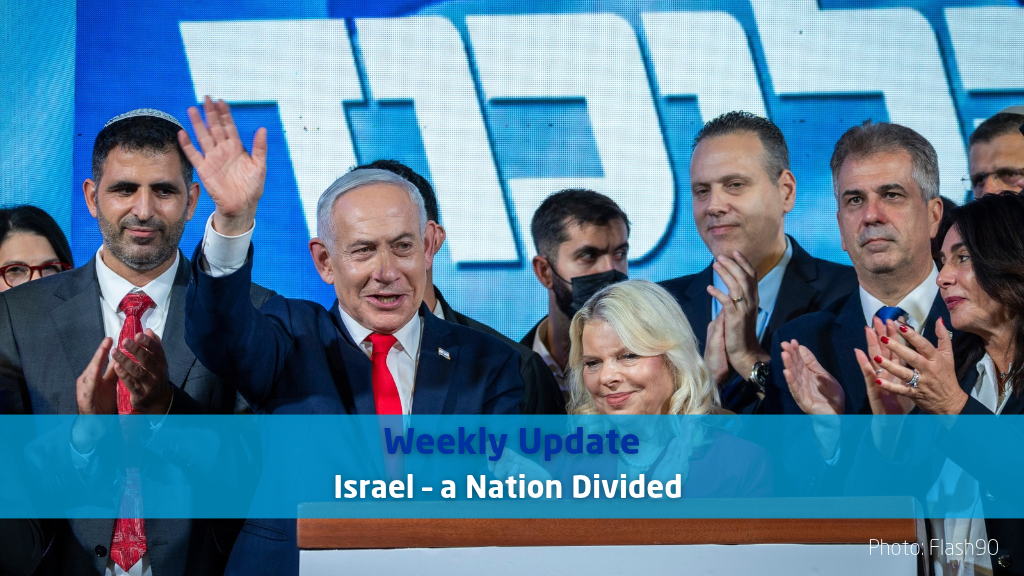
Last week’s Israeli election produced a hung Knesset. The official results confirm Likud as the largest party with 27 seats, followed by Gadi Eisenkot’s Yashar (21), Bennett and Lapid’s B’Yachad (12), the Joint List (11), Ra’am (8), The Democrats (8), Yisrael Beiteinu (7), Otzma Yehudit (7), United Torah Judaism (7), Shas (6) and Religious Zionism (6). Netanyahu’s bloc has 53 seats, the opposition bloc 48 and the Arab parties 19. Nobody has the 61 needed to govern.
This afternoon President Herzog began formal consultations, starting with Religious Zionism. He will meet Likud and Yashar tomorrow, and must give a candidate the mandate to form a government by 11 November. On current indications, Eisenkot will be recommended by the opposition parties and, it seems, by both Arab parties, giving him around 60 recommendations. Avigdor Liberman has now said he will also back Eisenkot, but insists that a stable government can, and must, be formed without Ra’am and the Joint List. Netanyahu is expected to receive around 46 recommendations. United Torah Judaism has not committed to anyone and is demanding legislation on draft exemptions for yeshiva students first.
Netanyahu is calling for a “broad national government” led by himself and without the Arab lists, and has accused the Arab parties of having “stolen” the vote. Eisenkot has accused Likud of attempting a “pogrom against democracy” and promises to form a government quickly, but has not said how. Meanwhile the investigation into alleged electoral fraud involving Arab parties has become a political battle of its own: the Attorney General has accused Shin Bet chief David Zini of hindering the inquiry, and Shin Bet reportedly wants to question four Arab politicians, though it has not yet produced evidence against three of them.
Whoever receives the mandate will have 28 days, extendable by 14, to form a coalition. If that fails, the mandate can pass to another candidate and ultimately to the Knesset. If all efforts fail, Israel will face yet another election, with Netanyahu remaining caretaker prime minister in the meantime.
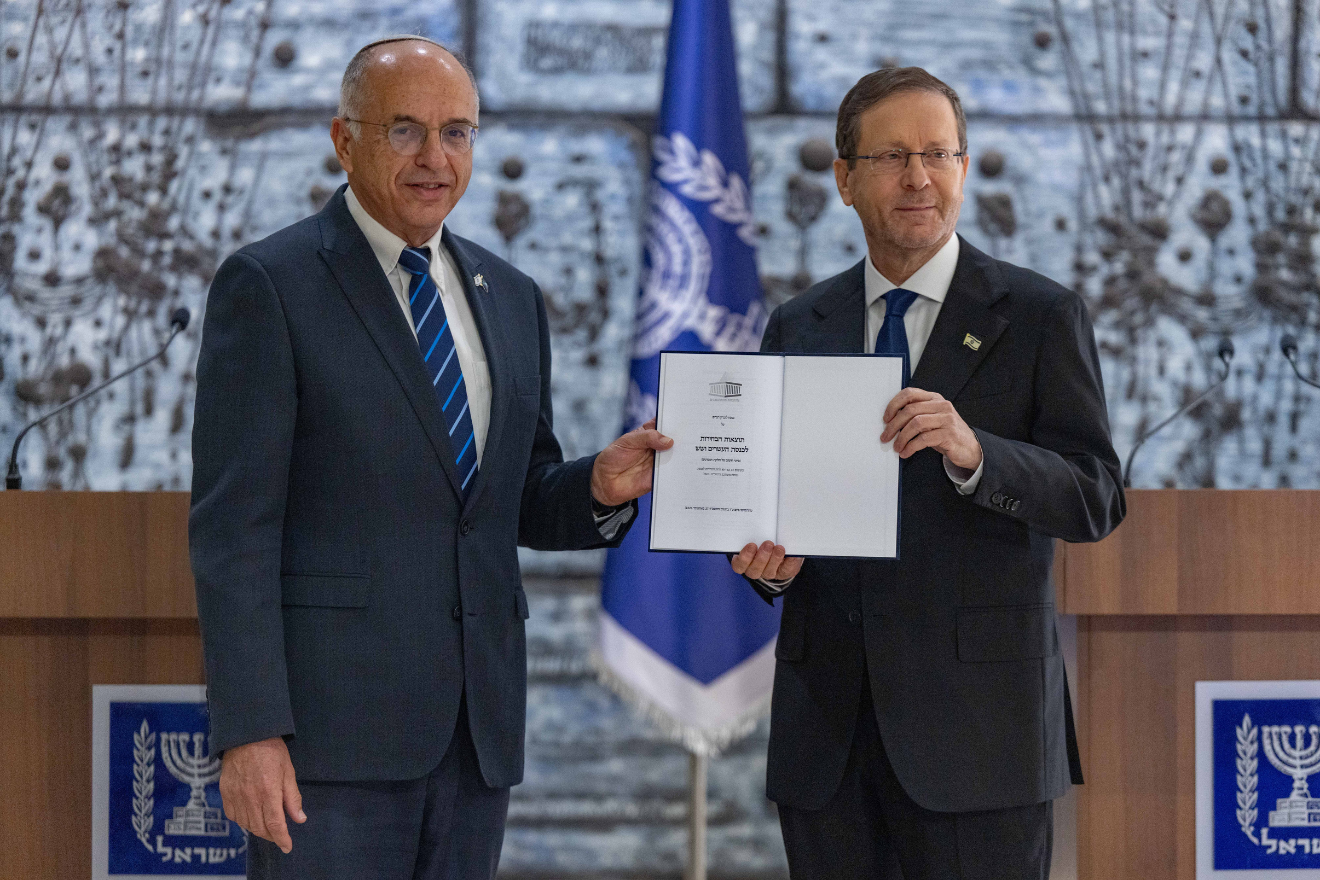
Chairman of the Central Elections Committee, Supreme Court Justice Noam Sohlberg, presents the official results of Israel’s 26th Knesset elections to Israeli President Isaac Herzog at the President’s Residence in Jerusalem | Photo: Yonatan Sindel/Flash90
4. The war against Iran and its proxies
Lebanon.
Eight months after Hezbollah joined the war in support of Iran in March, Israel continues to hold around 700 square kilometers of southern Lebanon and to strike Hezbollah targets across the south. Lebanese authorities report more than 4,300 deaths since March. This week Israeli media reported that the IDF is preparing plans to advance on Tyre, Sidon and Nabatieh, strike Beirut’s southern suburbs and blockade the ports of Beirut and Tripoli if the war with Iran resumes and Hezbollah joins in. Israel has reportedly asked the Lebanese army to set up roadblocks to keep Hezbollah out of the fight. Lebanese security forces have arrested Hezbollah members transporting explosives from the Bekaa Valley towards Beirut. Hezbollah leader Naim Qassem refuses to discuss disarmament, and U.S.-sponsored talks between Israel and Lebanon have stalled.
Syria.
Israel continues to operate in the buffer zone along the Golan and on Mount Hermon, with frequent raids into Quneitra and the Daraa countryside to detain suspects and dismantle what the IDF calls terrorist infrastructure. Damascus has condemned the incursions, and protests took place in several Syrian cities on 23 October. Netanyahu has made clear that Israel’s security doctrine now puts prevention and offense ahead of containment, and that Israeli forces will stay as long as threats persist.
Israel and the U.S.
Over the weekend Netanyahu and Trump held what Trump called a “very good talk.” According to AP and Axios, Netanyahu urged the President to launch a new wave of strikes on Iran once the midterms were over, a report Israel’s UN envoy denied. Trump has said he is in no hurry, while noting that “one or two” Iranian nuclear sites still need to be dealt with. Secretary of State Rubio says the President “hasn’t made a decision,” and Vice President Vance is optimistic about a negotiated settlement. Qatari mediators are working on a framework under which Iran would stop attacks in the Strait of Hormuz and the U.S. would lift its naval blockade. Yet on the eve of the elections, U.S. forces quietly struck Iranian missile positions around Qeshm Island and Bandar Abbas. Israel has also warned U.S. and Gulf officials that Iran could use chemical weapons. Washington and Jerusalem remain allies, but they are no longer clearly in step.
5. How these issues are connected
These four issues are all really part of one story. The Iranian Revolutionary Guard Corps (IRGC) still wields power in Iran, and – despite the heavy losses it has suffered in the war – it is dominating the region.
The war with Iran helped decide the American election, and the American election will shape the war with Iran. A Democratic Congress, elected in large part by voters tired of that war, will make it much harder for President Trump to resume large-scale strikes, and Trump himself is already looking for a deal.
Trump’s announcement on aid must be read in the same light. It was made on election day, in response to Democratic attacks, and it signals that support for Israel is no longer the bipartisan certainty it once was. Israel can no longer take either party for granted.
In Jerusalem, too, the war and the coalition talks are intertwined. A renewed confrontation with Iran could strengthen Netanyahu’s case for a national emergency government under his leadership. At the same time, any new government, whether led by Netanyahu or Eisenkot, will have to manage relations with a weakened President and a skeptical Congress, while fighting on several fronts and losing American financial support.
The people of Israel are increasingly having to stand alone. That is difficult – but it is necessary. God is drawing his people towards Himself. Our prayer is that they will trust not in their own strength, but in God alone, who is their Rock and Salvation. He has promised:
“My dwelling place will be with them; I will be their God, and they will be my people. Then the nations will know that I the Lord make Israel holy,when my sanctuary is among them forever.’” (Ezekiel 37:27-28)
Prayer
Pray for Israel’s leaders.
Pray for President Herzog as he consults with every party this week and decides who will be given the mandate. Pray for Benjamin Netanyahu, Gadi Eisenkot and all party leaders, that they would put the good of the nation above personal and party interest. “The king’s heart is in the hand of the LORD” (Proverbs 21:1).
Pray for the leaders of the United States.
Pray for President Trump and for the new Congress, for Speaker-designate Jeffries and Senator Schumer, that they would act with wisdom, justice and faithfulness towards Israel, and that God would turn the hearts of America’s leaders to bless the descendants of Abraham (Genesis 12:3).
Pray for wisdom on the war with Iran.
Pray that the regime’s threat to Israel and the region would be ended, that negotiations would not reward evil, and that the Lord would protect Israel’s soldiers and civilians on every front, in Lebanon, Syria and beyond.
Pray for the people of Lebanon and Syria.
Many ordinary Lebanese and Syrians are caught between Israel’s enemies and the war. Pray that Hezbollah’s grip on Lebanon would be broken, and that Lebanon and Syria would find a path to peace with Israel.
Pray that Israel would trust in the Lord.
As American support becomes less certain, pray that Israel would not put its trust in princes, or in horses and chariots, but in the Holy One of Israel (Psalm 20:7; Isaiah 31:1).
Pray for the Church.
Pray that Christians in America, Europe and around the world would stand faithfully with Israel when it is no longer politically convenient to do so, and would pray without ceasing for the peace of Jerusalem (Psalm 122:6).

Trump says US aid to Israel will stop at the end of the year
On the day of the U.S. midterm elections, Trump told Fox & Friends that roughly $4 billion in annual U.S. aid to Israel “gets cut off at the end of the year.”
Donald Trump: Benjamin Netanyahu agreed to end $4 billion in US aid to Israel by end of 2026
“He brought it up. He brought it up.” Israeli defence sources expressed surprise at the accelerated timeline.
6 Jewish takeaways from the midterm elections
A weakened Trump, pressure from the left on Jeffries and Schumer, and an uncertain outlook for Netanyahu.
What can Jews take away from the sweeping Democrat victory in the US midterm elections?
A weakened Trump, paired with a more assertive Democratic Congress, makes similar support for aggressive action against Iran and its proxies less likely.
60 for Eisenkot, 46 for Netanyahu: Who gets first shot at forming Israel’s government?
The final results, the expected recommendations and the timetable for coalition talks.
U.S. launches new attacks on Iranian targets days after Netanyahu pressed Trump for more strikes
Limited U.S. strikes near the Strait of Hormuz as diplomacy with Tehran continues.
Lebanon caught between Israeli threats and Hezbollah’s hard-line stance
Hezbollah refuses to discuss its weapons as Israel prepares for the possibility of renewed war with Iran.
Protests break out in Syria against ‘Israeli incursions and attacks’ as tensions rise
Israeli raids in southern Syria and the Syrian response.
SCRIPTURE FOR THE WEEK:
Psalm 121
1 I lift up my eyes to the hills- where does my help come from? 2 My help comes from the LORD , the Maker of heaven and earth. 3 HE will not let your foot slip- he who watches over you will not slumber; 4 indeed, HE who watches over Israel will neither slumber nor sleep. 5 The LORD watches over you- the LORD is your shade at your right hand; 6 the sun will not harm you by day, nor the moon by night. 7 The LORD will keep you from all harm- he will watch over your life; 8 the LORD will watch over your coming and going both now and forevermore.
Why Israel? by Rev. Willem Glashouwer
Order the book