Unless the Lord builds the house
“Unless the LORD builds the house, its builders labor in vain. Unless the Lord watches over the city, the watchmen stand guard in vain.”
(Psalm 127:1)
Israel’s leaders are engaged in two great tasks at the same time. In Jerusalem, Gadi Eisenkot has been given the mandate to build a new government. On the borders, and far beyond them, Israel’s watchmen are keeping guard against an Iranian regime that is more defiant, and more openly nuclear in its rhetoric, than at any time since the latest phase in the war began in February.
Both tasks are urgent, both will determine Israel’s security and stability in the short and medium term, and both are fragile.
A week after the American midterms, Washington is holding fire on Iran while Tehran all the while sets impossible conditions. And Israel’s coalition negotiations are being shaped, at every turn, by the war, or at least perceptions about it.
Psalm 127 reminds us that neither the builders nor the watchmen can succeed in their own strength. In this Weekly Update we look at both stories, how they are connected, and how we can pray.
1. What is Iran doing?
Iran is combining defiance with pressure. The Strait of Hormuz remains closed, and Tehran insists it will stay closed until the United States accepts all seven of its conditions, including the lifting of sanctions, the unfreezing of Iranian assets, an end to the U.S. naval blockade of Iranian ports and guarantees against further attacks. Iran says its proposal, passed through Qatari mediators, would reopen the strait within two days if those conditions were met.
Yesterday, the secretary of Iran’s Supreme National Security Council, Mohsen Rezaei, went further, declaring that “we are not currently conducting any negotiations with the Americans” and calling U.S. claims of progress “complete lies.”
Meanwhile, the danger at sea is growing. Several tankers have been hit by explosions or mines in and around the strait over the past week, and one seafarer was killed on a tanker in the Gulf on 5 November. The Revolutionary Guard (IRGC) claimed to have shot down a U.S. MQ-9 drone over Qeshm Island, and on 7 November it announced that it had lifted its self-imposed 2,000 km limit on the range of its ballistic missiles. Iranian officials have warned that European countries, undersea cables and Gulf data centers could become targets if the war resumes. In Saudi Arabia, debris from a Houthi missile damaged an Aramco building in Riyadh.
Most worrying is the nuclear rhetoric. On state television, Iranian hard-liner Mohammad Javad Larijani spoke of using nuclear weapons “tactically” against military bases and called for enrichment to 80%. The IRGC said it would be ready if the leadership changed Iran’s nuclear doctrine, and Supreme Leader Mojtaba Khamenei has never publicly confirmed that he upholds his father’s religious ruling against nuclear weapons. Iran is also reported to be distributing iodine tablets near its nuclear facilities. At home, the regime continues to crush dissent: on 8 November three men were executed in Karaj over January’s protests, accused of links to Israel and the U.S.
2. What is the United States considering?
President Trump’s message this week has been mixed. On 6 November U.S. forces carried out what he called “minor strikes” on an Iranian air-defence site on Qeshm Island. The next day, U.S. Central Command (CENTCOM) disabled a cargo ship trying to break the blockade and launched “Task Force Iron Gate,” which aims to extend the blockade to Iran’s land routes and the Caspian Sea. Trump has said that U.S. forces have identified 38 bridges as possible targets, and the Times reported that a strike on the heavily fortified “Pickaxe Mountain” nuclear site is being seriously considered. According to Fox News, Trump held two meetings with his national security team last week on resuming strikes, with 9 November, a moonless night, reportedly proposed and then shelved.
Yet the President is clearly reluctant to return to full-scale war. On 8 November he told CNN that new strikes were “highly unlikely” to be necessary if Iran signs a strong agreement, and he has since told Reuters that the U.S. will not launch a new offensive “for the time being,” that the war is militarily “effectively over,” and that there is a “good chance” of a deal, while adding that America can strike “anytime we want.” Secretary of State Rubio is more sceptical. Speaking at the G7 in Paris, he called Iran’s demands “outrageous and ridiculous,” said a deal might not be possible, and argued that economic pressure is working. The Treasury has added new sanctions, and the U.S. is offering up to $20 million for information on Iran’s nuclear programme.
How are the U.S. elections affecting all this? Very directly. Trump has acknowledged that the Iran war was one reason for the Republicans’ heavy losses last week, and Vice President Vance has said it was the reason. Iran’s parliamentary speaker greeted the results by declaring that Americans had said “no to war.” When the new Congress is sworn in in January, Democrats will control the committees and will have new tools to investigate and restrict the war. Even before then, a government funding deadline on 11 December and the annual defence bill give Senate Democrats leverage. Analysts in Tehran believe this uncertainty is making Trump hesitate, and they are trying to exploit it. Next week Trump expects to meet Presidents Putin and Xi at the APEC summit in China, with Iran on the agenda.
3. Israel: “Not finished with Iran”
Israel’s position is clear. On 8 November Defence Minister Israel Katz said that Israel is “not finished” with Iran, that “the mission is still not complete,” and that Iran is trying to renew its pursuit of nuclear weapons. He also warned Hezbollah not to join any renewed Iranian attack. According to the Financial Times, Prime Minister Netanyahu is calling President Trump every day to urge him to resume the war, while Gulf leaders urge restraint. Last month Netanyahu said Israel is prepared to strike Iran pre-emptively, even without U.S. support. Israel’s Channel 12 has reported that an Israeli operation against Iran was planned around the time of the 27 October election and was halted after Washington learned of it, a report the Prime Minister’s Office denies.
The Israeli elections are affecting Israel’s capacity to counter the Iranian threat. Israel’s military and intelligence capabilities are unchanged, but its political capacity to take far-reaching decisions is weakened. Netanyahu is now a caretaker prime minister without a majority, while his rival (Eisenkot) holds the mandate. Launching a major new operation without American backing, and in the middle of coalition talks, would be politically explosive, and some opposition figures have openly voiced suspicion that a new war could be used to disrupt the formation of a government. President Herzog, in giving Eisenkot the mandate, warned that Iran “is not waiting even a moment in its plots and threats,” and that Israel needs a stable government quickly.
What would change under Eisenkot? Probably less than many assume. Eisenkot, a former IDF chief of staff, regards Iran and its proxies as a threat that must be met militarily if necessary. Analysts at the Soufan Center expect that an Eisenkot government would not rule out joining a renewed U.S. campaign, or even acting alone if Iran’s nuclear program advances, but that it would be less likely to press Trump to resume the war or to oppose a U.S.-Iran deal. Netanyahu, for his part, warned in this week’s Knesset speech that a new government would face pressure to accept a nuclear Iran and to withdraw from Israel’s security zones in Lebanon, Syria and Gaza.
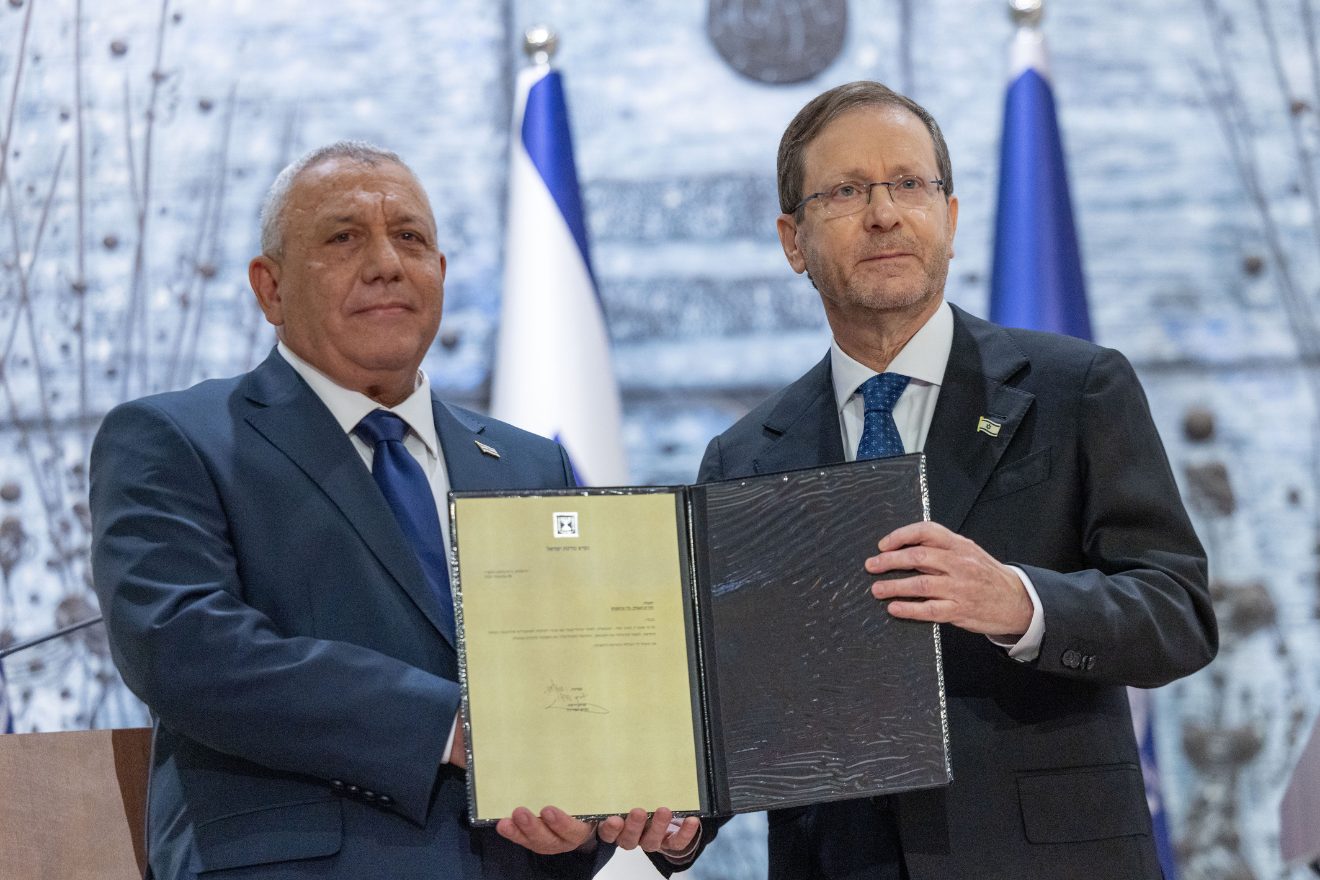
Israeli President Isaac Herzog formally tasks Yashar party leader Gadi Eisenkot with forming a new government | Photo: Chaim Goldberg/FLASH90
4. Eisenkot receives the mandate
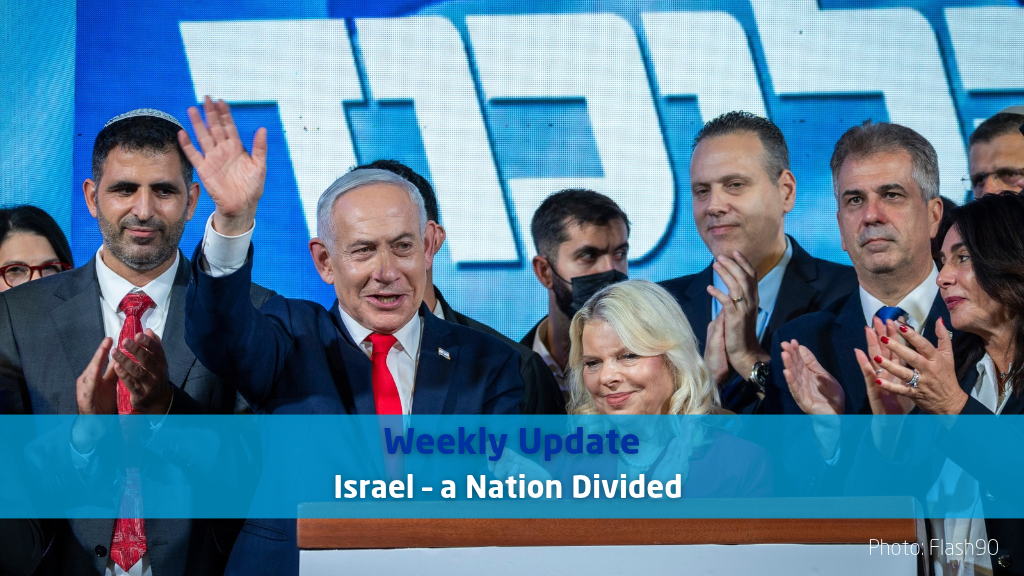
On Sunday 8 November President Herzog formally asked Gadi Eisenkot, leader of Yashar!, to form Israel’s next government. In the consultations Eisenkot was recommended by 67 Knesset members, including the parties of Naftali Bennett, Avigdor Liberman and Yair Golan, and both Arab parties, Ra’am and the Joint List. Netanyahu was recommended by 46, from Likud, Otzma Yehudit, Religious Zionism and Shas. United Torah Judaism (UTJ) recommended no one. Herzog acknowledged that “the fact that the Likud faction is the largest faction… has not escaped my attention,” but asked Eisenkot to form a government that would serve all Israelis.
Eisenkot has 28 days, until about 6 December, with a possible extension of 14 days. He has called for a “national emergency government,” warning that Israeli democracy is “at one of the most vulnerable moments” in its history and that “creative and unconventional political steps will be required.” He has set four principles for any partner: recognition of Israel as a Jewish and democratic state; commitment to the values of the Declaration of Independence; service for all citizens, whether military, national or civilian; and recognition of Hamas as a terrorist organisation, with a commitment to dismantling its military and governing power in Gaza.
The 26th Knesset was sworn in on 10 November, and the session immediately showed how deep the divisions run. In a passionate speech, Netanyahu repeated his call for a “national unity government” under his own leadership and declared that Israel “cannot rely on a narrow government with supporters of terrorism and enemies of Israel.” Eisenkot called it a “hate-filled speech” and cancelled a negotiating meeting with Likud planned for today. Eisenkot’s bloc has also nominated Matan Kahana to replace Amir Ohana as Knesset Speaker, with a vote expected next week, and has tabled bills for a state commission of inquiry into 7 October, term limits for the prime minister and the repeal of the judicial overhaul.
5. The challenges facing Eisenkot
The arithmetic is unforgiving. Eisenkot’s own bloc – Yashar! (21), B’Yachad (12), The Democrats (8) and Yisrael Beiteinu (7) – holds just 48 seats. Netanyahu’s bloc has 53. The remaining 19 of the total 120 seats belong to the two Arab parties. Every route to a government requires Eisenkot either to bring in parties that his own partners reject, or to persuade parties from Netanyahu’s camp to cross over.
Liberman (Yisrael Beiteinu) is the pivot. Without his seven seats, Eisenkot has no majority at all. Liberman refuses to rely on Ra’am or the Joint List, “either directly or indirectly,” and opposes a minority government. Instead, in a remarkable reversal after years of campaigning against them, he has offered to bring the Haredi parties in, accepting “painful compromises” on their military service (the Haredi parties insist that Haredi men remain exempt from military service). His message to Eisenkot: “Give up the Arab support, and I’ll make sure to bring in the Haredi parties.” Eisenkot meanwhile insists that service for all is non-negotiable. Even the Knesset Speakership has caused friction between them.
Eisenkot has also left the door open to Likud. He has said that Likud members, and even Bezalel Smotrich, would be welcome if they accept his four principles and agree to serve under his leadership. Likud says it is willing to talk to anyone who wants unity, but not under those conditions.
For now, a unity government seems as distant as ever, and if Eisenkot fails, the mandate could pass to another candidate, or Israel could be heading for yet another election in early 2027.
6. The Haredi and Arab parties: the kingmakers
The Haredi parties. The Haredi parties hold the key to a Jewish majority. Politically they are repsented by UTJ (7) and Shas (6), which together would give Eisenkot’s bloc exactly 61 seats. Shas remains firmly in Netanyahu’s camp. UTJ, however, is in play. It withheld its recommendation from Netanyahu in protest at the failure to pass a law exempting yeshiva students from military service, and its “Lithuanian” rabbis, Rabbi Dov Lando and Rabbi Moshe Hillel Hirsch, have reportedly refused to meet Netanyahu despite repeated attempts by his office, his advisers and his wife to reach them. On 9 November Eisenkot and Liberman agreed to open talks with UTJ and Shas on a softened draft law. According to Channel 12, the Haredi parties are likely to seek a transitional period of a year or more with no real enlistment and no sanctions on draft evaders, backed by legal guarantees that the arrangement will survive the High Court. That goes to the heart of Eisenkot’s own principle of service for all.
The Arab parties. Both Arab parties recommended Eisenkot for prime minister, and with a record 19 seats they could decide the outcome. The Joint List says it will not seek ministries or formal membership of the coalition, but would support an Eisenkot government from outside and would not bring it down, even in wartime, in return for action on crime in Arab communities and an end to home demolitions in Bedouin villages. Ra’am’s leader Mansour Abbas wants his party to be part of the coalition. Eisenkot himself has kept his distance: he has said his priority is a “Zionist government committed to military conscription,” and Liberman and Bennett rule out depending on Ra’am. Even so, ynet reports that Eisenkot’s team is examining a minority government that would take office with the abstention of UTJ, Ra’am and the Joint List, which under Knesset rules requires only more votes for than against, not 61.
Netanyahu has made the Arab parties the centre of his campaign against Eisenkot, describing them as “supporters of terrorism.” Abbas, in turn, claimed this week that Netanyahu once told him, “Yahya Sinwar and I understand each other.” The question of whether a Jewish state at war can be governed with the support of Arab parties, some of whose members reject Zionism, is now the most divisive issue in Israeli politics.
7. How these issues are connected
The Iranian threat is the main reason both Netanyahu and Eisenkot are calling for an “emergency” or “unity” government. It is the argument Netanyahu uses against a coalition dependent on Arab parties, and the reason Herzog is pressing for a stable government quickly. At the same time, the Haredi draft question is not just a religious or social issue: after three years of war on several fronts, the IDF badly needs more soldiers.
Tehran is watching. A divided Knesset in Jerusalem and a divided government in Washington are exactly what the Iranian regime hopes for. Its strategy is to wait out its enemies, raise the cost of war through Hormuz, and exploit political weakness in both capitals. The coming weeks, with Eisenkot’s deadline in early December and the U.S. funding deadline on 11 December, will show whether Israel and America can act with unity and resolve, or whether Iran’s waiting game succeeds.
The builders and the watchmen both need the Lord.
We in the nations too can be watchmen on the walls of Jerusalem. The scriptures encourage us: “For Zion’s sake I will not keep silent, for Jerusalem’s sake I will not remain quiet, till her vindication shines out like the dawn, her salvation like a blazing torch.”
Prayer
Pray for Gadi Eisenkot and Israel’s party leaders.
Pray for wisdom for Eisenkot as he negotiates, and for Netanyahu, Liberman, Bennett, Golan and the leaders of the Haredi and Arab parties, that they would put the good of the nation above personal and party interest. “Where no counsel is, the people fall: but in the multitude of counsellors there is safety” (Proverbs 11:14).
Pray for unity in Israel.
Pray that the bitter divisions revealed in the Knesset this week would be healed, and that Israel would have a stable government quickly, without another long and divisive election. “Behold, how good and how pleasant it is for brethren to dwell together in unity!” (Psalm 133:1).
Pray for a just solution on military service.
Pray that a way would be found that honors both the study of Torah and the shared burden of defending the nation, and for the families of Israel’s soldiers and reservists who have carried that burden for three years.
Pray for President Herzog,
He oversees this process, and for the new Knesset as it begins its work.
Pray concerning Iran.
Pray that the Lord would frustrate the regime’s plans, that Iran would never obtain nuclear weapons, and that the Strait of Hormuz would be reopened. Pray for the people of Iran, who suffer under this regime, and for those facing execution. “The LORD bringeth the counsel of the heathen to nought: he maketh the devices of the people of none effect” (Psalm 33:10).
Pray for President Trump and America’s leaders.
Pray for President Trump, Vice President Vance, Secretary Rubio and the incoming Congress, that they would have wisdom and courage, that they would not be divided in the face of evil, and that any agreement with Iran would bring true security, not reward aggression.
Pray for protection.
Pray for Israel’s soldiers and civilians on every front, for seafarers in the Gulf, and for Israel’s neighbours who are threatened by Iran and its proxies. “He that keepeth Israel shall neither slumber nor sleep” (Psalm 121:4).

President Herzog tasks Gadi Eisenkot with forming Israel’s next government
Eisenkot was recommended by 67 MKs and Netanyahu by 46. Eisenkot pledges a “national emergency government.”
‘Unconventional steps required’: Eisenkot vows to form emergency gov’t as Herzog bestows mandate
The timetable, the parties’ positions and the possible outcomes.
Eisenkot stands by mandatory service after Liberman opens door to ultra-Orthodox parties
Liberman offers “painful compromises” on Haredi enlistment, but Eisenkot holds to his four principles.
Eisenkot weighs minority government with outside backing from Arab and Haredi parties
How UTJ, Ra’am and the Joint List could allow an Eisenkot government to take office without joining it.
60 for Eisenkot, 46 for Netanyahu: Who gets first shot at forming Israel’s government?
The final results, the expected recommendations and the timetable for coalition talks.
Eisenkot cancels Likud coalition talks over Netanyahu’s Knesset speech
Netanyahu calls for national unity under his leadership. Eisenkot calls the speech divisive.
Will Trump strike nuclear sites again as Iran engages ‘cognitive warfare’?
Iran’s demands, its threats and the U.S. options.
Iran denies ongoing talks with US, planned meeting in Qatar
Rezaei: Hormuz will stay closed until all seven Iranian conditions are met. Rubio: Iran’s demands are “outrageous and ridiculous.”
‘Not finished with Iran’: Israel hints at fresh strikes amid Netanyahu’s political uncertainty
Defence Minister Katz says “the mission is still not complete.”
Three ways the new Democratic Congress could constrain Trump on foreign policy
War powers, committee chairs and the power of the purse.
SCRIPTURE FOR THE WEEK:
Isaiah 62:1-7
1 For Zion’s sake I will not keep silent, for Jerusalem’s sake I will not remain quiet, till her vindication shines out like the dawn, her salvation like a blazing torch. 2 The nations will see your vindication, and all kings your glory; you will be called by a new name that the mouth of the LORD will bestow. 3 You will be a crown of splendor in the LORD’s hand, a royal diadem in the hand of your God. 4 No longer will they call you Deserted, or name your land Desolate. But you will be called Hephzibah, and your land Beulah; for the Lord will take delight in you, and your land will be married. 5 As a young man marries a young woman, so will your Builder marry you; as a bridegroom rejoices over his bride, so will your God rejoice over you. 6 I have posted watchmen on your walls, Jerusalem; they will never be silent day or night. You who call on the LORD, give yourselves no rest, 7 and give him no rest till he establishes Jerusalem and makes her the praise of the earth.
Why Israel? by Rev. Willem Glashouwer
Order the book