Pressure from every side
“no weapon forged against you will prevail, and you will refute every tongue that accuses you.”
(Isaiah 54:17, NIV 1984)
This week Israel faces pressure on three fronts at once. In The Hague, a landmark judgment of the International Court of Justice against Myanmar has changed the legal landscape for South Africa’s genocide case against Israel. In the Gulf, tensions with Iran are rising again, and Prime Minister Netanyahu is pressing Washington to join a new round of strikes. And at home, four weeks after an inconclusive election, Gadi Eisenkot is racing a deadline to form a new government.
In this Weekly Update we look at each of these developments, and offer some guidelines for prayer.
1. The Myanmar genocide judgment – what it means for the case against Israel
What the Court decided
On 19 November the International Court of Justice (ICJ) delivered its judgment in The Gambia v. Myanmar. By nine votes to six, the Court found that Myanmar committed genocide against the Rohingya in northern Rakhine State during the military “clearance operations” of 2016–2017. It is the first time the Court has held a State directly responsible for committing genocide.
Nobody disputes that terrible atrocities took place. The Court found that at least 10,000 Rohingya were killed, more than 1,800 raped, hundreds of villages burned and over 700,000 people driven into Bangladesh. The six dissenting judges did not deny these facts. The disagreement was about something else: how a court may prove that these acts were carried out with the intent to destroy the group – the element that distinguishes genocide from other grave crimes such as ethnic cleansing, crimes against humanity and war crimes.
A lower bar for proving genocidal intent
In its earlier cases (Bosnia v. Serbia, 2007, and Croatia v. Serbia, 2015) the Court set a very high bar: where there is no direct evidence, genocidal intent may only be inferred from a pattern of conduct if genocide is “the only reasonable inference” from the evidence. Formally the Court repeated that test. But, as Israeli law professors Amichai Cohen and Yuval Shany explain in Just Security, and as thinc. (The Hague Initiative for International Co-operation) argues in its analysis, the majority in fact applied it very differently:
- Intent can be pieced together from many factors. The Court inferred intent from “an array of different factors” taken together: the general context, selective targeting, acts that attack the foundations of the group (such as sexual violence and attacks on children), and the systematic scale of the operations.
- No plan or pattern required.
The Court did not require proof of a central plan or policy before inferring intent. - A shift in the burden of proof.
According to thinc., the Court in effect first asks whether genocide is a reasonable inference, and then requires the accused State to show that its alternative explanations – in Myanmar’s case counter-insurgency, forced displacement and punishment – account for all the evidence. Other purposes that are compatible with genocidal intent no longer compete with it. - Factors that once counted in a State’s favor were discounted.
In Croatia, the fact that a State did not use available opportunities to destroy a group weighed against a finding of intent. Here, the Court attributed Myanmar’s unused opportunities to unspecified “geographic and other constraints”. - Compliance with the laws of war is no defense.
The Court held that compliance with international humanitarian law (IHL) does not take conduct outside the Genocide Convention. - The duty to prevent.
Reversing Bosnia, the Court found that a State can breach its duty to prevent genocide even without a finding that genocide actually occurred. - UN reports.
The Court gave no weight to the legal conclusions of the UN fact-finding mission, but relied on its factual findings, and held that Myanmar’s refusal to cooperate justified drawing inferences of fact against it.
The six dissenters – Vice-President Sebutinde, Judges Tomka, Abraham, Xue and Nolte and Judge ad hoc Kress – argued that the majority substantially lowered the standard set in Bosnia and Croatia, calling the new holistic test “so indeterminate that it borders on arbitrariness”. Judge Nolte warned that the reasoning will open the Court to political pressure in the future.
Thinc. also raises concerns about the evidence. The Court made no site visit; the UN mission had no access to northern Rakhine; live witnesses covered only three of some 509 villages; and the finding relied partly on unsigned UN and NGO summaries.
Implications for South Africa v. Israel
The judgment does not decide South Africa’s case. But it is now the template the Court will apply, and Cohen and Shany spell out what that could mean:
- South Africa would not need to prove that Israel had a plan or policy to commit genocide. Statements by Israeli officials and the broader context could carry significant weight.
- The fact that Israel complies with the laws of war would not in itself defeat the claim. Israel’s stated war aims – defeating Hamas and bringing the hostages home – would be weighed against the whole record: the scale of destruction in Gaza, restrictions on aid, official statements and the conduct of soldiers who disobeyed orders.
- The destruction of universities, mosques and cultural sites could be introduced as context or as evidence of harm to the “foundations” of the group – facts the Court set aside in Bosnia as “cultural genocide”.
- The entire population of Gaza might be treated as the targeted group.
- The 2025 genocide finding of the UN Commission of Inquiry carries no legal weight as such, but its factual findings could be relied on – and Israel’s non-cooperation with it could count against Israel.
There are, however, crucial differences. Myanmar was facing a militant group reported to have only 40 to 70 firearms. Israel was attacked on 7 October 2023, when some 1,200 people were murdered and about 250 taken hostage, and has since fought a large, well-armed terrorist army embedded in a densely populated urban area. Israel also took extensive measures to reduce civilian harm, including evacuations – a factor the Court itself used to distinguish earlier cases.
The case against Israel will not be decided soon. South Africa has until November 2027 to file its reply, and Israel until May 2029 to respond. By then the composition of the Court will have changed, with new judges joining in 2027 and 2030.
The deeper concern goes beyond Israel. As thinc. warns, if compliance with the laws of war is no longer a defence, the ICJ could effectively begin to micromanage armed conflicts – including urban warfare against non-State terror groups. That should worry not only Israel but NATO and every democracy that may one day have to defend itself. Both Cohen and Shany and the dissenting judges conclude that blurring the line between genocide and other crimes may in the end weaken, rather than strengthen, the protection the Genocide Convention was meant to give.
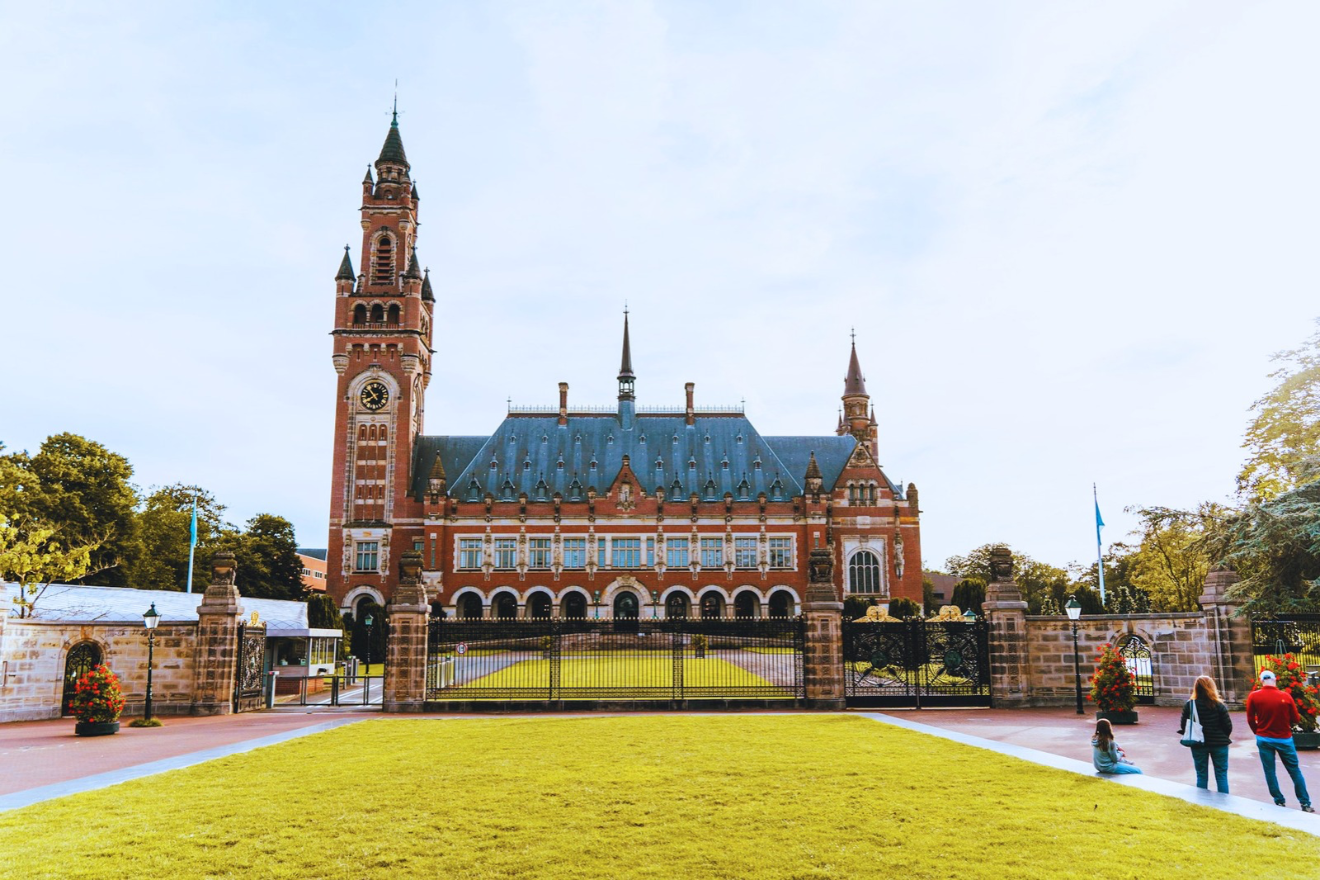
ICJ | Photo: Hassan Anayi/Unsplash
2. Iran – will there be new strikes?
Nine months after the United States and Israel launched joint strikes on Iran on 28 February, the confrontation with the Islamic Republic is far from over. A ceasefire agreed in June lasted less than three weeks. Since then, hostilities have repeatedly flared, and the US has maintained a naval blockade of Iran’s ports for more than four months. In recent days the situation has become more tense:
- Israel is pressing for action.
According to the New York Times, Prime Minister Netanyahu is urging the US to join Israel in a new four-to-seven-day campaign of strikes. Mossad chief Roman Gofman reportedly travelled to Washington last week to make the case. Israel is concerned that Iran is rebuilding its missile and drone capabilities. - Chemical and biological weapons?
President Trump has said there are “indications” that Iran is looking at chemical and biological weapons now that it has been shut out of nuclear weapons. US officials reportedly disagree about how strong this intelligence is; Iran dismisses the claims as a replay of the 2003 Iraq case. - Trouble in the Gulf.
US forces struck an Iranian Revolutionary Guards missile site on Qeshm Island in what they called self-defence. Iran has fired at targets in Bahrain and Kuwait. Several tankers have been hit in the Strait of Hormuz since mid-November, and Trump has warned that ships running the blockade would end up “at the bottom of the sea”. - Trump is in no rush.
Trump has said he is inclined to resume strikes after the New Year if negotiations fail, but that he is not rushing a decision. Saudi Arabia, several other Gulf states and Britain have reportedly urged Washington privately not to strike, fearing Iranian retaliation and disruption of energy supplies. - Diplomacy continues – just.
Indirect talks, with Qatar among the mediators, have stalled. Iran insists its enriched uranium will never leave the country and refuses unrestricted cooperation with IAEA inspectors.
Inside Israel, the question has become entangled with politics. Netanyahu accuses his rivals of minimising the danger for political reasons, and reports say Israeli security officials do not support his push for renewed action. Gadi Eisenkot, himself a former IDF chief of staff, says he sees no immediate threat requiring military action before a new government is sworn in, and that the gravest danger is the roughly 440 kilograms of enriched uranium still in Iranian hands. Avigdor Lieberman has reportedly said that Israel should not act alone without American participation.
The coming weeks will be critical. Iran’s regime is under enormous economic pressure, but remains defiant. The danger of a wider war – and of renewed missile attacks on Israeli cities – remains very real.
3. Forming a new government – Eisenkot races the clock
Four weeks after the elections of 27 October, Israel still has no new government. President Herzog has given Gadi Eisenkot, leader of the Yashar party, the task of forming one. Netanyahu remains caretaker prime minister.
The arithmetic
Netanyahu’s bloc of Likud, the national-religious and the ultra-Orthodox parties holds 53 of the Knesset’s 120 seats. Eisenkot’s “change bloc” holds around 48. The Arab parties have 19. Nobody has the 61 seats needed for a majority.
The latest developments
- A first coalition partner.
On Tuesday Yashar (21 seats) announced that it will sign a coalition agreement with Avigdor Lieberman’s Yisrael Beytenu (7 seats) – the first such agreement since the election. Its details are confidential, but Lieberman may become defence minister. - Unity talks with Likud.
At the same time, negotiating teams from Yashar and Likud have met three times in two weeks to explore a national unity government. They have reportedly agreed to set up a committee on judicial reform, but the central question – who will be prime minister – has not yet been resolved. Likud reportedly wants Netanyahu to remain prime minister; others propose a rotation in which Eisenkot serves first. - Divisions in the change bloc.
Naftali Bennett supports a unity government with Likud under Eisenkot’s leadership – but not with Netanyahu as prime minister – and warns against rushing into a minority government. Lieberman prefers a government supported by the ultra-Orthodox parties. Yair Golan’s left-wing Democrats (8 seats) have suspended talks with Eisenkot in protest at the negotiations with Likud, calling them a “sham”. - Red lines.
Eisenkot has said he will not compromise on two issues: a state commission of inquiry into the failures of 7 October, and military service for all – including the ultra-Orthodox. Netanyahu, by contrast, is asking for “flexibility” so that the ultra-Orthodox parties can join.
What next?
Eisenkot’s 28-day mandate ends on 6 December, although he can ask the President for a 14-day extension. Israeli media report that he may also try to form a minority government. If he fails, Netanyahu may be given the opportunity to try. If nobody succeeds, Israel will go to the polls yet again next year.
The outcome will shape not only Israel’s domestic future but also how it handles the threat from Iran and the growing pressure from the international community.
Prayer
Pray for justice and truth in the nations. Pray that the judges of the International Court of Justice will judge with wisdom and integrity, free from political pressure. Pray that the truth about the war in Gaza – including the atrocities of 7 October and the reality of fighting a terrorist army hiding among civilians – will be understood. “Righteousness and judgment are the habitation of his throne” (Psalm 97:2).
Pray for protection from Iran. Pray that the Lord will frustrate the plans of the regime in Tehran, prevent it from obtaining weapons of mass destruction, and protect the people of Israel and the region from war. Pray also for the people of Iran, who suffer under this regime.
Pray for wisdom for leaders. Pray for President Trump, Prime Minister Netanyahu and Israel’s military and security chiefs as they make decisions of life and death. Pray that every decision will be taken for the security of the nation, not for political advantage.
Pray for the formation of a government. Pray for Gadi Eisenkot, Benjamin Netanyahu, Naftali Bennett, Avigdor Lieberman and all the party leaders. Pray that pride and personal ambition will give way to the good of the nation, and that a stable government can be formed that unites rather than divides. “The king’s heart is in the hand of the LORD… he turneth it whithersoever he will” (Proverbs 21:1).
Pray for President Herzog, that he may guide the process with wisdom and impartiality.
Pray for unity among the people of Israel, and that in a time of pressure from every side, many will turn to the Keeper of Israel who neither slumbers nor sleeps.

Gambia v. Myanmar: A Landmark Judgment That Unsettles the Law of Genocide
Amichai Cohen and Yuval Shany analyse the judgment and its implications for South Africa v. Israel.
ICJ lowers standard for proving genocidal intent
Thinc. on how the Court changed its approach – and why it matters.
Netanyahu, Eisenkot spar over perception of Iran as an ‘immediate’ security threat
PM accuses rivals of ‘minimizing’ danger for political reasons after Eisenkot says no need for immediate military action; Liberman said to warn of potentially ‘illegal’ attack on Iran by Netanyahu
Israel’s Eisenkot secures first coalition partner in bid to form government
The Yashar party says it agreed to sign a coalition pact with Israel’s Our Home party, led by Avigdor Lieberman.
SCRIPTURE FOR THE WEEK:
Psalm 121 (NIV 1984)
1 I lift up my eyes to the hills- where does my help come from? 2 My help comes from the LORD , the Maker of heaven and earth. 3 He will not let your foot slip- he who watches over you will not slumber; 4 indeed, he who watches over Israel will neither slumber nor sleep. 5 The LORD watches over you- the LORD is your shade at your right hand; 6 the sun will not harm you by day, nor the moon by night. 7 The LORD will keep you from all harm- he will watch over your life; 8 the LORD will watch over your coming and going both now and forevermore.
Why Israel? by Rev. Willem Glashouwer
Order the book