Sanctions on Settlements – and Silence on Islamism
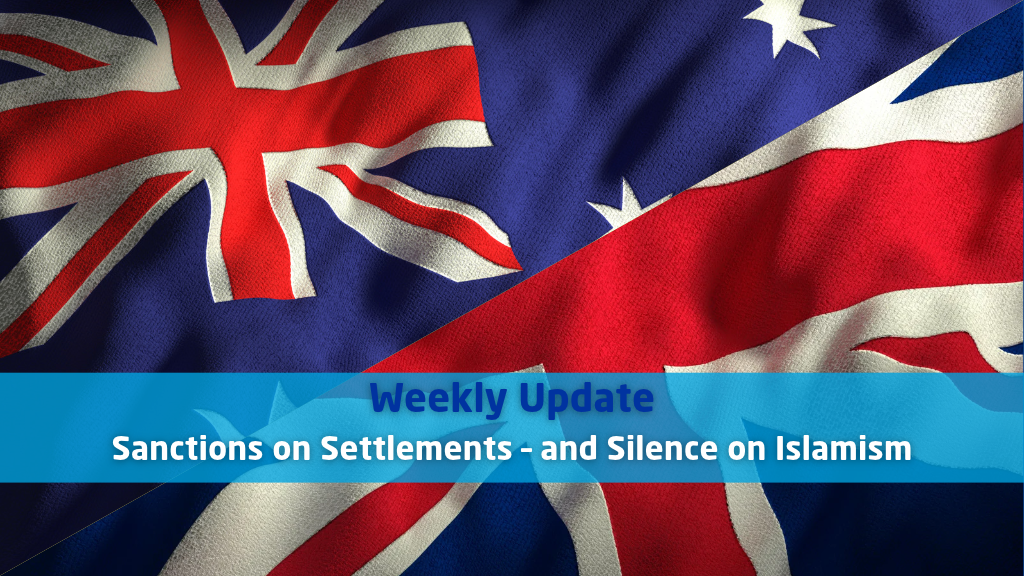
This week two of Israel’s oldest friends, the United Kingdom and Australia, took coordinated action against Israelis involved in building communities in Judea and Samaria – the West Bank. Within twenty-four hours of each other, London and Canberra announced sanctions against Israeli construction companies, settlement organisations and individuals, including some of the best-known figures in the settlement movement.
Both governments say they are acting to save the two-state solution. But there is a deep incongruity at the heart of their foreign policy. Both nations are quick to condemn Israel for alleged breaches of international law, yet remarkably slow to confront the Islamist ideology that is undermining their own societies – and that remains the greatest obstacle to a peaceful Palestinian state living side by side with Israel.
In this Weekly Update we explain what happened, why London and Canberra say they acted, and why their approach misses the heart of the problem.
What happened this week
The United Kingdom.
On Tuesday 17 November, Foreign Secretary Ed Miliband announced sanctions on eight Israeli construction and property development companies involved in building settlements, among them Har Hevron Development Company, Hemdat Shomron and S.A.G. (Velvel) Construction and Development. The measures include asset freezes and director disqualifications. The UK also sanctioned Tzav 9, an Israeli activist group that has repeatedly blocked aid convoys bound for Gaza.
This is the first concrete package since Britain announced a “reset” of its approach in September, when it banned imports of goods from the settlements and created new sanctions powers – the Global Human Rights and International Humanitarian Law Sanctions Regulations 2026. Those powers reach far wider than before: not only those who commit violence, but anyone who builds, finances or promotes settlement activity. In a video message, Miliband addressed Israeli firms directly: “Do not bid, do not build, and do not profit from the destruction of the two-state solution.”
The timing was deliberate. The announcement came just before the final deadlines in the tender process for E1, the controversial building project east of Jerusalem.
Australia.
On Wednesday 18 November, Foreign Minister Penny Wong followed suit, sanctioning three individuals and four organisations. The individuals are Daniella Weiss – often described as the “godmother” of the settler movement – together with Itamar Yehuda Levi and Eliav Libi. The organisations are Amana (the settlement movement’s development arm), Weiss’s Nachala movement, HaShomer Yosh (which sends volunteers to farms and outposts) and the Eyal Harei Yehuda construction company. It is the first time Australia has sanctioned a construction company.
Australians and Australian businesses are now banned from trading with, or providing financial or other support to, those listed, and the individuals are banned from travelling to Australia. Breaches carry a maximum penalty of ten years’ imprisonment. Wong said the targets had been involved in planning and establishing new settlements, raising funds, recruiting volunteers and supporting violent settlers. She added a warning: “Australian businesses should not bid for construction tenders for illegal settlement developments.” These measures build on earlier Australian sanctions against Israeli ministers, settlers and settlement groups.
Israel’s response.
Foreign Minister Gideon Sa’ar has vowed that Israel will respond to the British sanctions. Meanwhile, in Israel itself, Attorney General Gali Baharav-Miara has instructed the caretaker government to halt the tender process for 1,234 housing units in E1 until a new government is formed.
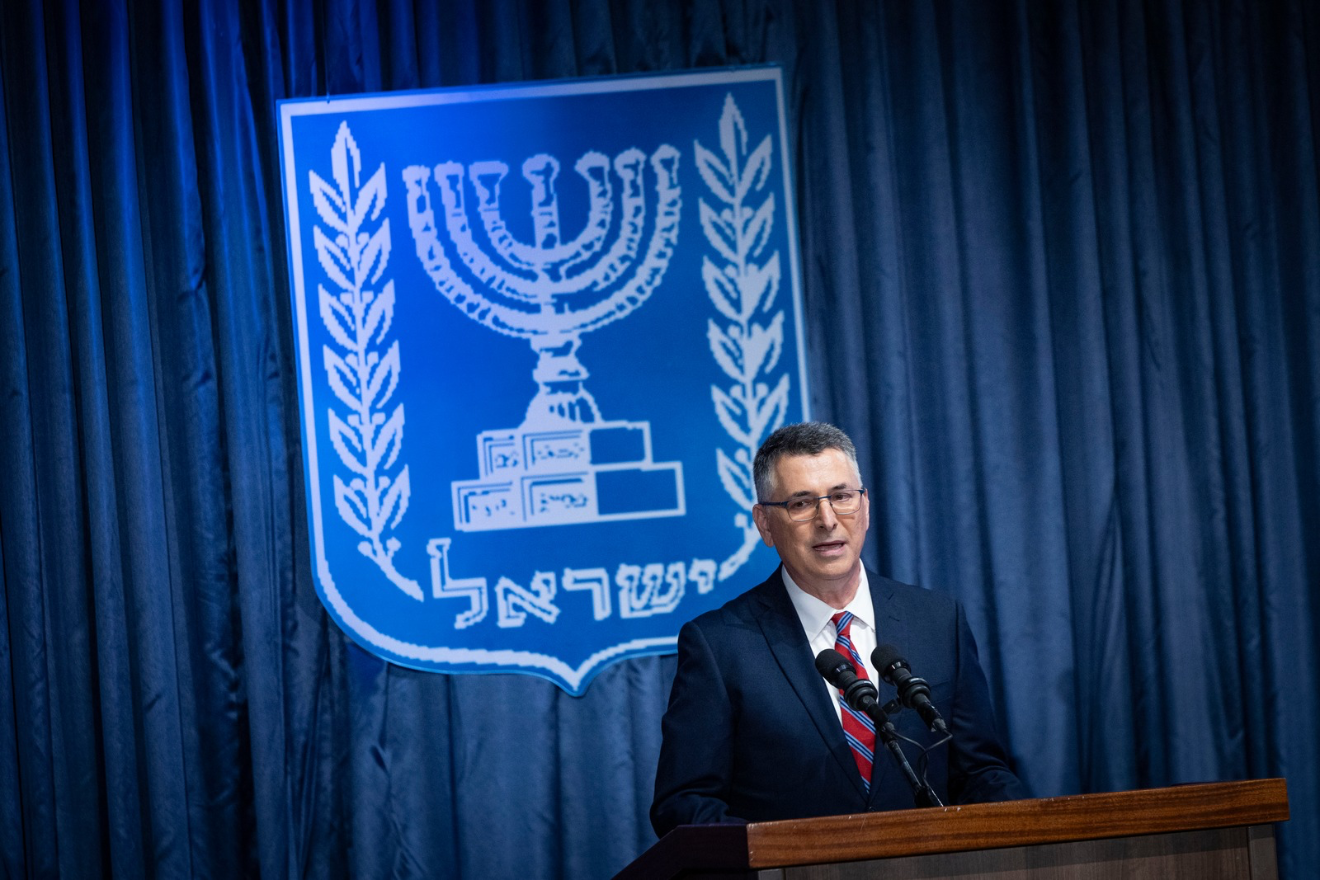
Israeli Foreign Minister Gideon Sa’ar | Photo: Chaim Goldberg/Flash90
Why London and Canberra acted: E1 and the two-state solution
Both governments frame these measures as a last-ditch attempt to keep the two-state solution alive. “Protecting the two-state solution is the North Star of this Government’s approach,” Miliband said. Prime Minister Andy Burnham said Britain was standing up for the two-state solution before it is rendered impossible by new settlements. Wong said settlement expansion and settler violence are “extinguishing the possibility of a two-state solution.”
The focus of their concern is E1. The plan envisages around 3,400 homes on the strip of land between Jerusalem and Ma’ale Adumim. Critics say it would effectively cut the West Bank in two, breaking the territorial link between Ramallah in the north and Bethlehem in the south, and severing both from East Jerusalem. Some Israeli ministers have not hidden their intentions: Finance Minister Bezalel Smotrich has called E1 the way to kill a Palestinian state de facto. Wong also pointed to demolitions and displacement of Palestinians in the E1 area in recent weeks, and to a rise in settler attacks recorded by the UN in October.
To be clear: violence against Palestinians is wrong, and it is condemned by many Israelis themselves. But it is absurd to suggest that so-called “settler violence” is preventing a “two-state solution”. The question is whether London and Canberra have correctly diagnosed what stands in the way of peace.
The incongruity
There is something deeply incongruous about British and Australian foreign policy. Both governments are meticulous about Israeli construction projects. Both have recognised a Palestinian state. Both speak constantly of international law. Yet both appear unwilling to name and confront the ideology that is doing real damage – at home and in the Middle East – to undermine both international law and any real prospects of a peaceful Palestinian state. . That ideology is Islamism: the political movement that turns the Muslim faith into a programme of domination and, too often, violence. (It is important to distinguish Islamism from Islam, and from the many Muslims who reject it.)
At home.
On Yom Kippur 2025, Jihad al-Shamie rammed his car into worshippers outside the Heaton Park Hebrew Congregation synagogue in Manchester and attacked them with a knife. Two men, Adrian Daulby and Melvin Cravitz, died. During the attack he phoned the police to pledge allegiance to the Islamic State. Ten weeks later, on the first night of Hanukkah, a father and son opened fire on a Chabad celebration at Bondi Beach in Sydney, killing fifteen people. Police found homemade Islamic State flags in their car and described the attack as inspired by the Islamic State. It was Australia’s deadliest terror attack.
These were not isolated events. In Britain, research by the Counter Extremism Group has documented the central role of Islamist preaching in spreading antisemitism. In Australia, a Royal Commission on Antisemitism and Social Cohesion is underway, but critics say its interim findings barely confront the ideology driving the hatred – even though antisemitism surged after the Hamas massacre of 7 October 2023, and Australia’s intelligence agency found that Iran was behind attacks on Jews in the country. Jewish communities in both nations now live with security guards at their schools and synagogues. Yet the energy that London and Canberra pour into sanctioning Israeli builders is rarely matched by comparable resolve against the networks, preachers and foreign sponsors that radicalise young men in their own cities.
In the Middle East.
The same blind spot affects their vision of a Palestinian state. Hamas – an Islamist movement whose founding charter calls for Israel’s destruction – carried out the worst massacre of Jews since the Holocaust. Both Britain and Australia rightly proscribe Hamas. But their peace policy treats houses in E1 as the decisive obstacle to peace, while the ideology that rejects any Jewish presence in the land is treated as a secondary matter.
There are hopeful signs among Palestinians. The latest survey by the Palestinian Center for Policy and Survey Research, conducted in October, found that support for Hamas has fallen to 19 percent, and that a narrow majority (53 percent) supports a Palestinian state alongside Israel on the 1967 lines. But the same polling organisation found just a year ago that a majority of Palestinians still considered the 7 October attack “correct,” and that an overwhelming majority opposed disarming Hamas. A state that cannot – or will not – disarm Islamist militias, end incitement in its schools and mosques, and accept the legitimacy of a Jewish state next door will not be a peace-loving state, wherever its borders are drawn.
A serious policy for peace would put as much effort into dismantling the Islamist infrastructure – its funding, its incitement and its sponsors in Tehran and elsewhere – as it puts into sanctioning Israeli construction firms. And a serious policy for social cohesion at home would confront the same ideology in London, Manchester, Sydney and Melbourne. Until that happens, sanctions on settlements will do little to bring peace, and much to isolate the one democracy in the region.
Prayer
Pray for Israel’s leaders.
As Israel forms a new government, pray for wisdom for its leaders in responding to international pressure, and for decisions on the land that honour the Lord and seek justice and security for all who live there.
Pray for the governments of the United Kingdom and Australia.
Pray that Prime Minister Andy Burnham, Foreign Secretary Ed Miliband, Prime Minister Anthony Albanese and Foreign Minister Penny Wong will see clearly, and will find the courage to confront Islamist extremism at home and abroad. “The king’s heart is in the hand of the LORD” (Proverbs 21:1).
Pray for the Jewish communities of Britain and Australia.
Pray for comfort for the families of those murdered in Manchester and at Bondi, for protection for synagogues and schools, and for Jewish people to feel safe in their own countries.
Pray for Arab Palestinians.
Pray for Palestinians who long for a peaceful future, and that they may be freed from the grip of Hamas and every ideology of hatred. Pray for an end to violence from every side.
Pray for Christians in Britain and Australia.
Pray that churches will stand with the Jewish people, speak truth with grace, and refuse to be silent in the face of antisemitism.
Pray for the peace of Jerusalem.
“They shall prosper that love thee” (Psalm 122:6).

‘Do not build’: UK sanctions 8 Israeli construction companies for building West Bank settlements
Britain targets settlement builders and an activist group that blocks aid to Gaza.
Britain sanctions Israeli aid-blocking group and settlement construction companies
“Aid must be allowed to reach civilians in desperate need, and those who obstruct it must be prepared to face the consequences,” Foreign Secretary Ed Miliband said.
West Bank settler sanctions – Australian Foreign Minister’s media release
Australia has today imposed its next tranche of targeted sanctions on those involved in illegal settlement expansion and human rights abuses against Palestinians in the West Bank.
SCRIPTURE FOR THE WEEK:
Isaiah 62:1-3, 6-9
1 For Zion’s sake I will not keep silent, for Jerusalem’s sake I will not remain quiet, till her vindication shines out like the dawn, her salvation like a blazing torch. 2 The nations will see your vindication, and all kings your glory; you will be called by a new name that the mouth of the LORD will bestow. 3 You will be a crown of splendor in the LORD’s hand, a royal diadem in the hand of your God.
6 I have posted watchmen on your walls, Jerusalem; they will never be silent day or night. You who call on the LORD, give yourselves no rest, 7 and give him no rest till he establishes Jerusalem and makes her the praise of the earth. 8 The LORD has sworn by his right hand and by his mighty arm: “Never again will I give your grain as food for your enemies, and never again will foreigners drink the new wine for which you have toiled; 9 but those who harvest it will eat it and praise the LORD, and those who gather the grapes will drink it in the courts of my sanctuary.”
Why Israel? by Rev. Willem Glashouwer
Order the book