Israel – a Nation Divided
The Bible tells us that the Lord will bring His people home to the land. They will become one, and God’s holiness will be revealed through them to the nations. In Ezekiel we read:
“I will make them one nation in the land, on the mountains of Israel. There will be one king over all of them and they will never again be two nations or be divided into two kingdoms. They will no longer defile themselves with their idols and vile images or with any of their offenses, for I will save them from all their sinful backsliding, and I will cleanse them. They will be my people, and I will be their God.”
Ezekiel 37
The Lord did not say it would be easy to unify His people. He did not say that the people of Israel would all agree with each other, or that it would happen in a particular way or within a particular time frame.
In fact, the process of “making them one nation in the land” is proving to be a difficult, drawn-out process.
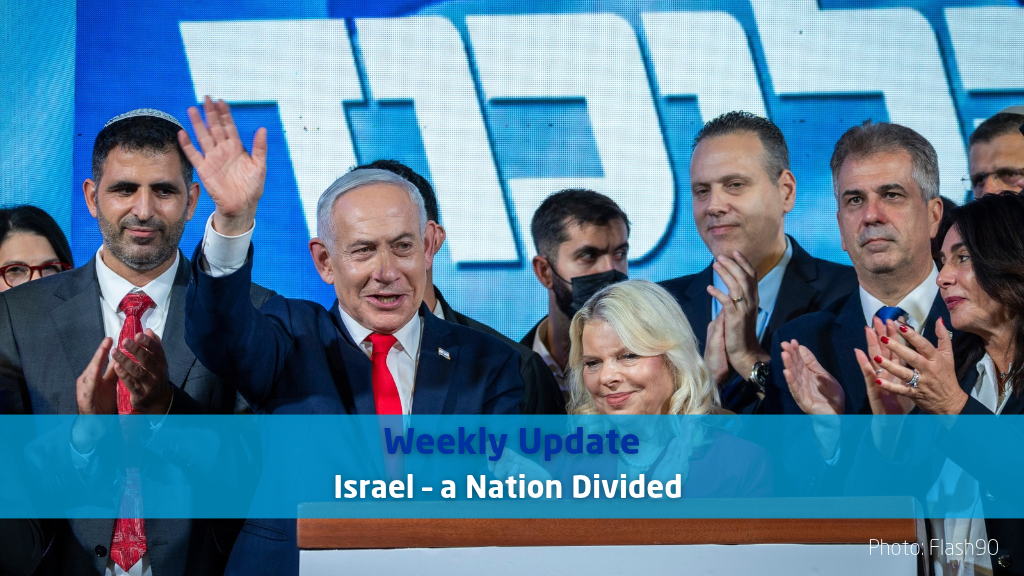
On the 28th of October, Israelis went to the polls. The result: Netanyahu’s bloc of parties has lost seats but is still the largest bloc. The anti-Netanyahu parties have failed in their bid to become the largest bloc. But there is now a political stalemate, with no clear pathway towards a stable government. The country seems more divided than ever in three groups that refuse to work together, but none of which has enough support to form a government on its own: the (mainly) secular Zionists who are united in their hate of Netanyahu, the (mainly) national-religious and ultra-orthodox who support Netanyahu, and the Arab parties.
In this Weekly Update we give an overview of the elections, insight into what comes next, and some guidelines how to pray for the people of Israel at this critical time in their history.
The elections – a nation divided
The political landscape of Israel is complex, and largely misunderstood. In 2015, Reuven Rivlin, then Israel’s president, gave a celebrated speech describing his country as four “tribes” – secular, national-religious, ultra-Orthodox and Arab – each with its own schools, its own newspapers and its own idea of what the state is for. At the ballot box, the lines fall slightly differently, but the principle holds.
These “tribes” were all represented in yesterday’s elections. While not all votes have yet been counted at the time of writing, the result of the elections is clear: the majority of Israelis want Netanyahu and his religious nationalist government to be replaced, but nobody can agree on who or what should replace them. The “Netanyahu bloc” that currently forms the government has lost so many seats that it can no longer form a majority, but the anti-Netanyahu bloc has received even less votes. The Arab parties are potential king-makers.
In total, over 30 political parties vied for seats in the Knesset. Only twelve passed the threshold needed to be represented. These twelve parties are grouped in three bloc: the “pro-Netanyahu” bloc, (which includes secular Zionist party Likud plus the national-religious and ultra-Orthodox parties), the “anti-Netanyahu” bloc (containing a group of center-left and right wing parties, united in little other than the conviction that Netanyahu must be replaced) and the “Arab bloc” – a group of Arab parties.
Netanyahu’s bloc has won 53 seats, against 48 for the opposition parties. The two Arab parties (the Joint List and Ra’am) have 19 seats. Nobody is near the 61 needed to govern. Netanyahu’s Likud remains the largest party, with around 26 seats, ahead of Eisenkot’s Yashar on roughly 21.
The prime minister’s coalition has thus lost its majority, but the opposition has failed to win one. Israel has voted for change without agreeing what change should look like. Israeli Arabs turned out in larger numbers than ever before. Their number of Knesset seats has increased from currently ten to 19. Neither the “Netanyahu bloc” (of which Netanyahu’s Likud is the largest with 26 seats) nor the Opposition bloc (of which Eisenkot’s Yashar party is the largest, with 21 seats) is able to form a government without the Arab parties – unless some members of the opposition bloc defecting to join Natanyahu.
The problem is that both Netanyahu’s bloc and the opposition parties have sworn they will not govern with the Arabs. And the opposition parties have all sworn they will never govern with Netanyahu. (Eisenkot’s party was created to replace him. Bennett has ruled out working with Netanyahu. Liberman has made opposition to Netanyahu almost a defining feature of his political career.)
That leaves the possibility of a national unity government, which could perhaps be justified by the continuing confrontation with Iran. Netanyahu has already invoked the country’s military achievements and the possibility of renewed action against Tehran.
Another possibility is that nobody manages to form a government, Israel goes back to the polls, and Netanyahu remains caretaker prime minister in the meantime. As journalist Jake Wallis Simons puts it:
- “The man whom his opponents have spent years trying to remove would survive yet another election without actually winning it. Israel has produced an overwhelming Zionist majority in parliament, but one so bitterly divided that it cannot agree on a government. The Arab parties have won unprecedented influence but remain largely excluded from the coalitions their votes could sustain. The opposition has spent years demanding Netanyahu’s removal, but cannot agree on the means of achieving it. Bibi has lost his majority; his enemies have failed to win one; and in Israeli politics, the margin between those two things can mean the difference between defeat and survival.”
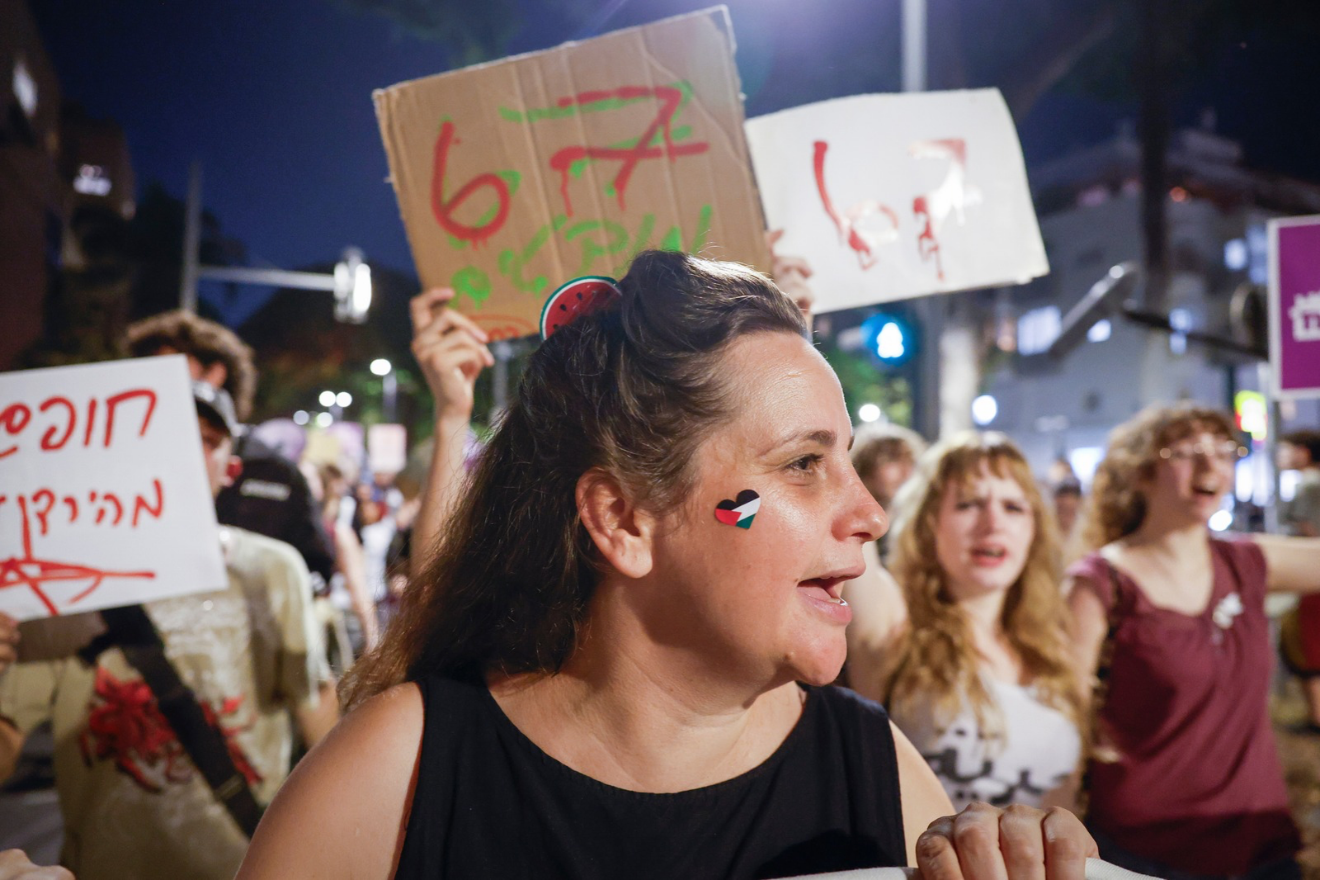
Activists block roads during a demonstration calling for the formation of a government that includes Arab political parties, | Photo: Jamal Awad/Flash90
Scandal – foreign Interference?
In a dramatic development, Supreme Court Justice Noam Sohlberg, who chairs the Central Elections Committee, has ordered Shin Bet to investigate the possibility that Qatar and Turkey may have interfered with the elections. Evidence has emerged that Arab leaders may have received bribes through channels that were previously used to transfer terror funds. At the request of Likud, Solberg has instructed Shin Bet chief David Zini to open an investigation into “suspicions regarding foreign funding and suspicion of electoral bribery by foreign entities.” This is provoking much controversy about the integrity of the Arab political leadership and the extent to which they are actively undermining the Jewish State of Israel. This of course makes it now impossible that either the pro-Netanyau or anti-Netanyahu camps will work together with the Arab parties.
What happens from here?
Israel’s president Isaac Herzog will play a crucial role in the coming weeks. The Presidency is mostly ceremonial, but the period right after an election is when it matters most. Herzog’s job now is to decide who gets the first chance to form the next government, and that is especially important this time because of the result.
Under Israel’s basic law on government formation, the president must consult the parliamentary factions and assign a Knesset member to form a government within seven days of the official results being published. Herzog says formal consultations will begin once Supreme Court Justice Noam Sohlberg, who chairs the Central Elections Committee, submits the final tallies, which he expects next week. At meetings in Jerusalem, each elected party recommends its choice for prime minister, and the president then gives one candidate the task of forming a government. He is supposed to pick the candidate with the best chance of forming a government, who is not necessarily the leader of the party with the most seats. If that candidate cannot assemble a majority within a maximum of six weeks, others can be given a turn. If no government can be formed, that could eventually lead to another election.
In his first public comments after the vote, Herzog urged the parties to do everything possible to avoid another election. He said he expects everyone who comes to the consultations to arrive with an open mind. He also praised the exceptionally high turnout as a mark of honor for Israeli society. He has said that he would do all he could to avoid a fresh election, including backing a unity government between Netanyahu and Eisenkot. He also vowed not to let outside pressure, notably from Donald Trump, sway his decision.
Herzog’s first choice will be whether to ask Netanyahu or Eisenkot to form a government. He may try to steer them toward a unity government, but it’s unclear that such an arrangement is even possible. There is precedent for presidents nudging the parties this way. In 2019, after the election for the 22nd Knesset, then-president Reuven Rivlin lobbied Netanyahu and Benny Gantz to form a unity government.
Divisions
Israel is at a critical point in its history. Everything changed after the attack of 7 October 2023. Broadly speaking, the country has become more nationalist, more security-conscious and less inclined to compromise with its enemies than the Israel of a generation ago. Indeed, Israel is still fighting a war on seven fronts.
But the nation is exhausted. There is much anger and frustration. And, paradoxically, more than ever before Israel is being condemned and criticized in the international community. It is increasingly isolated and alone.
At this time, it is more important than ever that Israel have a strong government and that the people of Israel be united as one. And unity is exactly what the elections have shown is lacking in Israel.
Prayer
Only the Lord God of Israel can bring the unity that is so needed, and for which its people thirsts. It is to Him that we must turn with our intercessions and prayers.
Pray for President Herzog.
Pray that the Lord give President Isaac Herzog wisdom, courage and discernment as he consults with every party and chooses who will be asked to form a government. Guard him from pressure, from within Israel and from abroad, and help him act with integrity for the good of the whole nation. “The king’s heart is in the hand of the LORD… he turneth it whithersoever he will” (Proverbs 21:1).
Pray for the nation’s leaders.
Lift up Benjamin Netanyahu, Gadi Eisenkot and all the party leaders, Jewish and Arab alike. Soften hearts where there is pride, and open minds where there is division. Help them put the welfare of the people above party interest and spare the country the strain of yet another election if it is Your will. Give them wisdom to govern justly in a time of war and great uncertainty. Pray for the newly elected Knesset members. Pray for every member of the new Knesset, whatever their party, faith or background. May they serve with honesty and humility, and seek the good of all who live in the land.
Pray for the Jewish people of Israel.
After years of war, grief and division, may the Lord bring comfort to families who have lost loved ones and healing to a weary nation. Unite a people who have been deeply divided. Above all, draw hearts to Yourself, that many would come to know the hope found in their Messiah.
Pray for Arab, Druze and other citizens.
Father, we pray for Israel’s Arab citizens, the Druze community and all minorities, many of whom feel their voices are not heard. Give them a fair place in the life of the nation. Break down suspicion between communities and build trust, respect and peace among neighbours.
Pray for Christians in the land.
We pray for Christian congregations across Israel. Strengthen them to be salt and light, to pray faithfully for their leaders, and to show the love of Christ across every dividing line, even in a season of political tension.
Pray for the peace of Jerusalem.
“They shall prosper that love thee” (Psalm 122:6). Lord, we ask for peace within Israel’s borders and with her neighbours, and for the true and lasting peace that comes only through the Prince of Peace.

Elections as a democratic Jewish ritual
Israel votes today, reaffirming a 3,000-year-old civilization’s commitment to democracy in the heart of the Middle East.
Netanyahu’s right-wing bloc ahead of opposition as post-election vote count continues
Partial results projected Netanyahu’s bloc securing the most seats, with Likud the largest party, albeit without a clear path to a governing majority.
What just happened? Has Bibi survived? Now what? The answers nobody’s giving you
Netanyahu may not need to win so much as he needs everybody else to lose.
Israeli elections chief orders Shin Bet probe of foreign influence on vote
The letter does not name the foreign actor, but Israel’s Channel 12 News reported that the suspicions concern Qatar.
Unity, defections or another election: Israel’s paths out of deadlock
The country’s next government will depend on whether its political leaders can reconcile their competing commitments, or whether voters will again be asked to resolve a deadlock that negotiations could not.
SCRIPTURE FOR THE WEEK:
Ezekiel 37:15-28
15 The word of the LORD came to me: 16 "Son of man, take a stick of wood and write on it, 'Belonging to Judah and the Israelites associated with him.' Then take another stick of wood, and write on it, 'Ephraim's stick, belonging to Joseph and all the house of Israel associated with him.' 17 Join them together into one stick so that they will become one in your hand. 18 "When your countrymen ask you, 'Won't you tell us what you mean by this?' 19 say to them, 'This is what the Sovereign LORD says: I am going to take the stick of Joseph-which is in Ephraim's hand-and of the Israelite tribes associated with him, and join it to Judah's stick, making them a single stick of wood, and they will become one in my hand.' 20 Hold before their eyes the sticks you have written on 21 and say to them, 'This is what the Sovereign LORD says: I will take the Israelites out of the nations where they have gone. I will gather them from all around and bring them back into their own land. 22 I will make them one nation in the land, on the mountains of Israel. There will be one king over all of them and they will never again be two nations or be divided into two kingdoms. 23 They will no longer defile themselves with their idols and vile images or with any of their offenses, for I will save them from all their sinful backsliding, and I will cleanse them. They will be my people, and I will be their God. 24 " 'My servant David will be king over them, and they will all have one shepherd. They will follow my laws and be careful to keep my decrees. 25 They will live in the land I gave to my servant Jacob, the land where your fathers lived. They and their children and their children's children will live there forever, and David my servant will be their prince forever. 26 I will make a covenant of peace with them; it will be an everlasting covenant. I will establish them and increase their numbers, and I will put my sanctuary among them forever. 27 My dwelling place will be with them; I will be their God, and they will be my people. 28 Then the nations will know that I the LORD make Israel holy, when my sanctuary is among them forever.' "
Why Israel? by Rev. Willem Glashouwer
Order the book