Modern blood libels in The Hague and Venice
The Jewish people have always been the subject of false accusations and slander. When Nehemiah rebuilt Jerusalem’s walls, Sanballat didn’t contest the project honestly — he wrote an open letter to the Persian authorities accusing Nehemiah of secret rebellion, hoping an official body would act on an unverifiable claim before the truth could catch up (Nehemiah 6:6–8). Centuries earlier, Haman took a similar approach at the level of an entire people, telling the king that the Jews’ “laws are diverse from all people” and that they should not be permitted to live — an accusation broad enough to justify anything, and specific enough to be checked by no one (Esther 3:8–9). In both cases, the accusation didn’t need to be true. It only needed to be believed by someone with power to act on it.
“Blood libel” is a special kind of lie. It refers to the medieval myth, first recorded in Norwich in 1144 and recurring for centuries after, that Jews murdered non-Jewish children for ritual purposes. What made it durable wasn’t just that it was false — it was how it was built: an accusation of hidden intent, supported only by testimony that could never be independently checked, where denial by the accused was treated as further proof of guilt rather than evidence of innocence. There was no action the accused could take that would count as disproof.
What makes blood libel distinct, rather than just “a false accusation,” is its structure, not just its falseness: The claim is about hidden intent or ritual, not a directly observable act. Nobody claimed to have publicly witnessed a murder in the town square; the accusation was always about something happening in secret, behind closed doors, known only through rumor or coerced testimony.
The evidence offered was inherently unverifiable. Confessions were extracted under torture. Witnesses were anonymous or interested parties. There was rarely, if ever, a body, a trial record, or physical evidence that could be independently examined.
Denial functioned as confirmation, not refutation. Because the community was assumed to be capable of concealment, the absence of evidence was read as evidence of a cover-up rather than evidence of innocence. There was no action the accused could take that would count as disproof.
The charge outran the specifics of any single case. Even when a particular blood libel was investigated and dismissed by civil or church authorities, the underlying accusation persisted and reattached itself to the next town, the next child’s disappearance, the next generation.
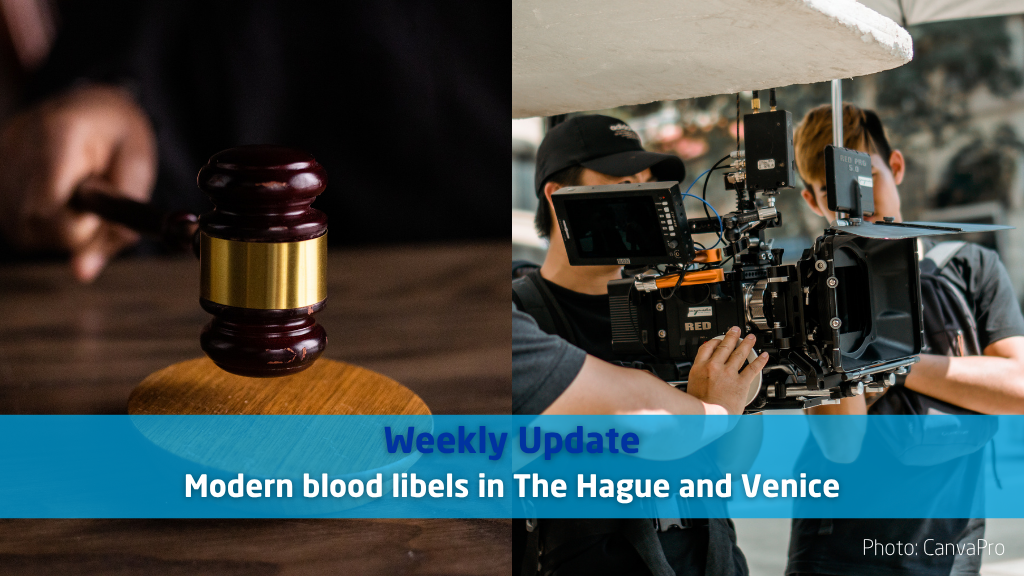
This week offers two illustrations, in very different arenas, of the same dynamic: institutions with real power to shape global opinion — a world court and a major film festival — are advancing narratives about Israel’s conduct that leave out the context needed to judge them fairly. In both cases, the conclusion has already been drawn: Israelis are child killers.
“”For the mouth of the wicked and the mouth of the deceitful are opened against me: they have spoken against me with a lying tongue. They compassed me about also with words of hatred; and fought against me without a cause.””
Psalm 109: 2–3
The International Courts in The Hague: Framing Israel as Genocidal Intent
The International Court of Justice in The Hague has become the forum for a witch-hunt against Jews. Those doing the hunting are devious in their methodology.
At the request of the Organisation of Islamic Cooperation (OIC), the small African state The Gambia filed a genocide case at the International Court of Justice (ICJ) against Myanmar in 2019 over the treatment of the Rohingya. A verdict is expected next month. On its face, this has nothing to do with Israel. But the international lawyers representing six NATO countries — the UK, France, Germany, the Netherlands, Denmark, and Canada — filed a joint brief in 2023 urging the Court to adopt a more expansive, “holistic” way of inferring genocidal intent, rather than requiring, as current ICJ precedent does, that genocidal intent be the “only reasonable inference” the evidence supports.
Several commentators have started to realise that this seems to be part of a deliberate strategy to use the Myanmar case as a lower-stakes test case to soften the genocide standard before the Court rules on Israel. Evidence of that scheme includes: The Gambia and South Africa have similar legal teams; and The Gambia appointed the South African jurist Navi Pillay as ad hoc judge, knowing full well that she chaired the UN Permanent Commission of Inquiry into Israel’s infringements of human rights (itself a kind of star chamber) that has already concluded that Israel committed genocide,
An analysis released this week by The Hague Initiative for International Cooperation (thinc.) argues that lowering the threshold for proving genocide will undermine efforts by Western states to counter terrorism, as their armies will be exposed to genocide charges whenever there are significant numbers of children killed or large-scale displacement of civilians.
It will also make it easier for the Court to condemn Israel for genocide, when it makes that decision in 2029. Two articles last weekend in the Wall Street Journal (WSJ) make the connection with Israel. An op-ed by law professor Orde Kittrie and former NATO chief legal adviser Andres Muñoz-Mosquera states plainly that lowering the threshold is “the express goal of some advocates” (for example former Human Rights Watch Director Kenneth Roth) specifically to “pave the way for a genocide finding” against Israel, and warns it would also expose the U.S., other NATO members, and their officials to genocide claims in foreign courts. They quote an unnamed ICJ litigator’s admission that activists must “shoehorn” claims into genocide because it’s the ICJ’s only real jurisdictional hook over a war — “it’s genocide, or it’s nothing.”
The WJS editorial board, writing September 11, draws a sharper factual distinction: Myanmar’s alleged mass executions of Rohingya civilians may genuinely satisfy the existing “only reasonable inference” test, but Gaza does not, given Hamas’s extensive tunnel network, theft of aid, and use of civilians as human shields — factors that make a defensive-war explanation at least as reasonable as a genocidal one. It notes South Africa’s own case needed an 18-month extension even from a sympathetic ICC prosecutor.
Notably, Fiji’s UN ambassador, Filipo Tarakinikini, has co-authored a more measured piece in the prestigious law blog Opinio Juris on September 14 with international law professors Geert-Jan Alexander Knoops and Gregory Rose, contending that the “only reasonable inference” test isn’t a loophole but is working exactly as designed: in urban warfare, legitimate military explanations for civilian harm will often exist, and a test that filters those out is doing its job. Their piece never mentions Israel directly, but its warning is the same one raised in the Wall Street Journal: once a court adjusts legal thresholds to fit a desired outcome in one case, it erodes the standard for every case that follows.
Venice Film Festival: NAZA and the Question of Context
At this year’s Venice Film Festival, the documentary NAZA — directed by Yuval Abraham and Rachel Szor — received a 25-minute standing ovation and the festival’s Special Jury Prize. The film draws on interviews with 24 anonymous Israeli soldiers and officers who allege that the killing of Gazan civilians was not the incidental cost of urban warfare but systematic and deliberate policy, driven, in the words of one unnamed interviewee, by “total dehumanization of Palestinians.”
It’s a serious charge, delivered to a standing ovation. But it’s worth looking closely at how the case is built.
Start with the sourcing: every accusation rests on anonymous testimony. No accuser is named, no service record is verifiable, and the IDF itself says it cannot confirm whether these individuals served, in what unit, or in what capacity. An allegation of mass atrocity that can’t be checked, contested, or falsified is testimony that asks to be taken on faith rather than evidence that can be tested.
The claims are also unverified by any independent standard — no forensic investigation, no corroborating documentation, no cross-examination, only edited interviews assembled into a narrative.
Most significantly, the film leaves out context that would let viewers weigh the claims fairly. It doesn’t address that Hamas fighters routinely operated in civilian clothing, from tunnels beneath homes, hospitals, and schools, making combatants and civilians difficult to distinguish in real time. It doesn’t engage the argument made by West Point’s John Spencer and other urban-warfare scholars, that weighing expected civilian harm against military necessity isn’t evidence of malicious intent — it’s a calculation international humanitarian law actually requires commanders to make before every strike. And it omits evidence cited by former Ambassador Michael Oren that the IDF “did their utmost to minimize civilian casualties.”
None of this means IDF conduct is beyond scrutiny; legitimate questions about specific strikes deserve serious investigation. But a film built entirely on unnamed sources, without independent verification, and without operational context, isn’t well equipped to settle that question — it’s equipped to produce a verdict before the facts are fully in. Critics have already drawn the comparison to Jenin, Jenin, the 2002 film that shaped international opinion on the Battle of Jenin long before the more measured facts caught up with it.
What does this mean for Christians?
Christians watching a court reshape a legal standard, or a film festival reward an unverifiable narrative, are watching a very old tactic in modern dress. The right response is never panic, and it isn’t silence either — it was Nehemiah’s plain denial: “There are no such things done as thou sayest.” We must speak out against those who propagate lies and misinformation against God’s people.
And we should pray that we will be given a spirit of discernment, that eyes will be opened to see what is really happening.
Scripture promises: “No weapon that is formed against thee shall prosper… this is the heritage of the servants of the LORD” (Isaiah 54:17).
Prayer
This week, let us pray that those who spread lies and disinformation concerning the Jewish people will be confused and defeated.
Pray that the courts in The Hague and around the world will speak justice in truth. Pray for the judges, who are confronted with lies, that they will have discernment, courage and wisdom.
Pray for the coming of the Messiah, and the coming of the kingdom, when justice will be done, truth will prevail, and the law will go out from Jerusalem.
‘Fighting NAZA like Jenin, Jenin
Michael Oren on Substack: Trying to convince the world that the documentary is rife with falsehoods will hardly mitigate the damage it will inflict on Israel’s image. No one in that rarefied Venetian audience will be convinced that Israel is anything other than genocidal.
Will Another Global Court Ruin Itself?
If the International Court of Justice lowers the threshold for genocide to smear Israel, it will backfire.
The ICJ’s Pernicious Plan to Redefine Genocide
The Trump administration may soon have reason to dismantle another international tribunal.
Hard Facts and the Threshold: What the Gambia v. Myanmar Should Not Decide
Genocide law is prescribed and the Court should apply the standard it has. It should not adjust it because the facts are terrible. That the facts are terrible is precisely when the standard is worth having.
SCRIPTURE FOR THE WEEK: Esther 3:8–9
8-9 "There is a certain people scattered abroad and dispersed among the people in all the provinces of thy kingdom; and their laws are diverse from all people; neither keep they the king's laws: therefore it is not for the king's profit to suffer them. If it please the king, let it be written that they may be destroyed..."
Ezra 4:12–13
12-13 “Be it known unto the king, that the Jews which came up from thee to us are come unto Jerusalem, building the rebellious and the bad city... if this city be builded, and the walls set up again, then will they not pay toll, tribute, and custom, and so thou shalt endamage the revenue of the kings."
Psalm 109:2–3
2-3 "For the mouth of the wicked and the mouth of the deceitful are opened against me: they have spoken against me with a lying tongue. They compassed me about also with words of hatred; and fought against me without a cause."
Why Israel? by Rev. Willem Glashouwer
Order the book