Shavuot: Why Law and Sovereignty are Important
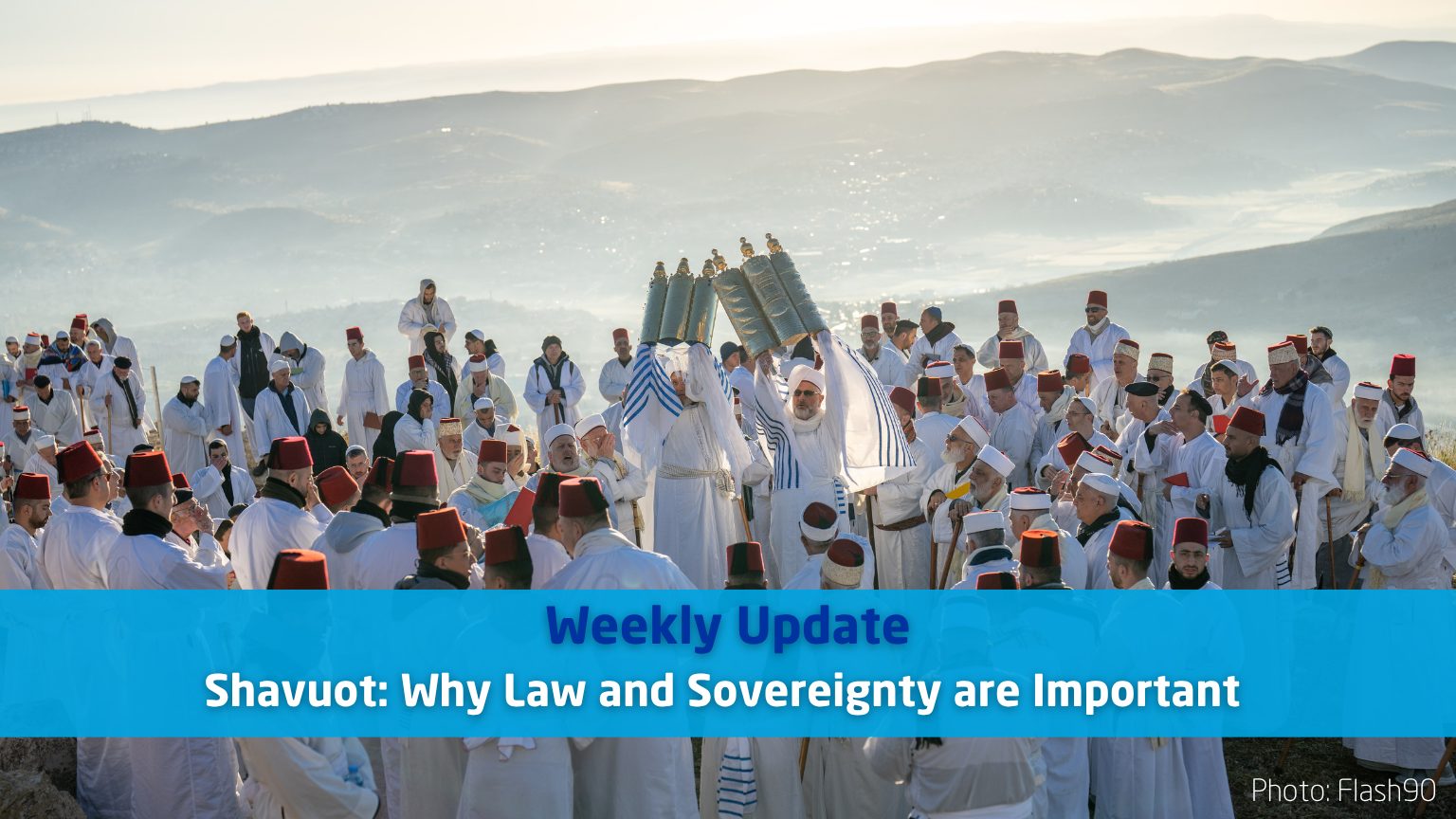
Shavuot is one of the three Jewish pilgrimage festivals that the Jewish people were called by God to celebrate in Jerusalem. Shavuot marked the wheat harvest in the land of Israel (Exodus 34:22). Rabbinic tradition teaches that the date also marks the revelation of the Ten Commandments to Moses and the Israelites at Mount Sinai, which occurred at this date in 1312 or 1313 BCE.
The word Shavuot means 'weeks' in Hebrew. Its date is directly linked to that of Passover, as Torah mandates the seven-week Counting of the Omer, beginning on the second day of Passover, to be immediately followed by Shavuot. This counting of days and weeks is understood to express anticipation and desire for the giving of the Torah. On Passover, the people of Israel were freed from their enslavement to the Egyptians; on Shavuot, they were given the Torah and became a nation committed to serving God.
This suggests an apparent paradox. Surely, submitting to the slavery of the law imposed by God was an infringement on the newly-won freedom from slavery to the Egyptians?
How can freedom and law be compatible?
The answer has to do with the concepts of responsibility and sovereignty. Michael Oren explained this well in his recent article on Shavuot:
- “But weren’t they already free? And by accepting the law, weren’t they forfeiting much of their freedom? So, logic would hold, but divine wisdom and the man who conveyed it, Moses, reasoned differently. They understood the fundamental requirements of a just and stable society. They understood that the sine qua non of such a society is law. They knew—inherently, incontrovertibly—that genuine freedom comes only with responsibility.
- For freedom without law, without limits, and without people taking responsibility for their actions, is not freedom but anarchy. And law without decision-making, without the freedom to make choices and take responsibility for them, is totalitarianism. Ideally, freedom and the law are in constant balance, mutually reinforcing, and preserving.
- Maintaining that equilibrium, though, necessitates a framework. To equitably apply the law and exercise freedom, a people needs a state. That is the message of much of the Torah after Exodus 20-23. Take, for example, Deuteronomy 16, in which the Children of Israel are told: ‘You must appoint judges and sheriffs for yourselves in all your cities that God, your God, is giving you, for each of your tribes. They must judge the people by rendering fair judgments… Justice, justice must you pursue, in order that you live and take possession of the land that God, your God, is giving you.’
- These words are not meant for nomads wandering the trackless desert but for a free people living as a sovereign nation. Only in such a framework can they decide who will best govern them and when and how to be just. Waging war, applying penal codes, designating cities of refuge—all are responsibilities that can only be fulfilled to the maximal extent in a situation of sovereignty. Freedom and responsibility are not only the products of sovereignty but also its perquisites.
- For the Children of Israel, gaining freedom from Egypt and accepting the Law were insufficient. To fully relish the first and effectively enforce the latter, they needed to inherit the land. They needed to cease wandering, sink indigenous roots, and begin to take responsibility. In short, they had to be Zionists.”
So here we see why Zionism is so hated by many secular humanists. Their obsession with freedom as goal in itself causes them to be blind to the truth that, because of human frailty, we humans need God’s laws in order to experience the blessing of freedom.
Those who hate Zionism hate the idea that God gave His laws to the Jews. They hate God himself.
Judea and Samaria
This leads us to the vexed question of sovereignty over Judea and Samaria, often called “the West Bank”. Since the fall of the Ottoman empire in WWI, there has been a vacuum of sovereignty. The British (1922-1948) had control, but not sovereignty. The Jordanians (1948-1967) also exercised control, but not true sovereignty. Since 1967, Israel has exercised sovereignty over the city of Jerusalem (including the Old City and its environs), but (under international pressure) has refrained from exercising sovereignty over Judea and Samaria.
The result of a lack of sovereignty is the chaos and violence we witness in Judea and Samaria today. The Palestinians are angry because they are treated as second-class people, and cannot exercise self-government. Israel is required to impose increasing military repression to stop this violence. It is a vicious circle.
The world – and even many Jews – are obsessed with preventing the Jewish people from exercising sovereignty over Judea and Samaria (the so-called “occupied territories”). At the same time, we see Israel increasingly asserting a kind of sovereignty over Judea and Samaria.
Times of Israel reports:
- “The [Israeli] government on Wednesday approved a NIS 250 million ($86 million) plan for the preservation and development of heritage and archaeological sites in the West Bank, as coalition members continued holding marathon sessions in the Knesset Education, Culture and Sports Committee to prepare a controversial bill seeking to extend Israeli civilian control over antiquities in the West Bank and Gaza for its final votes. According to a joint statement by the Prime Minister’s Office, Finance, Tourism, Heritage, and Settlement ministries, the plan includes the establishment of new heritage centers and tourism infrastructure, as well as funding for efforts to combat looting and vandalism. ‘In the year in which we will mark 60 years since the liberation of Judea, Samaria and Jerusalem, the heart of our homeland, the government of Israel is making a decision of the highest national and historical importance,’ Prime Minister Benjamin Netanyahu said, using the biblical name for the West Bank.”
This is a sign that the Jewish people realize that they have a responsibility to take care of their homeland – including Judea and Samaria. That responsibility is core to their nationhood.
It is the blindness of the nations – who are obsessed with keeping control of Jerusalem – that is preventing them from doing so.
At the end of the day, the people in the land – Jews and non-Jews – will only experience true blessing when the Jewish people exercise true sovereignty over the land.
Sovereignty gives not only rights; sovereignty under law imposes the responsibility to care for all people. When Israel takes full responsibility for the land that God has given them to care for, and fulfils the commands given to them to “pursue justice”, the world will realize that Zionism is not the enemy, but the real source of blessing – also for the Palestinians.
The festival of Shavuot reminds both Israel and the nations that Jerusalem will no longer be a “stone of contention” and a “cup of trembling” (Zechariah 8 and 12), but “a house of prayer for all nations” (Isaiah 56), and the source of blessing for the world.
This week, let us pray for the leaders of Israel as they consider the future of their nation and the land. Pray also for the leaders of all nations, that the blindness that covers them will be removed, and they will abandon the failed “land for peace” formula but recognize that true blessing for all in the land will only come when there is true sovereignty. Pray for peace and prosperity for all in the land – Jews and non-Jews.
Let us continue to pray for the peace of Jerusalem, and the speedy coming of the Messiah of Abraham, Isaac and Jacob. He alone can usher in a kingdom of peace and righteousness.
Can Jews and Palestinians Ever Live Together in Judea and Samaria?
The West Bank — or Judea and Samaria, depending on who you ask — is one of the most contested regions in the world. But beyond the politics and headlines, real people live there. Jews and Palestinians, side by side, yet worlds apart.
Leon Meijer, executive director of Christians for Israel International spoke with residents on the ground to understand what daily life actually looks like, what motivates Jewish settlers to live there, and whether coexistence is truly possible — or simply an idealistic dream.
West Bank, Gaza antiquities bill advances as government okays $86 million heritage plan
Times of Israel: “Knesset committee working to finish controversial legislation, which critics say would mark an unprecedented step toward annexation, for final votes in the plenum on Sunday.”
Land, Law, and Freedom: Why Shavuot is THE Zionist Holiday
Michael Oren: “The Children of Israel’s achievement at Sinai—and the goals of the earliest Zionist thinkers.”
The Plan to Eliminate Israel
Khaled Abu Toameh at Gatestone: “The newly uncovered message reveals that the October 7 invasion was never intended to be a limited or isolated terrorist attack. It was conceived as the opening phase of a much broader regional war aimed at destroying Israel and replacing it with an Islamist entity backed by the Iranian regime and its proxies. According to documents captured by the IDF, Hamas leaders had already begun formulating plans for a multi-front war against Israel as early as 2022.”
SCRIPTURE FOR THE WEEK:
Isaiah 56:1-81 This is what the Lord says: "Maintain justice and do what is right, for my salvation is close at hand and my righteousness will soon be revealed. 2 Blessed is the man who does this, the man who holds it fast, who keeps the Sabbath without desecrating it, and keeps his hand from doing any evil." 3 Let no foreigner who has bound himself to the Lord say, "The Lord will surely exclude me from his people." And let not any eunuch complain, "I am only a dry tree." 4 For this is what the Lord says: "To the eunuchs who keep my Sabbaths, who choose what pleases me and hold fast to my covenant- 5 to them I will give within my temple and its walls a memorial and a name better than sons and daughters; I will give them an everlasting name that will not be cut off. 6 And foreigners who bind themselves to the Lord to serve him, to love the name of the Lord , and to worship him, all who keep the Sabbath without desecrating it and who hold fast to my covenant- 7 these I will bring to my holy mountain and give them joy in my house of prayer. Their burnt offerings and sacrifices will be accepted on my altar; for my house will be called a house of prayer for all nations." 8 The Sovereign Lord declares- he who gathers the exiles of Israel: "I will gather still others to them besides those already gathered."