The US-Iran Ceasefire Ends, and Israel Heads to the Polls
The past week brought the collapse of the fragile U.S.-Iran ceasefire, a fatal Israeli strike in southern Lebanon that further undermines the newly signed framework agreement there, a symbolic but hollow handover of power in Gaza, and the formal countdown to Israeli elections.
Four fronts, one common thread: none of the diplomatic architecture built over the past two months is holding.
Iran-US: The Ceasefire Collapses
The Islamabad memorandum of understanding, signed with fanfare on 17 June, did not survive three weeks. On 6-7 July, Iranian forces attacked three commercial vessels transiting the Strait of Hormuz. The United States responded with what Central Command called a series of “powerful strikes,” hitting more than 80 targets across Iran, including the perimeter of the Bushehr nuclear plant and the area around Kharg Island – the terminal that handles roughly 90% of Iran’s crude oil exports. Iran’s health ministry reported 14 killed and 78 wounded. Tehran retaliated by striking U.S.-linked infrastructure in Kuwait and Bahrain and a satellite antenna in Qatar; Jordan intercepted eight Iranian missiles overnight with no reported casualties.
Asked directly about the status of the MOU, President Trump speaking during the NATO top in Ankara was unambiguous about the Iranian leadership: “I think it’s over. They are scum. I don’t want to deal with them anymore.” The U.S. Treasury has withdrawn the sanctions waiver that had allowed Iran to sell oil on the open market, and Trump has revived his earlier threats to strike Iranian infrastructure and to seize Kharg Island outright – “there’s not a thing they can do about it,” he said. Oil prices rose more than 5% within minutes of his remarks. Israel’s defence establishment has placed the IDF on elevated readiness, watching for signs the renewed U.S.-Iran conflict draws Israel back in; American refuelling aircraft, withdrawn from the region during the ceasefire, are reportedly returning.
It is worth recalling what this newsletter noted when the MOU was first signed: the agreement left Iran’s missile programme and its financing of proxies untouched, deferred the nuclear file rather than resolving it, and rested on Tehran’s willingness to accept a settlement it had never truly conceded to. Three weeks on, Iran’s leadership – now formally under Mojtaba Khamenei, who has not appeared in public since his installation as Supreme Leader in March following his father’s death in the February strikes that opened this war – has shown it still regards control of Hormuz as worth the risk of renewed American bombardment. The stalemate this newsletter described a month ago has simply resumed, on worse terms.
Israel: Countdown to Elections
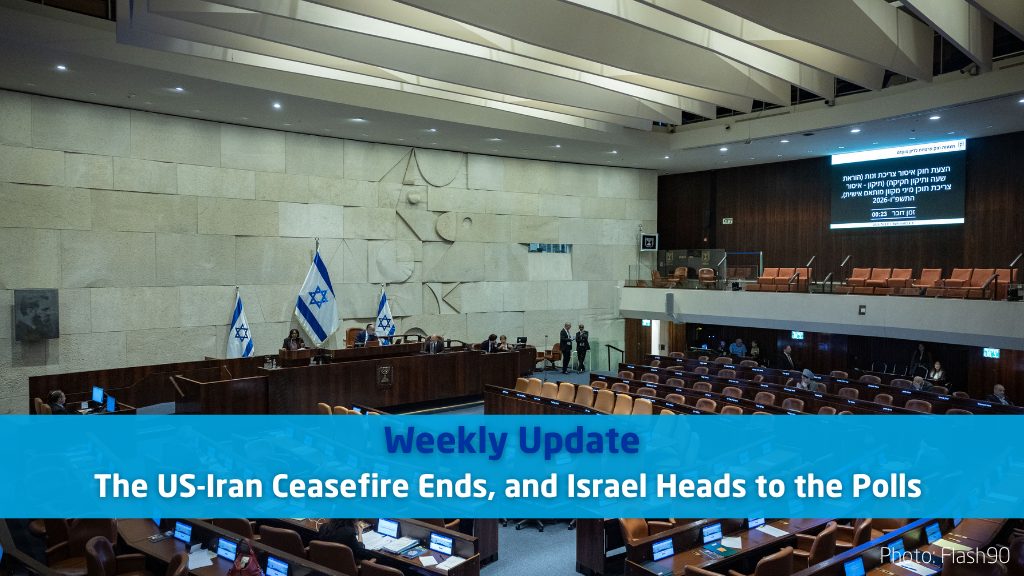
The Knesset is expected to dissolve on 17 July, setting Israel on course for national elections on 27 October – the latest date permitted by law. The coalition is racing to pass its remaining legislative priorities before recess, chief among them a Basic Law declaring Torah study a foundational value of the State, which passed its first reading 63-53 on the strength of ultra-Orthodox United Torah Judaism and Shas votes. The bill is designed to shield Haredi draft evaders from sanction and prosecution – the same conscription dispute that has convulsed the coalition for two years, after the Supreme Court struck down the previous exemption framework as unconstitutional.
The conscription fight has already claimed a senior figure on the Right. Yuli Edelstein, who as Foreign Affairs and Defense Committee chairman had drafted a compromise Haredi conscription bill before being removed from that post, left Likud on 1 July to “forge a new political path,” breaking with the government over the exemptions he was ousted for challenging. On 7 July a new electoral alliance, reportedly named Foundations of Israel, was announced, pairing former Likud figure Gideon Tropper with Yoaz Hendel’s Reservists Party – one of several new formations jockeying for position on a crowded right-of-centre map.
Polling remains difficult to read. One survey this week found 53.3% of respondents naming Netanyahu the figure best suited to be prime minister – more than double his nearest rival, Gadi Eisenkot, at 26.5% – with Likud projected to lead the field and the current coalition holding a narrow 63-57 seat edge. Other polling continues to show a majority of the electorate favouring parties outside Netanyahu’s coalition, a majority that, as in previous cycles, has not coalesced around any single alternative government. The defining issue of the campaign remains responsibility for the failures of 7 October 2023: the opposition is demanding a state commission of inquiry, which Netanyahu continues to resist in favour of narrower internal reviews.
Israel-Lebanon: The Framework Unravels Before It Starts
Barely two weeks after Secretary of State Marco Rubio announced the U.S.-brokered framework agreement for “lasting peace and security” between Israel and Lebanon, an Israeli strike on a vehicle in Nabatieh al-Fawqa in southern Lebanon killed at least four people this week, including a school principal, her mother, a foreign domestic worker and a Syrian national. Lebanese officials say this violate a ceasefire that formally began on 21 June under the terms of the wider U.S.-Iran memorandum of understanding.
Israel argues that the ceasefire’s own terms explicitly preserve Israel’s right to act against “imminent or ongoing threats” even while formally refraining from offensive operations. Israeli officials cite this clause to justify strikes, framing them as defensive rather than a breach. Israel also says Hezbollah has continued rocket, drone, and anti-tank missile attacks on Israeli troops and the north, and that it is rebuilding its weapons stockpiles and military infrastructure in southern Lebanon in violation of the deal’s requirement that Lebanon prevent Hezbollah from operating there. Netanyahu has repeatedly ordered the IDF to “respond forcefully” or “with force” to what he calls Hezbollah provocations, arguing Hezbollah is trying to “sabotage” a historic Israel-Lebanon peace process. Israel insists it is only targeting specific Hezbollah commanders, weapons depots, or infrastructure “used for military purposes,” citing precision munitions and prior evacuation warnings to minimize civilian harm.
The framework itself envisions a “sequenced process” in which the Lebanese Armed Forces reassert sovereign control across Lebanon, contingent on the verified disarmament of Hezbollah – with no requirement that Israel withdraw from the roughly one-fifth of Lebanese territory it currently holds until that disarmament is complete. Netanyahu has said Israeli forces will remain in the buffer zone “until Hezbollah disarms.” Hezbollah’s leadership has declared the agreement “null and void”; Secretary-General Naim Qassem called it “absurd, humiliating, and insulting” and reiterated that Hezbollah will not disarm and will continue to fight so long as Israeli operations persist.
Israeli and Lebanese negotiating teams are due in Rome on 14-15 July for working-group talks on border disputes and implementation mechanics. Behind the scenes, Israel is reportedly drafting a comprehensive “full-fledged peace agreement, A-Z” with Lebanon – not for immediate signature, but to be ready “on the shelf” for the day Hezbollah is no longer a factor. That day shows no sign of arriving soon. As long as Hezbollah’s survival as an armed force is politically indistinguishable from its survival as an institution within the Lebanese state, disarmament by consent looks no more likely now than it did a month ago.
“Settler violence” in the West Bank
A report published 7 July by the Israeli watchdog groups Peace Now and Kerem Navot found that Israeli settler outposts now control nearly one-fifth of the West Bank – described by the authors as an “unprecedented” expansion of de facto control achieved largely outside formal annexation votes, through outpost growth, retroactive legalisation, and administrative measures that steadily narrow Palestinian Authority jurisdiction. Finance Minister Bezalel Smotrich has openly framed annexation of up to 82% of the West Bank as a policy goal; critics describe settler violence as the enforcement arm of that strategy on the ground.
Organisations such as B’Tselem, Peace Now, Human Rights Watch and the UN Office for the Coordination of Humanitarian Affairs (OCHA) argue there has been a recent surge in “settler violence”, maintaining their data reflect genuine, verified incidents and describe settler attacks as a systemic, escalating problem with the tacit or active involvement of Israeli authorities. However several writers and organizations criticize their methodology, arguing the “settler violence” narrative is overstated. For example David Litman at CAMERA has published the most data-driven version of this argument. Using the same UN OCHA “settler-related incidents” data that outlets like CNN, the Washington Post, and BBC cite, his 2025 article argues settler violence is driven predominantly by a surge in Palestinian attacks on Israelis (tracked via Shin Bet data), not the reverse. He also flags that OCHA’s own definition of “settler-related incidents” includes alleged attacks, access-prevention incidents, and clashes triggered by Palestinians attacking settlers — and cross-checking B’Tselem’s own named list of Palestinians killed in such incidents, he found most were killed while carrying out stabbing, shooting, or car-ramming attacks, or infiltrating Israeli communities armed.
The point isn’t that settler violence never happens, it clearly does – and that is a problem that Israel must address strongly and unambiguously. But that the widely cited numbers are inflated by counting non-violent or Palestinian-instigated incidents as “settler violence,” that fatality statistics blur armed attackers with civilian bystanders, and that media coverage strips out the preceding Palestinian attacks and the broader terrorism baseline that would otherwise contextualize the figures.
Gaza: Facts on the Ground, Not on Paper
In Gaza, Hamas announced on 6 July that it had dissolved its governing administration and would transfer civil authority to a technocratic committee based in Cairo and chaired by Ali Shaath, a Gaza-born engineer and former Palestinian Authority official, operating under UN and Board of Peace supervision. The move was met with open scepticism: the Board of Peace said it would judge the handover “by actions, not promises,” and an Israeli official dismissed it outright as “a spin that has no significance.” Nine months into the ceasefire, the substantive question – Hamas’s disarmament – remains unresolved. A new mediator proposal reportedly under discussion would have Israeli-backed militias in Gaza disarm alongside Hamas, while rehabilitating roughly 10,000 members of Hamas’s police force to keep order in the Strip – an arrangement that, if it materialises, would leave armed Hamas-linked structures intact under a different name. Israel has continued to strike targets in the more than half of Gaza it still holds, saying it is acting against operatives who threaten its troops.
This week, let us pray for the people of Israel, and for their leaders as the nation heads toward an election. Pray for the enemies of the Jewish people. Above all, let us continue to look to God and trust that He will fulfill His promises. Pray for the peace of Jerusalem, and the speedy coming of the Messiah of Abraham, Isaac and Jacob. He alone can protect His people, and usher in a kingdom of peace and righteousness.
US launches second night of strikes against Iran, as Israel said bracing for war to restart
The Times of Israel: Israeli security officials are closely watching the escalating U.S.-Iran conflict, anticipating it could rapidly widen and draw Israel back into direct fighting.
> Read more..
Israeli attack on vehicle in Lebanon kills at least four
Al Jazeera: A strike on a car in Nabatieh al-Fawqa killed a school principal, her mother, a domestic worker and a Syrian national, the latest in a series of Israeli strikes since the 21 June ceasefire.
> Read more..
Israeli settler outposts now control nearly a fifth of West Bank, report says
Haaretz: A new Peace Now and Kerem Navot report describes an “unprecedented” expansion of outpost control across the West Bank, achieved largely outside formal annexation procedures.
> Read more..
The Settler Violence Myth
Gadi Taub in Tablet: How a flawed narrative about Jewish settlers in Judea and Samaria became a global campaign—and a weapon against Israel.
> Read more..
Hamas dissolves its government in Gaza to transfer power to a UN-backed committee
AP/PBS: Hamas says it has dissolved its civil administration and is preparing to hand power to a Cairo-based technocratic committee – a move the Board of Peace says it will judge “by actions, not promises.”
> Read more..
Netanyahu best suited as next prime minister, likely to form new gov, new poll suggests
JNS: A new survey finds Netanyahu far ahead of his rivals as preferred prime minister, with his coalition projected to hold a narrow Knesset majority – even as other polling shows most voters favour parties outside it.
> Read more..
The Arithmetic of Bias: CNN’s West Bank coverage
David Litman at CAMERA in 2025: CNN’s coverage of violence in the West Bank is a pattern of misleading coverage that is doing a tremendous disservice to the network’s audience. CNN’s coverage, with all its demonstrable biases, simply does not reflect reality. Media consumers concerned with truth and accuracy should demand more from the network.
> Read more..
SCRIPTURE FOR THE WEEK: Psalm 46:1-3, 4-7, 10-11
God is our refuge and strength, an ever-present help in trouble. Therefore we will not fear, though the earth give way and the mountains fall into the heart of the sea, though its waters roar and foam and the mountains quake with their surging. There is a river whose streams make glad the city of God, the holy place where the Most High dwells. God is within her, she will not fall; God will help her at break of day. Nations are in uproar, kingdoms fall; he lifts his voice, the earth melts. The Lord Almighty is with us; the God of Jacob is our fortress. Come and see what the Lord has done, the desolations he has brought on the earth. He makes wars cease to the ends of the earth. He breaks the bow and shatters the spear; he burns the shields with fire. He says, “Be still, and know that I am God; I will be exalted among the nations, I will be exalted in the earth.” The Lord Almighty is with us; the God of Jacob is our fortress.
Why Israel? by Rev. Willem Glashouwer
Order the book