Three Small Miracles for Adina
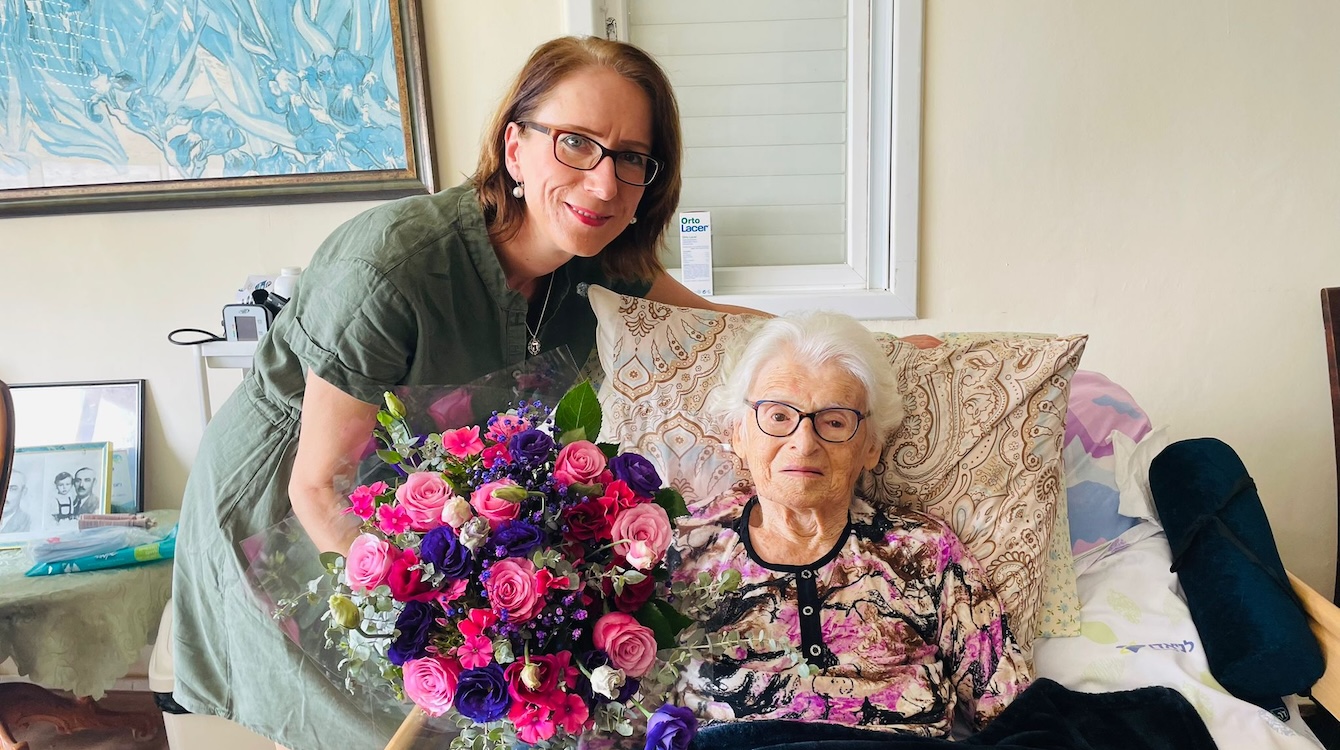 Anemone Rüger (C4I) with Adina, who turned 101 in November. Raised in the Carpathian Mountains, Adina rebuilt her life in the US after the Shoah before immigrating to Israel at the age of 81. | Photos: C4I
Some of the most precious encounters happen spontaneously—encounters with survivors whom we would never meet at an event due to their age. Many of our project partners are descendants of Holocaust survivors, including Yonatan, who told me about his 100-year-old grandmother in Netanya during a visit to the Jaffa Institute.
The so-called expressway to the north, which is lined with construction sites slowing down traffic even on weekends, leads through Netanya. I want to try to find a parking space, a flower shop, and Adina, Yonatan’s grandmother, in the congested city center. Three small miracles for a precious and healing moment.
“Adina is being cared for by a young woman from India who has learned Hebrew for her”
Adina is resting on her daybed as she is feeling weak. She is being cared for by a young woman from India who has learned Hebrew for her. Still a beautiful woman, this lady with such a special charisma has lived through a whole century of human history!
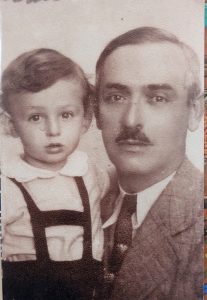
Adina’s father with her younger brother, Shmil. Both were murdered in the Holocaust | Photo: Private
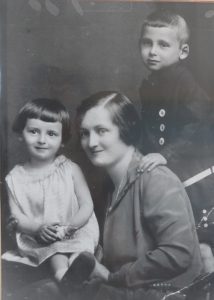
Childhood photo of Adina with her mother and her older brother, Hersz | Photo: Private
That’s my dad in the photo, and my brother is to his left. And in the other photo, that’s me with my mother,” Adina explains. The nurse has hung the photos opposite Adina’s bed so that she can always see them.
I tell Adina about my family, about the many Christians in Germany who love the Jewish people, about my work. “That’s very nice,” Adina says repeatedly in a soft voice; every sentence obviously takes a lot of effort. The bright flowers make her face light up.
When I read her the card with the verse from Isaiah 62, she quietly repeats each word: “You will be a beautiful crown in the hand of the Lord…” Then she whispers with all her strength: “You can’t imagine how happy I am that you visited me!” Only afterwards do I learn her whole story from her grandson Yonatan.
From the Carpathians to Auschwitz
“My grandmother was born in 1924 in a small village called Svaliava near Mukachevo in the Carpathian Mountains; at that time it was Czechia, today it is Ukraine,” Yonatan tells me. “She was the middle child of three. Her older brother, Hersz, is with her in the photo with their mother. Her younger brother, Shmil (Schmuel), can be seen in the photo with his father. They were wealthy and had a large house. Their father, Yitzchak, was often away on business in America, and Malka, their mother, stayed with the children.”
“You can’t imagine how happy I am that you visited me!”
When the war broke out, Yitzchak returned to be with his family. He was immediately deported to a labour camp, where he perished. Adina’s older brother also disappeared in a labour camp.
“My grandmother was already 18 when the Germans invaded the area,” Yonatan continues. “She was deported to Auschwitz with her mother and younger brother. She remembers that they had to line up in front of a certain Mengele. Then Shmil, her younger brother, was pulled out. He was maybe eight or nine. Malka started crying and ran after her son. So they both went together into the line for the gas chamber.
“My grandmother didn’t understand what was happening. She was desperate to avoid being separated from her family. ‘Do you see the smoke over there? That’s where they’re being taken,’ one of the prisoners said to her. She had to work in the crematorium until liberation. Her job was to examine the bodies after they had been gassed to see if they were wearing any gold.”
I can hardly breathe listening to Yonatan telling me this unbelievably tragic story so matter-of-factly on the phone. I would love to drive back to Netanya right now.
“My grandmother never talked about it. But my mother grew up with her mother screaming in her sleep every night from nightmares and crying for her family. She always needed strong sleeping pills to be able to fall asleep.”
“Someone tapped her on the shoulder. It was Hersz, her brother”
A New Start in America
After the war, Adina was taken to Hungary with other survivors; a year later, she boarded a ship to the United States. By then, she was 22 years old and alone in the world. A Jewish couple from Minnesota adopted her, gave her a new home, and helped her train as a kindergarten teacher—a profession she pursued with great passion throughout her life. She eventually moved to New York, where a large community of Holocaust survivors had formed. She was still haunted by the question of what had become of her older brother.
“One day, she was standing in line at the checkout in a store,” Yonatan recounts. “Someone tapped her on the shoulder. It was Hersz, her brother, two years her senior. He had been searching for her for a long time. He then took care of her for the rest of his life. He already owned several bars in New York and had achieved a certain level of prosperity. He visited her every Shabbat. And every few years, he bought her a car, even though she already had a family and was well provided for. He supported her as a big brother until the end of his life 17 years ago.”
Aliyah at 81
After 30 years, Adina moved with her family to Florida, where she stayed for another 20 years. When she was already well into retirement, she decided—at the age of 81—to make Aliyah with her 90-year-old husband and follow their two daughters to Israel. She had already learned Hebrew in her hometown in the Carpathians.
“Grandma Adina always had guests for Shabbat,” Yonatan recalls. “When we used to visit her in the US, she often had 10 or 15 guests at the table who had no one else.”
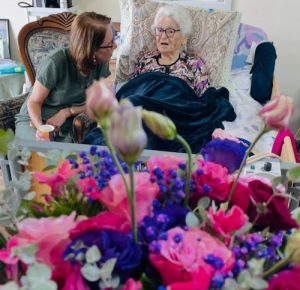
Anemone Rüger (C4I) and Adina | Photo: C4i
When Yonatan receives the photos of the flowers from the nurse a few minutes after my visit, he thanks me warmly. “What you did for my Grandma is incredible!” Really? I am humbled by his words. In relation to Adina’s story, what I did seems to be less than nothing. Now that he has told me the whole story, I just want to cry. And go back there again. But at the same time, I know that God takes the little we have and turns it into something divine.
Please support the Holocaust Survivors in Israel. Any amount is welcome.
Support in €
Support in US $

Why Israel? by Rev. Willem Glashouwer
Order the book