Decision-time for the nations

The Scriptures are full of promises that in the last days the Lord will in His mercy bring His people, who will have been scattered among the nations, home to the mountains of Israel. He said He would do this not because the Jewish people are so numerous or because they are more holy than other people. He does it because He is faithful to His word, because He wants to show mercy to His people and cleanse them of their sins, and because the restoration of His people is a sign to the nations of God’s Holiness and sovereignty. For example, in Ezekiel 36 we read:
“Therefore say to the Israelites, ‘This is what the Sovereign Lord says: It is not for your sake, people of Israel, that I am going to do these things, but for the sake of my holy name, which you have profaned among the nations where you have gone. I will show the holiness of my great name, which has been profaned among the nations, the name you have profaned among them. Then the nations will know that I am the Lord, declares the Sovereign Lord, when I am proved holy through you before their eyes. “‘For I will take you out of the nations; I will gather you from all the countries and bring you back into your own land. I will sprinkle clean water on you, and you will be clean; I will cleanse you from all your impurities and from all your idols. I will give you a new heart and put a new spirit in you; I will remove from you your heart of stone and give you a heart of flesh. And I will put my Spirit in you and move you to follow my decrees and be careful to keep my laws. Then you will live in the land I gave your ancestors; you will be my people, and I will be your God.
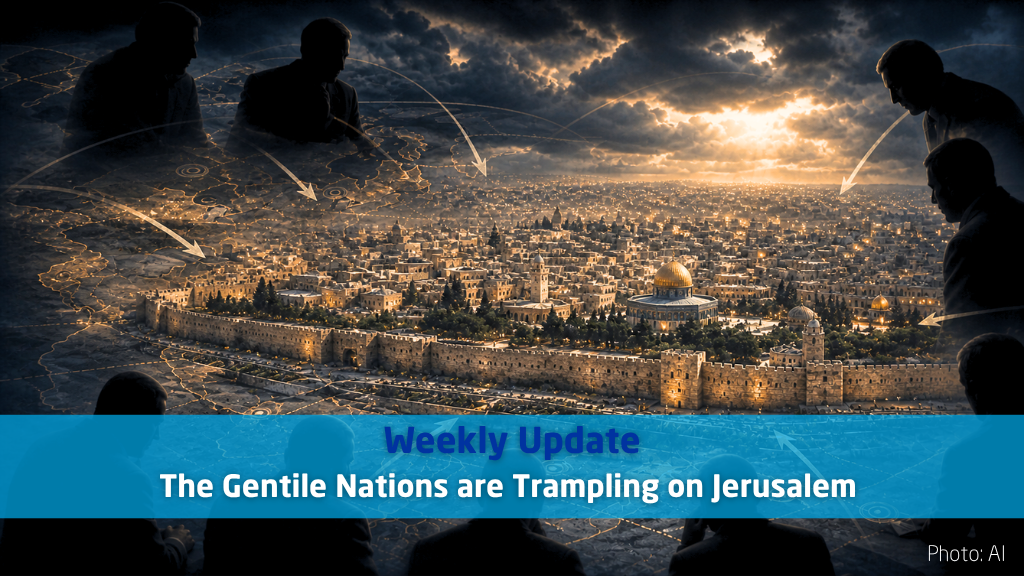
The Bible tells us that the restoration of God’s people to the land will present the nations with a choice – do they align themselves with God’s plans, or do they oppose them? It will be a time when nations must make a choice. One of the points of contention will be the status of the land, especially Jerusalem; some countries will seek to divide the land, and it is possibly these nations who will prepare to go up against Jerusalem (Zechariah 12), while on the other hand “many peoples and powerful nations will come to Jerusalem to seek the Lord Almighty and to entreat him” (Zechariah 8:22).
We need to remember this bigger picture when we watch events in the world regarding Israel and its relations with our nations. There can be little doubt that we are witnessing the fulfilment of prophecy, although we cannot always be sure exactly where we are on God’s timetable, or what the precise sequence of events will be.
With that in mind, this week we look at current developments concerning Israel’s relationship with the nations.
Confronting Iran While Losing Ground in the West
Over the past week, two fronts moved in opposite directions. The first concerns Israel’s military confrontation with the revolutionary regime in Iran, and its proxy Hezbollah in Lebanon. Six months after the war that killed Khamenei, Washington is betting it can finish the job against Iran with sanctions rather than military campaigns — even as Tehran answered with missiles and drones against three U.S.-aligned Gulf states in 48 hours. The second front concerns Israel’s relations with Western-oriented countries. Here we see that Israel’s own diplomatic standing with the West kept eroding, as the fallout from the E1 settlement plan continued to isolate Jerusalem from allies it fought alongside against Iran only months ago. UK, France, Germany, Italy, the Netherlands, Canada and Norway are, together with Ireland, Spain and Belgium, becoming the most vociferous critics of Israel’s presence and activities in the so-called “occupied Palestinian territories”. At the same time, Israel is strengthening relations with countries like Greece, Venezuela and Finland.
Iran: The Economic War Opens, Then the Guns Come Out Again
Six months on from “Operation Roaring Lion/Epic Fury” — the joint Israeli-U.S. campaign that killed then-Supreme Leader Ali Khamenei in its opening strike on February 28 — a lengthy JNS analysis this week captured where the confrontation actually stands: Iran “battered, bruised and degraded” but entrenched, with no nuclear deal in sight, and Israel “waiting in the wings” for a possible next round. The six-week war saw Israel drop roughly 19,000 munitions and the U.S. about 17,000, causing an estimated $100 billion in damage; Iran fired some 550 missiles at Israel and 850 more at Gulf states. A ceasefire declared in April collapsed repeatedly, an MOU signed at Versailles in June expired unfulfilled on August 17, and Washington has since pivoted to what Treasury Secretary Scott Bessent calls “Operation Economic Outcast” — an “unprecedented, whole-of-government” sanctions campaign meant to “collapse every last option for Iran.” Netanyahu’s public reaction was notably restrained, thanking Trump and Bessent for exacting “a steep price from that cruel dictatorship” rather than pressing for renewed strikes.
Tehran’s answer arrived within days. On the night of August 30-31, U.S. forces struck Iranian Revolutionary Guard Corps minelaying units it said were threatening shipping in the Strait of Hormuz; Iran retaliated by firing on Jordan, where air defenses intercepted eight missiles, and by sending drones at the UAE’s Al Minhad Air Base. By September 1, the exchange had widened into what Iranian state media called a “decisive operation”: further missiles and drones aimed at U.S.-linked targets across the region, with Jordan intercepting 13 ballistic missiles (destroying 10, three landing harmlessly) and Kuwait and Bahrain activating air defenses against Iranian drones. Trump confirmed a further U.S. strike on Iranian radar-reconstruction sites — “we waited until it was almost built and then we hit it,” he said.
Analysts JNS spoke with are split on what comes next. Former ambassadors Michael Oren and Danny Ayalon back sustained economic strangulation — Oren likens it to a Cold War-style blockade that “could take years” — while military figures including Amos Yadlin and Amir Avivi insist Israel retains the option, and per Yadlin “the only red line,” of acting alone should Iran move to reconstitute enriched uranium. Meir Ben-Shabbat, former head of Israel’s National Security Council, was blunter: Tehran’s “self-confidence has increased,” and the regime likely judges it can outlast the pressure Trump faces domestically ahead of the U.S. midterms.
Lebanon: Rome Talks Enter their Eight Round
Israel’s PM Netanyahu met this week with U.S. Ambassador to Israel Mike Huckabee and U.S. Ambassador to Lebanon Michel Issa to work through the sticking points still blocking progress on Hezbollah’s disarmament and an Israeli force withdrawal. An eighth round of the U.S.-mediated Rome talks is expected in early September, building on June’s framework agreement — but reports out of Beirut this week suggested the next session may simply confirm how far apart the two sides remain rather than close the gap. As in previous rounds, the practical question of verification — who certifies that Hezbollah fighters and weapons have actually left contested positions — remains unresolved, and Hezbollah continues to reject the legitimacy of any negotiation over its own disarmament.
Europe Turns the Screw Over E1
The diplomatic cost of Israel’s West Bank policies kept mounting this week. The joint statement issued August 20 by the UK, France, Germany, Italy, the Netherlands, Canada and Norway condemning Israel’s tenders for the E1 settlement project — warning it could “bury” the two-state solution — continued to reverberate, with commentary across Israeli and international outlets this week debating whether Netanyahu’s government even minds the outrage. The read from several analysts: E1 construction shores up the prime minister’s right flank at exactly the moment his coalition needs it, making the diplomatic price a cost he is willing, even eager, to pay. It is a striking split-screen: the same Western governments that fought alongside Israel’s interests against Iran this year are now the ones publicly rebuking it over the West Bank.
It is important to put the “E1” issue in perspective. The E1 development is part of the greater metropolis of Jerusalem. It is very interesting that those nations that oppose the E1 development are the same nations that insist on the so-called “two-state solution”: this involves the division of the land that was promised to the Jewish people under the Mandate for Palestine and the establishment of a Jew-free (judenrein) Palestinian state with its capital in “East Jerusalem” (ie. the Old City and its environs). Notable leaders of this group are several European nations (especially Netherlands, Germany, Spain, Belgium, Ireland), together with UK and Canada.
Elsewhere: Arms Deals and Quiet Openings
Away from the two main fronts, Israel’s week abroad was a study in contrasts. Israel signed a $3.5 billion air defense agreement with Greece on August 31, deepening defense ties with a NATO member amid Greek-Turkish tension in the eastern Mediterranean — a reminder that Israel’s arms relationships are holding up in some quarters even as they fray in others.
Separately, Israel was strengthening its relations with several other Western-oriented states:
- Israel and Venezuela are restoring consular relations after a 17-year break, with UN Ambassador Danny Danon meeting his Venezuelan counterpart on September 1.
- PM Netanyahu hosted Democratic Republic of Congo President Félix Tshisekedi to discuss expanded ties, including planned embassy exchanges.
- Finland, meanwhile, is quietly deepening defense cooperation with Israel even as it ends its funding of UNRWA — one more example of governments separating their security relationship with Jerusalem from their public stance on the Palestinian file.
Prayer
As we witness prophecy unfolding, let us be humble, alert, and patient. Our main task is to speak the truth and to persevere in prayer.
Pray for Israel and her leaders, that wisdom would guide them as pressure mounts on every front — economic, military and diplomatic. Pray for the enemies of the Jewish people, that hearts bent on destruction would be turned toward peace. Pray for the peace of Jerusalem, and for the nations now gathering in judgment against Israel, that they would instead be drawn to bless her. And pray for the speedy coming of the Messiah of Abraham, Isaac and Jacob, who alone can still the raging of the nations and establish the peace no sanctions regime, ceasefire or joint statement has yet achieved.

Six months on, Israel waiting in the wings as Trump’s war on Iran shifts to economic pressure
JNS: A six-month retrospective on the war that killed Khamenei, the collapsed ceasefires and MOU that followed, and why Israel is holding fire while Washington bets on sanctions to finish the job.
Read more..
Kuwait, Bahrain report Iranian drone attacks after US base in Jordan targeted
The Times of Israel: A live account of the widening exchange between Iran and U.S.-aligned Gulf states, including Jordan’s interception of 13 ballistic missiles and Trump’s confirmation of American strikes on Iranian radar sites.
Read more..
Joint Leaders’ Statement on the E1 West Bank Settlement Plan: 20 August 2026
GOV.UK: The formal text of the joint condemnation by the UK, France, Germany, Italy, the Netherlands, Canada and Norway, warning that the E1 project threatens to “bury” the two-state solution.
Read more..
E1 settlement: Why Netanyahu, Israel’s right might not mind global outrage
Al Jazeera: An analysis arguing that E1 construction serves the prime minister’s domestic political needs closely enough that the diplomatic backlash may be a price worth paying.
Read more..
Israel signs $3.5 billion air defense deal with Greece
Defense News: Israel and Greece formalize a major air defense agreement, deepening ties with a NATO member amid rising Greek-Turkish tension in the eastern Mediterranean.
Read more..
SCRIPTURE FOR THE WEEK: Psalm 2:1-5, 8, 12
Why do the nations rage, and the peoples plot in vain? The kings of the earth set themselves, and the rulers take counsel together, against the Lord and against His Anointed, saying, “Let us burst their bonds apart and cast away their cords from us.” He who sits in the heavens laughs; the Lord holds them in derision. Then He will speak to them in His wrath, and terrify them in His fury. Ask of me, and I will make the nations your heritage, and the ends of the earth your possession. Blessed are all who take refuge in Him.
Why Israel? by Rev. Willem Glashouwer
Order the book