The Gentile Nations are Trampling on Jerusalem
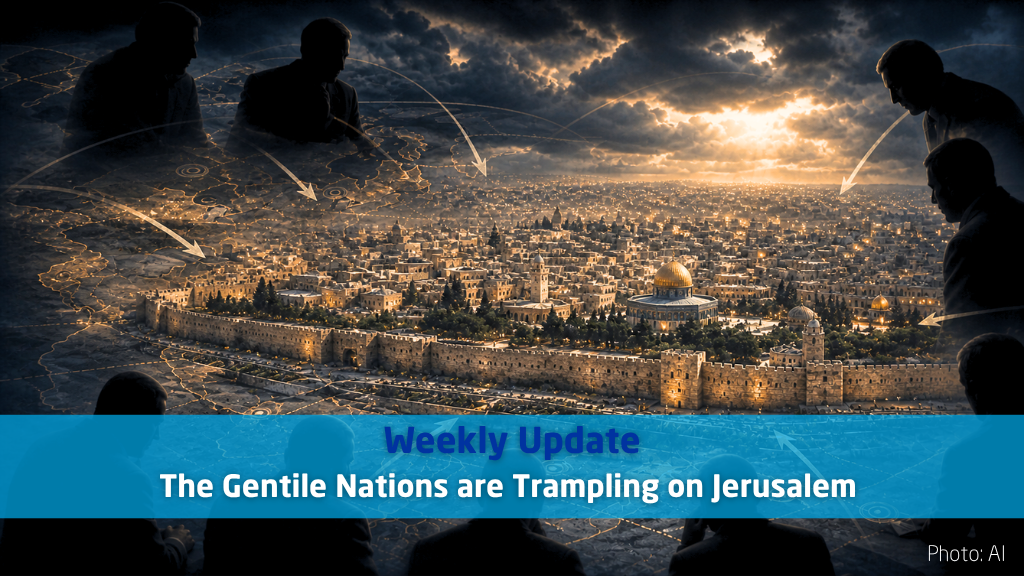
Three separate international deals moved forward this week, on three separate fronts, and in each case Israel was either excluded from the room or overruled inside it. A new Sunni-nuclear defense bloc is being formed without Israel at the table. Palestinian factions began assembling a coalition that, for the first time, may seat Hamas and Islamic Jihad inside a “legitimate” Palestinian parliament. And the Gaza disarmament process kept insisting the gaps with Israel were closing even as the IDF kept finding Hamas weapons in mosques.
These developments remind us of the words of Jesus concerning the end times: “Jerusalem will be trampled on by the Gentiles until the times of the Gentiles are fulfilled.” Indeed, today we see the Gentile (ie. non-Jewish) nations making all kinds of plans and agreements that affect the future of Jerusalem. However, we know that this trampling will come to an end and that the Lord will overcome the plans of the nations that seek the destruction of Israel:
“The LORD foils the plans of the nations; he thwarts the purposes of the peoples. But the plans of the LORD stand firm forever, the purposes of his heart through all generations.” Psalm 33:10-11
A New Defense Pact in Mecca — and Israel Isn’t on the Guest List
Saudi Arabia, Turkey, and Pakistan signed a mutual-defense agreement in Mecca early August. This agreement treats an attack on any one signatory as an attack on all three — a NATO Article 5-style commitment among a bloc that combines Saudi money, Pakistani military experience and nuclear weapons, and one of NATO’s own largest armies in Turkey. It was announced as a defensive arrangement. It is already being read as something else.
Writing in Gatestone, Khaled Abu Toameh traces the pact back to a trust deficit years in the making: the 2019 Iranian strike on Saudi Aramco facilities, and Washington’s underwhelming response to it, reportedly “virtually eliminated any Saudi confidence in the US security commitment,” per Middle East Institute analysis he cites. That reading — allies hedging because they no longer believe the American security umbrella will hold — is by now a familiar refrain in this newsletter, and it fits a pattern from Gaza to Hormuz of Washington managing crises with statements rather than follow-through.
What makes the pact more than a Gulf insurance policy is who’s in it. Jonathan Spyer, director of the Middle East Forum, describes the rhetoric coming out of the Turkey-Pakistan-Saudi grouping as “jointly and extremely anti-Israel” — and flags Turkey and Qatar specifically as “practical supporters” of Hamas, not merely sympathetic bystanders. Abu Toameh goes further, raising the pointed question of whether Pakistan’s nuclear umbrella — the only one in the Muslim world — could in some future scenario extend cover to Turkey against Israeli retaliation. Nothing in the agreement’s text says so. But nothing in the region’s recent history makes the question unreasonable to ask.
Elie Podeh, a Hebrew University professor writing in the Jerusalem Post, sees a subtler danger than a shared nuclear umbrella. He argues the old bloc system — the Iran-led “Axis of Resistance” against a “moderate” Sunni Arab camp — is dissolving into a messier set of overlapping, sometimes contradictory alignments; Pakistan, notably, maintains its own ties with Iran even as it joins a Saudi-led pact aimed in part at hedging against Iran. New platforms like the “Group of Eight” and the “Quartet” (R4) are proliferating alongside it. Egypt, tellingly, sat this one out. Podeh’s concern for Israel isn’t military — it’s exclusion. In his telling, Israel is being quietly written out of the region’s new architecture altogether, treated as a diplomatic pariah in the post-October 7 landscape even as former rivals build new frameworks around it.
There’s a third strand to this that neither Abu Toameh nor Podeh centers, and it belongs in the picture. Oded Ailam of the Jerusalem Center for Security and Foreign Affairs argues the pact’s real beneficiary isn’t Riyadh, Ankara, or Islamabad at all — it’s Beijing. China gets to expand its footprint across the region without taking on a single security commitment of its own: “China does not need to become the region’s security provider,” Ailam writes. “It is enough for Beijing to sell the cameras, drones, missiles, ports, and factories.” Pakistan’s decades-deep relationship with Chinese weapons systems makes it a built-in gateway, and the commercial numbers dwarf anything military: Chinese trade with Saudi Arabia and the UAE each ran roughly $108 billion in 2025. Ailam’s read is patient rather than alarmed — “China is not looking. It is waiting” — and his prescription for Israel isn’t to chase Saudi favor but to deepen ties with the UAE, so no single outside power ends up holding uncontested leverage over the region.
Spyer himself has since gone further, in a separate Middle East Forum piece, on exactly what this bloc is and isn’t. He’s skeptical of the pact’s formal military value — there is, in his assessment, “less than meets the eye” to the mutual-defense clause itself — but argues that this undersells what actually matters: the agreement formalizes and hardens a conservative Sunni Islamist bloc that already existed in practice, built on Turkey, Pakistan, and Qatar as the true core, with Saudi Arabia a more reluctant, hedging participant and Syria’s new al-Sharaa government folded in as a fourth. Turkey, Spyer notes, is already building “a 200,000-strong new Syrian army, controlled and staffed by Sunni Islamist commanders” — not a symbolic gesture but a standing military fact on Israel’s northern border.
Spyer names three specific dangers for Israel: unified anti-Israel rhetoric backed by real action, since Turkey and Qatar are, alongside Iran, practical supporters of Hamas rather than merely sympathetic voices; Jerusalem itself as the bloc’s unifying symbol, which he warns is “likely to form the symbolic element that knits the emergent group together”; and the possibility that normalization talk from some of these same states is cover rather than sincerity — he cites an Israeli Channel 11 report suggesting unnamed governments may be advising Israel toward agreements as a delaying tactic ahead of future conflict, not a genuine peace track. The rhetoric backing this up is not subtle: he quotes Erdogan declaring “Zionism threatens not only me…it threatens everyone,” and Pakistani Defense Minister Khawaja Asif calling openly for a “united military front” against Israel.
Put the four arguments together and the picture is not reassuring. A bloc formed partly out of distrust in American guarantees, stocked with declared anti-Israel rhetoric and practical support for Hamas, forming at the exact moment Israel is losing a seat at the table in the region’s new diplomatic architecture — and doing so in a way that hands China a foothold it didn’t have to fight for, while its core members build militaries and rhetoric explicitly aimed at Israel and rally around Jerusalem as a unifying cause. Whether it hardens into the security threat Abu Toameh and Spyer both warn of, the diplomatic isolation Podeh describes, or the quiet Chinese entrenchment Ailam sees coming, all four point the same direction: fewer options for Israel, fewer allies willing to underwrite them, and rivals who may be talking peace in public while, per Spyer’s sourcing, planning otherwise in private.
Palestinians Head Toward a Vote with Hamas and Islamic Jihad on the Ballot
In 1993, Israel and the PLO entered into the Oslo Accords, which created a series of Palestinian institutions, including the Palestinian Authority and the Palestinian Legislative Council. For the last three decades, these institutions have been controlled by the Fatah party, headed since the death of Yasser Arafat in 2004 by Mahmoud Abbas. The exception is the Gaza Strip where, in 2006, Hamas defeated Fatah and in 2007 took control of the Strip in a bloody civil war.
Palestinian Legislative Council elections are scheduled for November 28 — the first since 2006 — and the maneuvering ahead of that date should worry anyone tracking Israel’s security, not just Ramallah’s politics. Writing in the Jerusalem Post, Dana Ben-Shimon reports that rival factions met in Cairo to build a “wide national list” coalition aimed squarely at unseating President Mahmoud Abbas and the official Fatah slate. The intent isn’t subtle: one Palestinian source at the talks put it as “We want to bring Abbas down; We want to end his dominance.” The push is led in large part by Mohammed Dahlan, the exiled former Fatah security chief who broke with the party, and it matters structurally as well as politically — under Palestinian law, the largest bloc in the new parliament gets the right to form the next government. Abbas isn’t ceding the field quietly; his deputy, Hussein al-Sheikh, has led a counter-delegation to Cairo of his own.
What turns this from an internal power struggle into a security story is who else is reportedly inside that coalition. Gatestone’s Khaled Abu Toameh reports that Hamas and Palestinian Islamic Jihad are joining the anti-Abbas alliance — the first time PIJ has ever taken part in a PA parliamentary election. Abu Toameh’s argument is that nothing about either group’s ideology has changed since they last had power: Hamas won 74 of 132 seats in the 2006 election, the last one Palestinians held, and used the mandate that followed to violently seize Gaza from the PA by force in 2007. Running inside a coalition list rather than as an outright party doesn’t rewrite that history, he argues — it risks doing the opposite, handing organizations that reject Israel’s existence outright a fresh claim to democratic legitimacy. He quotes Palestinian-American analyst Ahmed Fouad Alkhatib, who argues “Hamas must never again be trusted with Palestinian politics” and should face a “post-defeat reckoning” before any return to the table, and closes on his own line in the sand: “Unless the answer to all these questions is unequivocally yes, terrorists should have no role in elections, government, or Palestinian decision-making.”
The two pieces read almost like two halves of the same file. Ben-Shimon’s reporting is the mechanics — Abbas versus Dahlan, Cairo as the venue, the legal lever of largest-bloc-forms-government. Abu Toameh supplies the warning underneath it: that 2006 is the precedent nobody seems to be reckoning with. An internationally blessed election handed Hamas a parliamentary majority, and a year later that majority became a bloody takeover of Gaza. If Hamas and Islamic Jihad end up inside a winning coalition this November instead of sitting outside it, the question isn’t only who runs the Palestinian Authority — it’s whether the same script that produced Gaza in 2007 is now being written for the West Bank.
Conclude
These developments continue to remind us that the nations – in their ignorance and pride – continue to “trample on Jerusalem”, as Jesus predicted. This is a continuing sign of the future gathering of the nations against Jerusalem, when the Lord Himself will intervene to protect His people and destroy those nations. Amidst these threatening developments, it is important not to forget that the Lord continues to work to fulfil His purposes. As promised through the prophets, He is restoring the people of Israel to the land – especially Jerusalem, Judea and Samaria – as a sign to the nations that He alone is God. In doing so, He is dealing with His people, turning their hearts of stone into hearts of flesh.
Prayer
Pray for Israel and her leaders, in the weeks leading up to elections in Israel – that discernment would prevail over the diplomatic pressure to declare peace before peace is real.
Pray for the enemies of the Jewish people — for Hamas and Islamic Jihad, for the architects of new alliances built on old hatreds — that hearts of stone would be turned to flesh.
Pray for the peace of Jerusalem, and for the Jewish people who are asked again and again to trust agreements that keep proving hollow.
And pray for the speedy coming of the Messiah of Abraham, Isaac and Jacob, who alone can deliver the security and peace that no pact, no coalition, and no board has yet managed – or can manage – to provide.

‘The Mecca Agreement: A Threat to Regional Security?
Gatestone Institute: Khaled Abu Toameh traces the new Saudi-Turkey-Pakistan defense pact to collapsing Saudi trust in U.S. security guarantees, and warns of an implicit anti-Israel edge.
The New Crescent: Mecca Pact Gives Rise to a Sunni Bloc, Posing New Challenges for Israel
Jonathan Spyer in JPost: Jerusalem, and Islamic Claims There, Are Likely to Form the Symbolic Element That Knits the Emergent Group Together
Flexible and Shifting Alliances in the Region Instead of Blocs
Jerusalem Post: Elie Podeh argues Israel risks being frozen out of the Middle East’s new, looser regional alignments.
China and the Mecca Alliance
Jerusalem Post: Oded Ailam argues China, not any of the three signatories, is the pact’s real long-term winner.
Palestinian factions meet in Cairo to build anti-Abbas coalition
Jerusalem Post: Dana Ben-Shimon reports on the Dahlan-led push to unseat Abbas ahead of November’s Palestinian elections.
Palestinian “Terrorist” Political Parties
Gatestone Institute: Khaled Abu Toameh reports Hamas and Islamic Jihad are joining the anti-Abbas coalition, PIJ’s first-ever run at PA parliamentary elections.
SCRIPTURE FOR THE WEEK: Luke 21
As Jesus looked up, he saw the rich putting their gifts into the temple treasury. 2 He also saw a poor widow put in two very small copper coins. 3 “Truly I tell you,” he said, “this poor widow has put in more than all the others. 4 All these people gave their gifts out of their wealth; but she out of her poverty put in all she had to live on.”
5 Some of his disciples were remarking about how the temple was adorned with beautiful stones and with gifts dedicated to God. But Jesus said, 6 “As for what you see here, the time will come when not one stone will be left on another; every one of them will be thrown down.”
7 “Teacher,” they asked, “when will these things happen? And what will be the sign that they are about to take place?”
8 He replied: “Watch out that you are not deceived. For many will come in my name, claiming, ‘I am he,’ and, ‘The time is near.’ Do not follow them. 9 When you hear of wars and uprisings, do not be frightened. These things must happen first, but the end will not come right away.”
10 Then he said to them: “Nation will rise against nation, and kingdom against kingdom. 11 There will be great earthquakes, famines and pestilences in various places, and fearful events and great signs from heaven.
12 “But before all this, they will seize you and persecute you. They will hand you over to synagogues and put you in prison, and you will be brought before kings and governors, and all on account of my name.13 And so you will bear testimony to me. 14 But make up your mind not to worry beforehand how you will defend yourselves. 15 For I will give you words and wisdom that none of your adversaries will be able to resist or contradict. 16 You will be betrayed even by parents, brothers and sisters, relatives and friends, and they will put some of you to death. 17 Everyone will hate you because of me. 18 But not a hair of your head will perish. 19 Stand firm, and you will win life.
20 “When you see Jerusalem being surrounded by armies, you will know that its desolation is near. 21 Then let those who are in Judea flee to the mountains, let those in the city get out, and let those in the country not enter the city. 22 For this is the time of punishment in fulfillment of all that has been written. 23 How dreadful it will be in those days for pregnant women and nursing mothers! There will be great distress in the land and wrath against this people. 24 They will fall by the sword and will be taken as prisoners to all the nations. Jerusalem will be trampled on by the Gentiles until the times of the Gentiles are fulfilled.
25 “There will be signs in the sun, moon and stars. On the earth, nations will be in anguish and perplexity at the roaring and tossing of the sea. 26 People will faint from terror, apprehensive of what is coming on the world, for the heavenly bodies will be shaken. 27 At that time they will see the Son of Man coming in a cloud with power and great glory. 28 When these things begin to take place, stand up and lift up your heads, because your redemption is drawing near.” 29 He told them this parable: “Look at the fig tree and all the trees.30 When they sprout leaves, you can see for yourselves and know that summer is near. 31 Even so, when you see these things happening, you know that the kingdom of God is near.
32 “Truly I tell you, this generation will certainly not pass away until all these things have happened.
33 Heaven and earth will pass away, but my words will never pass away. 34 “Be careful, or your hearts will be weighed down with carousing, drunkenness and the anxieties of life, and that day will close on you suddenly like a trap. 35 For it will come on all those who live on the face of the whole earth. 36 Be always on the watch, and pray that you may be able to escape all that is about to happen, and that you may be able to stand before the Son of Man.”
37 Each day Jesus was teaching at the temple, and each evening he went out to spend the night on the hill called the Mount of Olives,38 and all the people came early in the morning to hear him at the temple.
Why Israel? by Rev. Willem Glashouwer
Order the book