Hope in the North: Cello in Metulla
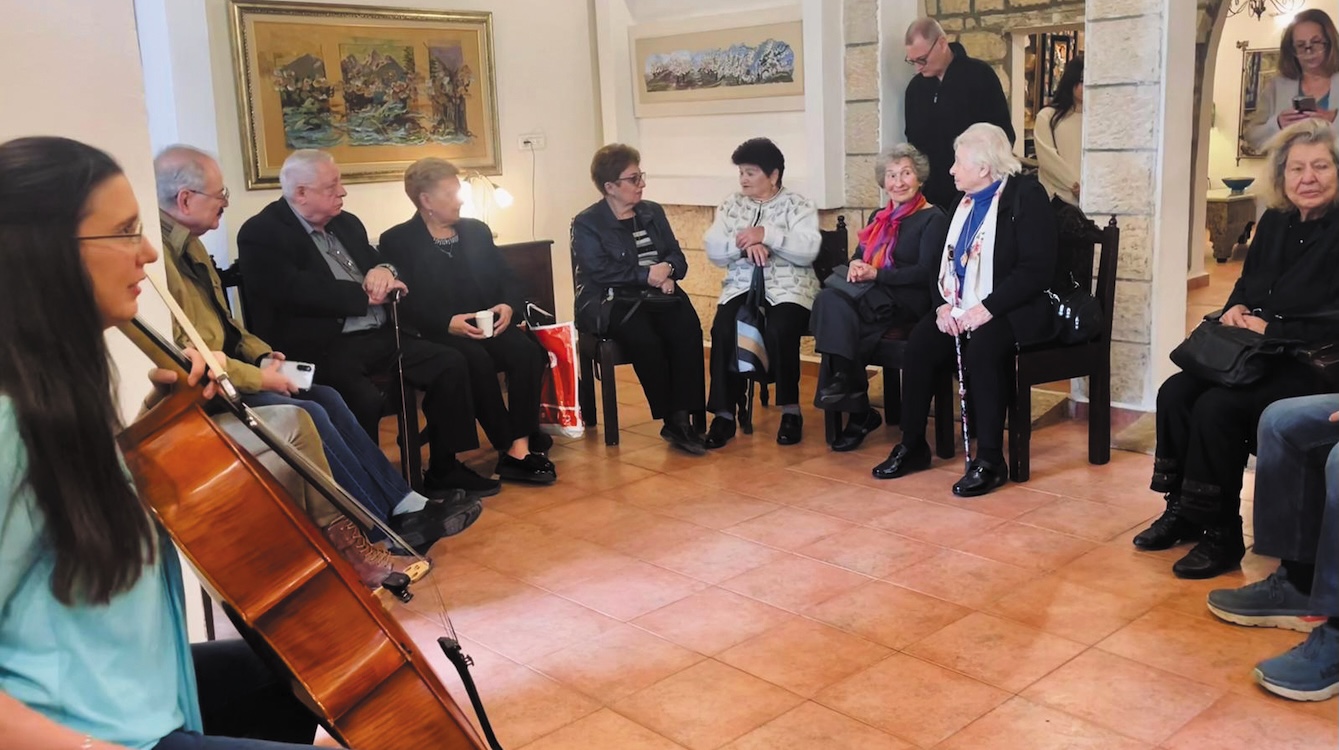 A small group of Holocaust survivors in Metulla received visitors from Germany. | Photos: C4I
In more than two years of war in Israel, two regions have suffered the most—the kibbutzim along the Gaza Strip and the towns along the Lebanese border in the north of the country. It is precisely here that Christians for Israel (C4I) ambassadors are traveling to bring hope—especially to the survivors of the Shoah who have since returned.
“For our working trip last summer, I had the north on my heart,” says Claudia Schall, who has been working part-time at C4I-Germany since the beginning of the year. “The border region had been severely affected by the war. That’s how we met Irit, who runs a hotel in Metulla with her mother, Miriam.”
“Within a five-kilometre radius, more than 60,000 residents were forced from their homes”
“We left right away on 8 October; we didn’t even wait for the official evacuation,” Irit recalls of the day after the Hamas massacre in the south, when Hezbollah began launching rockets at northern Israel. “I just had a feeling that this was going to last a while.”
Within a five-kilometre radius, more than 60,000 residents were forced from their homes. Two years later, every other house had suffered severe damage. Many families have yet to return, but things are looking up again—including for the Beit Shalom Hotel.
A Fresh Start & a Special Idea
“All the windowpanes were shattered by the rocket strikes,” says Irit. “Animals had taken up residence, and the grounds had become overgrown. When Claudia arrived with her team in August, we felt as though we were in Snow White. These Christians from Germany worked so hard! They started at 7am, and by the afternoon everything looked beautiful! They helped us get back on our feet. A few weeks later, we were able to welcome our first guests.”
Now the story has taken a moving turn. The family-run hotel has not only weathered dramatic years of war, but also brings to light the story of Irit’s grandparents—both Holocaust survivors from Krakow.
“When I saw the room with the exhibition, it occurred to me what it would be like to invite a group of Holocaust survivors here,” says Claudia.
Plans were made, flowers were ordered, and Claudia even managed to find a cello. Eti, an employee of the Israeli Holocaust Survivors Authority, brought the elderly guests. Two Russianspeaking survivors from Gita Koifman’s network also made the trip.
“I was ten when the Germans invaded our home in Ukraine back then”
Klavdia—Deported
“I was ten when the Germans invaded our home in Ukraine back then,” Klavdia recalls. “Grandpa took us to his farm in a horse-drawn cart. ‘The Germans are good people,’ he said. That’s why we didn’t leave. After the harvest was brought in, we were deported toward Odessa, 200 kilometres on foot. A quarter of the people never made it and died along the way.”
Klavdia’s mother heard some prisoners making escape plans along the way and joined them.
“After dark, we escaped into the forest. Suddenly, my little brother started crying. He was hungry, and Mom didn’t have any milk left. That’s when the others threatened to suffocate my little brother so he wouldn’t give us away!” Tears well up in Klavdia’s eyes as she recalls that moment.
“Grandpa and Grandma ran into an acquaintance along the way who gave them a ride for a bit. Their names were Chaim and Menya. We never saw them again. Grandma died on the way. Grandpa walked the entire way to Bogdanovka. When they arrived, the men were lined up at a dug-out trench and shot.”
“Roman, from Shabokrych, a Jewish shtetl, lost almost his entire family in a mass shooting in a single day”
Klavdia and her family found refuge in the Romanian-occupied Shabokrych ghetto, but that, too, became a death trap for many. Klavdia survived the war with her family, the years of famine that followed, and Soviet antisemitism. In 1990, she and her family were aboard one of the first flights to Israel.
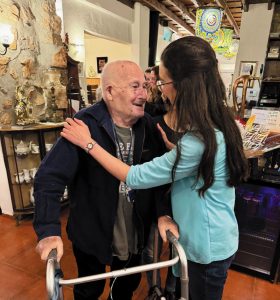
Claudia, C4I-Germany, with Leon, a Holocaust survivor from Poland | Photo: Christians for Israel
Reunion in Northern Israel
In Kiryat Shmona, she met Roman, who had grown up in Shabokrych when it was still a Jewish shtetl, and who lost almost his entire family in a mass shooting in a single day. These are just two of the survival stories shared at the gathering.
Claudia and Livia Tiersch, also new to C4I-Germany, perform music for the survivors with a small, talented team, conveying the message that they are not alone even on Israel’s northern border. They share hugs and flowers.
“It did the survivors so much good to get out for a change,” says Irit. “To experience this appreciation, to hear the songs. It was a wonderful gathering.”
The music also drew onlookers. “Afterward, a man came up to me,” Livia recounts. “He was so moved by our event. His parents survived the Holocaust in Hungary. It touched him so deeply to see us perform.”
Why Israel? by Rev. Willem Glashouwer
Order the book