Graffiti group: How a bunch of Brooklynites took matters into their own hands

The first time antisemitic graffiti appeared in my neighborhood in Brooklyn, N.Y., I walked down the street to see it for myself. Spray-painted in huge black letters across the bottom of a statue of the Marquis de Lafayette at the entrance to Prospect Park were the words “Globalize the intifada” and “From the river to the sea, Palestine will be free.”
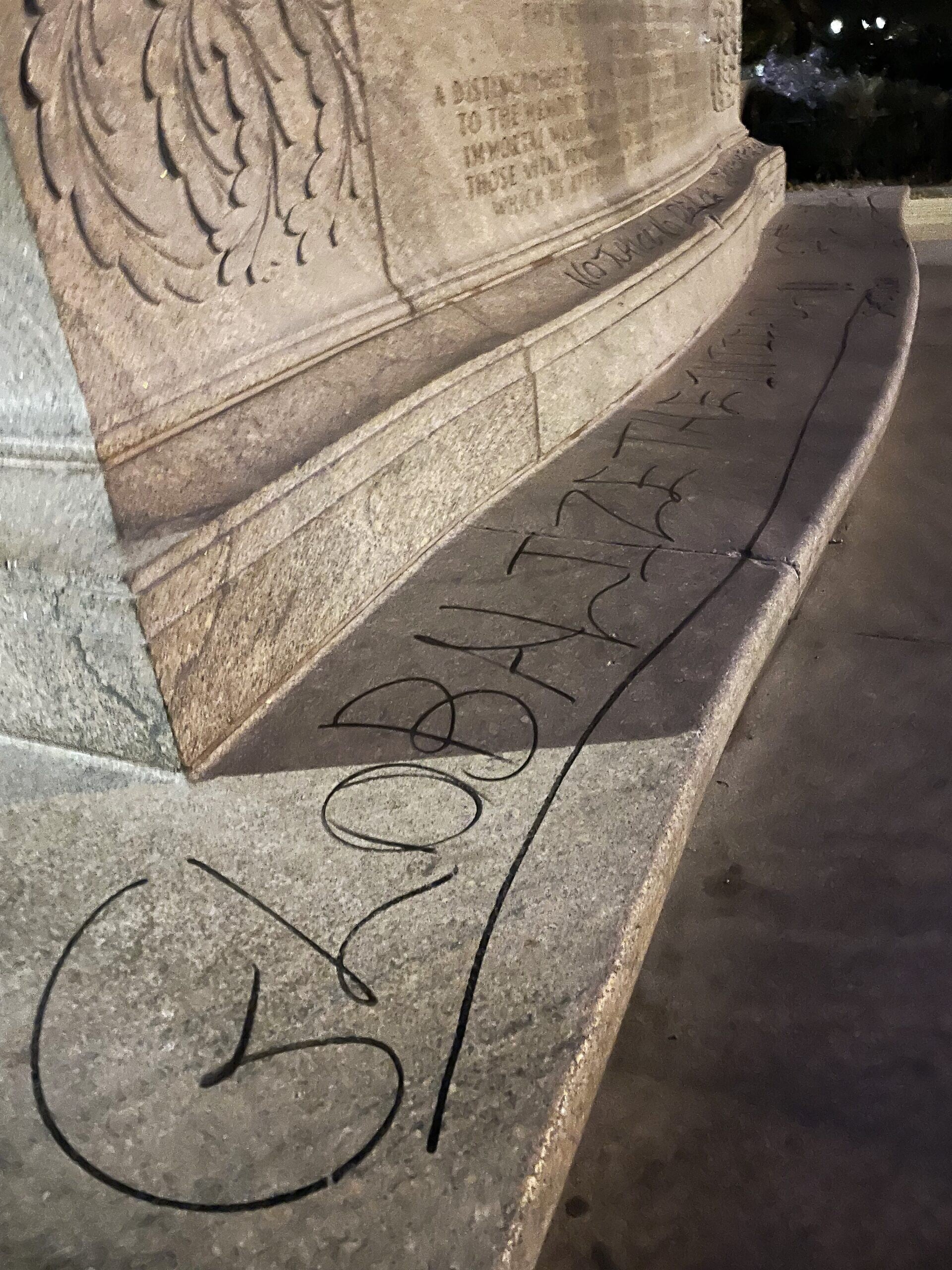
The statue sat at the entrance to the park near a large playground, one where my kids had played in the sandbox, graduated to the swings and the slide, and later met friends for skateboarding or to sip a pilfered beer.
My family has called Brooklyn home for more than 120 years, since my great-grandparents left violent, impoverished existences in Eastern Europe for the freedom of America. Never, in all my years as a New Yorker, had I seen graffiti that made my hands quiver and my blood run cold. Who had done this? Why? And, more importantly, what now?
In the fall of 2023, the neighborhood’s Jewish Facebook group came together to debate answers. We could call the police, but they rarely address graffiti. We could contact the city’s Department of Sanitation, which would definitely ignore it. Or, we could take care of it ourselves. Eventually, someone in the group handled it. But the graffiti wasn’t a random occurrence. It was the start of a tidal wave.
Soon, I couldn’t take a walk in the park without seeing spray-painted or chalked calls for violence against Jews. “Decolonize NYC from Zionists” looped around the outside of a fountain. “Death to the IDF” was chalked on my usual running path. Someone used a stencil to spray paint the letters ACAB in blood red across a stone archway.
One individual decided to take action. A man who prefers to remain anonymous organized volunteers into a group—an anti-graffiti group—on Facebook. He had watched in horror that year as our neighbors tore down the “missing” signs that Jews and their allies taped on streetlights and lampposts with the names and photos of people kidnapped from their beds, cars and a music festival during the Hamas-led terrorist attacks in southern Israel on Oct. 7, 2023. Posters crying out for the safe return of the Bibas family—a 32-year-old mother and her two young sons, one just a baby—were shredded and replaced with stickers proclaiming “I [heart] Hamas,” or spray-painted demanding to “Let Gaza Live.”
One day, walking to work, the man passed the largest synagogue in the neighborhood and found the sidewalk in front covered with pro-Hamas slogans, the doors plastered with “Free Gaza” stickers. He quickly returned to the synagogue with paint and a putty knife and cleaned up the mess. Soon, he became a one-man cleanup crew. After about a month, he realized that he wouldn’t be able to keep up the pace of work himself. Every evening, he removed graffiti across the neighborhood, and every evening it blossomed anew.
So he put out a call for help on the neighborhood’s Jewish Facebook group.
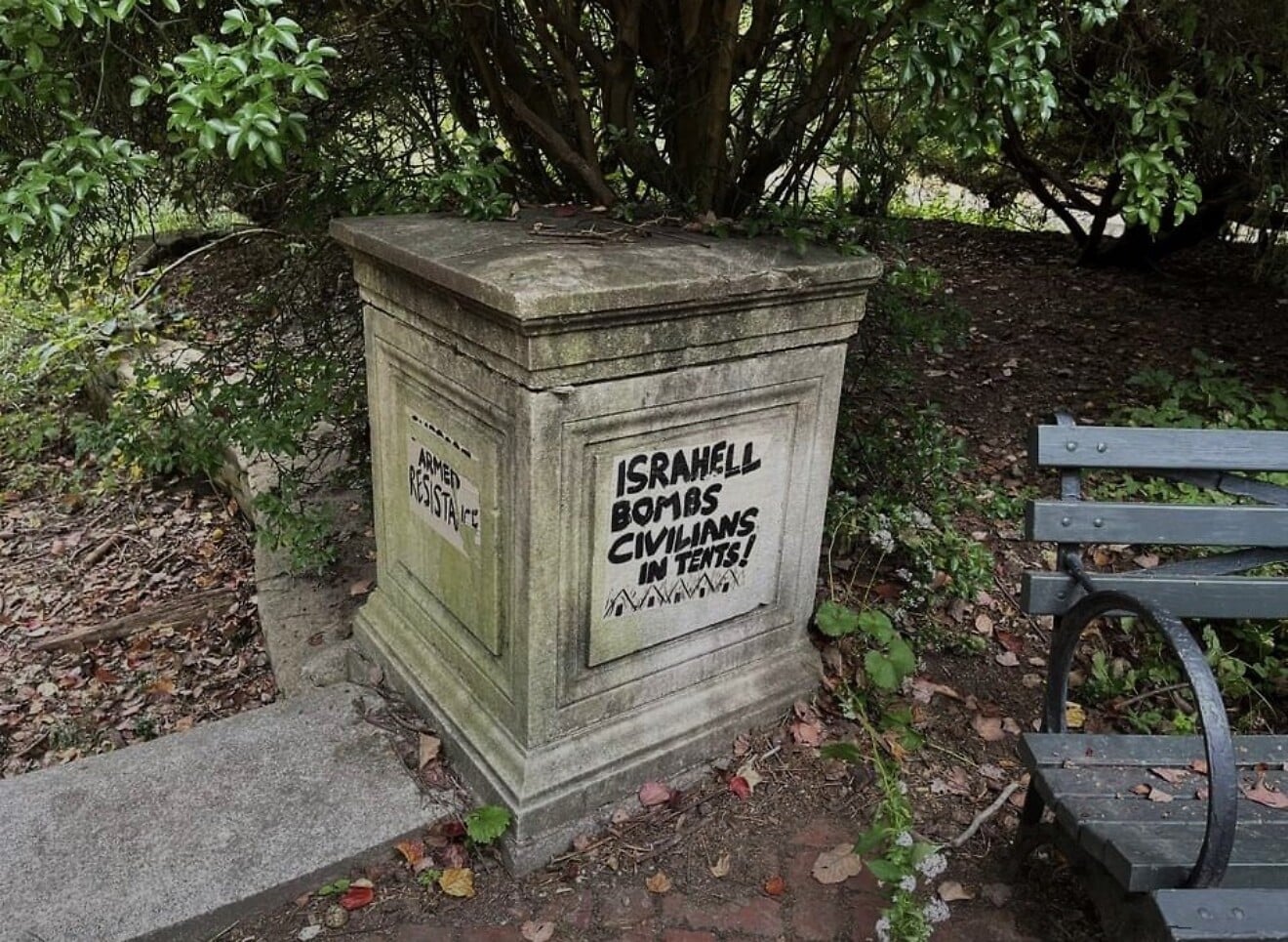
From ‘Free Gaza’ to ‘Free Pizza’
About 10 volunteers responded. The group divided a map of the neighborhood into squares encompassing all 585 acres of Prospect Park, plus additional city blocks surrounding it. Five synagogues, plus the local congressional office of Rep. Dan Goldman (D-N.Y.)—all frequent graffiti locales—fell within the graffiti clean-up zone.
On my first day as a volunteer, I dressed in stretchy black clothing, pulled a baseball cap over my head and stuffed a putty knife, a can of spray paint and a bottle of cleaning solution into my backpack. I made my way through the park, monitoring my acreage, scraping off offensive stickers and spray-painting over graffiti calling for the death of my friends and family in Israel. What I was doing was technically illegal, but as a medium-sized, middle-aged woman, I attracted little attention. People seemed to assume I was in some official capacity, and looked on approvingly as I removed graffiti.
On the neighborhood Facebook group, people exchanged graffiti-removal tips and tricks. One person enjoyed converting “Free Gaza” to “Free Pizza.” Someone else found that a solution of solvent plus Goo-Be-Gone made it easier to peel off stickers. Others printed up Israeli flag stickers to layer over the anti-Jewish ones.
While some Jews in the group were becoming graffiti-removal experts, others tried to reason with elected officials. The person who should have helped us was our city councilor, Shahana Hanif. Unfortunately, soon after Oct. 7, she condemned Israel for provoking the attack, noting that thousands of dead Israelis were the logical result of 75 years of an immoral occupation.
Still, many neighborhood residents were hopeful that American democracy provided elected officials who were sensitive to the plight of all constituents, regardless of race or religion. In the winter of 2024, several Jewish leaders met with Hanif, asking her to condemn the graffiti. Two members of the group shared stories of friends and relatives murdered on Oct. 7. Hanif was unmoved.
The city councilor stated explicitly that she would not condemn the terrorist group Hamas, refused to admit that Israel has a right to exist, and stated that she did not plan to lift a finger to combat the graffiti terrorizing her constituents. Other people’s right to free expression and damaging city property was more important to Hanif than the civil rights of a few annoying Jews.
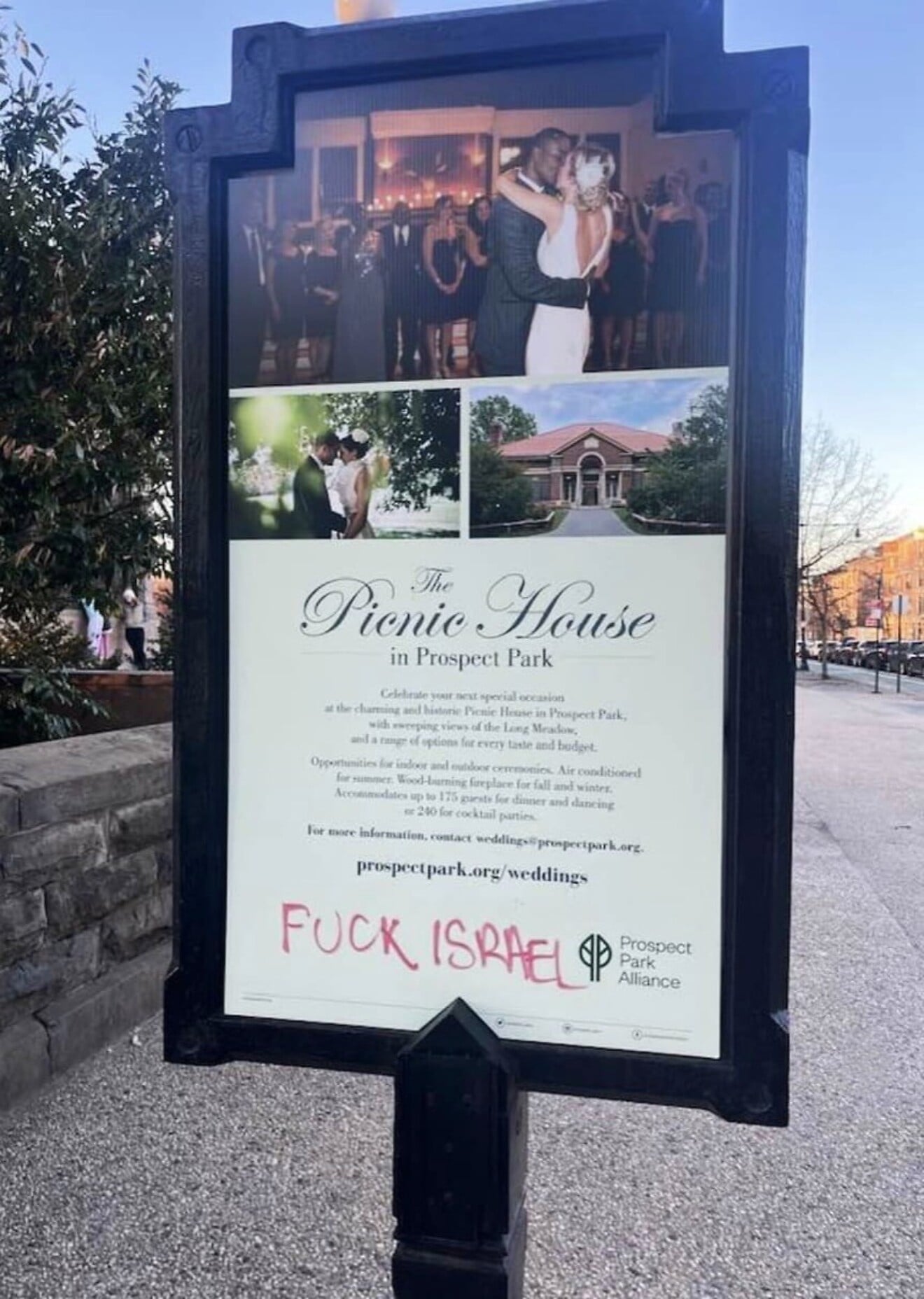
Over the course of 2024, the head of the graffiti group estimates that he cleaned up thousands of slogans and stickers. Eventually, the graffiti’s occurrence began to dwindle as the war moved off the front page of newspapers. After the ceasefire between Israel and Hamas in Gaza was put into place in mid-October, while antisemitic graffiti and stickers didn’t vanish, their frequency significantly diminished.
At the same time, violent events and boycotts began to occur. In January, a local restaurant that serves Israeli fare, Miriam in Park Slope, was vandalized—its windows smashed, red spray paint declaring the food to be “genocide cuisine.”
Despite her antisemitic stance, Hanif was easily re-elected to the New York City Council. She now co-chairs the city’s Task Force to Combat Hate.
From paint and chalk to violence
Meanwhile, the graffiti group now lies dormant, as the concerns of Brooklyn Jews have turned inward to physical safety and handling growing antisemitism in the public schools. For now, there are scarier things to worry about than someone scrawling “Free Gaza” near a sandbox, as what feels like an unstoppable tidal wave of hatred encompasses the most Jewish city in America.
This is the logical next step for hate against Jews, and the eventuality that the graffiti group was working against. First came graffiti, giving voice to the anger and words many in the city felt, but dared not speak aloud. Then came violence targeting Jewish stores, restaurants and museums, as the graffiti moved out of the park and into more public locations.
And now, unchecked, hate has metastasized from spray paint and chalk into active protests against Jews for simply being Jewish. The words people felt embarrassed to say aloud are now chants commonly heard across the city. Earlier this month, an event at the 92nd Street Y, a longstanding Jewish cultural institution, was mobbed by masked protesters with Palestinian flags, chanting messages of hate, simply because the Y is a space where Jews gather. At the same time, violence against Jews continues to climb. Last year, there were more hate crimes against Jews in New York than against all other groups combined. In January, according to the New York City Police Department, New York’s Jews experienced one hate crime per day.
The final move for antisemitic theories, as Jews well know, is from violence to policy. To head off this eventuality, New York City Council Speaker Julie Menin recently introduced a bill aiming to establish a safe perimeter in front of synagogues, mosques, churches and schools. But many groups stand against it, arguing that the bill curtails the right to free speech. (And makes it harder to yell at Jews entering a synagogue.)
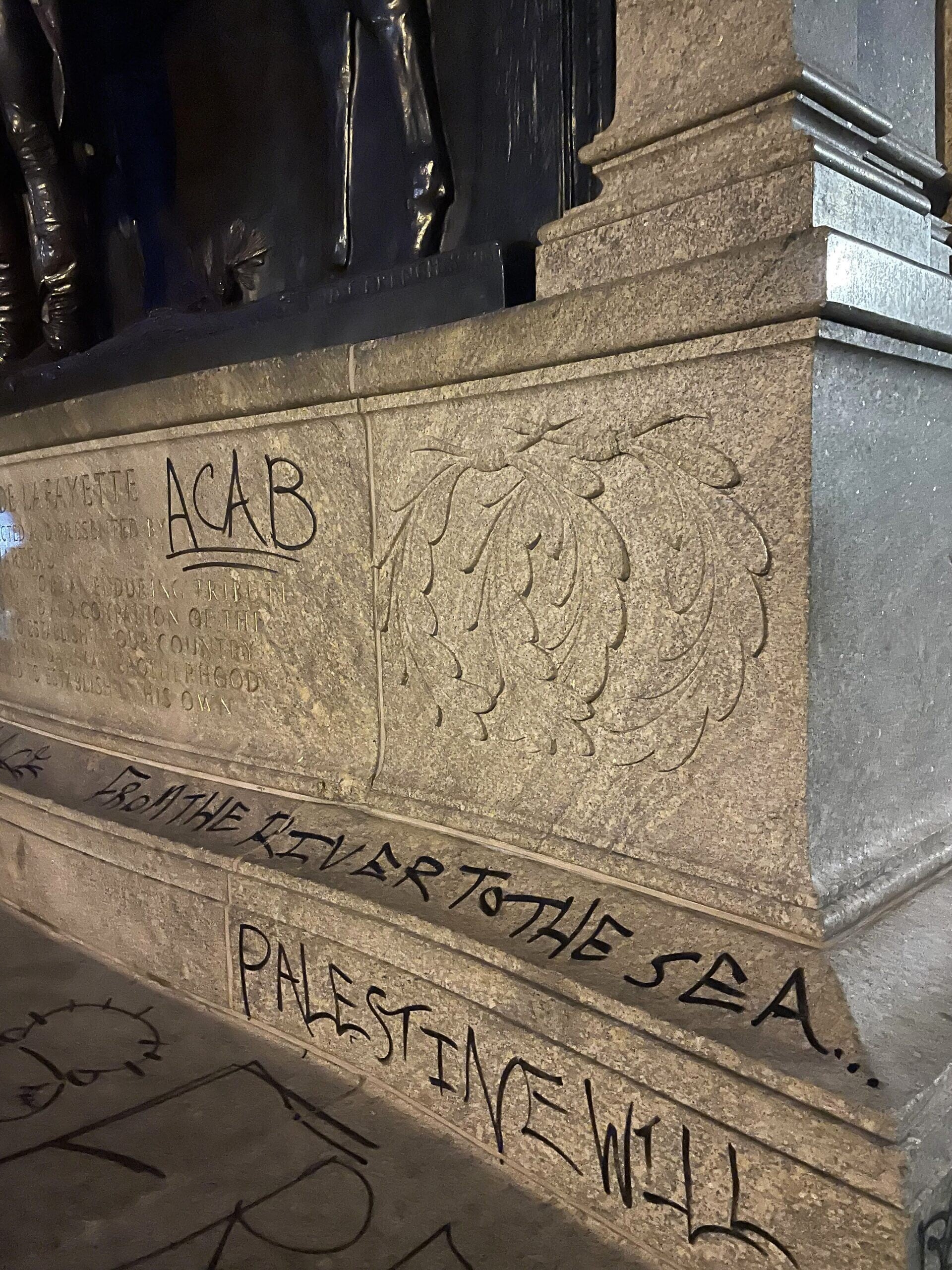
The bigger question is whether Jews want to live in a city where they require a mandated buffer zone in front of synagogues to keep them safe. Many Jews have already chosen not to live in a city iced with antisemitic graffiti. Some members of the erasing graffiti group have already moved out—many made nervous by the election of Zohran Mamdani as mayor, with his background of anti-Israel invective. Others are considering the previously unthinkable idea of leaving a city they love, where they used to live open, beautiful Jewish lives in peace.
Personally, I retired my spray paint can last summer. At first, going out in the park made me feel like a capable citizen, a proactive Jew and a woman fighting for the right to her own safety. But over time, as I washed yet another inverted red triangle—a symbol of Palestinian resistance—off the sidewalk outside my congressman’s office, I came to feel that I was but a tiny speck in a massive ocean of Jew-hatred. We are so few, and I am only one person with one small can of spray paint. I was no match for a city of nearly 9 million people, often disagreeing so vastly on political and social issues that it has consumed their lives.
As a result, I moved last summer to the one place I can be sure no one will deface public property to proclaim support for terrorists: Israel.
Today, when I walk out the door of my apartment building in Tel Aviv, I never know what I’m going to find. But the one thing I know I won’t see is a call for Jewish annihilation. Every day, I breathe a sigh of relief that my graffiti-combating days are behind me and head out into the city where I can be as openly Jewish as I want, anywhere, at any time, without fear of reprisal.
The post Graffiti group: How a bunch of Brooklynites took matters into their own hands appeared first on JNS.org.
Why Israel? by Rev. Willem Glashouwer
Order the book