Aggressors and victims: the clash of narratives
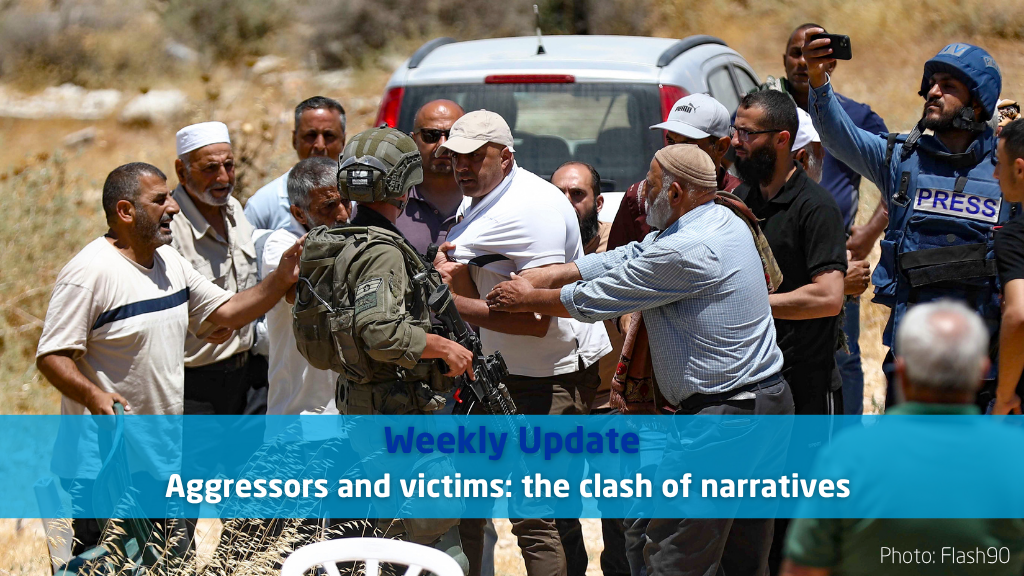
Events this past week underline yet again how public perception of the conflict between Israel and its neighbors is largely shaped by media framing. Israel’s enemies – Hamas, Hezbollah and their allies – cleverly manipulate the media by spinning events to portray themselves as innocent victims and Israel as a merciless aggressor. Messaging from Jerusalem – often confused by divisions within Israeli society – is greedily used by those who wish to portray the Jewish people in a bad light. It is no longer about truth, but about perception.
Israel’s military operations in the Gaza Strip – the clash of media narratives
After a short respite, Israel has resumed military operations in the Hamas-controlled section of the Gaza Strip. Two recent incidents in the Gaza Strip reveal the “battle of narratives”. The secular media widely adopts the “Hamas narrative”: Israel’s killing of Palestinians in Gaza are unjustified attacks on innocent victims. Israel’s justifications are widely ignored or rejected in the media. Part of the problem is that the Israeli political leadership gives confusing signals. Another issue is that the IDF generally does not immediately release detailed information, probably due to the highly-sensitive nature of the incidents.
Colonel Jamal Abu Kamil, 43, was killed August 13 when an Israeli drone fired three missiles at his car on al-Rashid Street in Gaza City. The IDF and Israel Security Agency identified him as "a commander in the Hamas terrorist organization who infiltrated Israeli territory during the October 7th Massacre" — i.e., a participant in the October 7, 2023 attack itself. The IDF stated that "throughout the war and in recent months, the terrorist advanced terror attacks against IDF troops and Israeli civilians, and was eliminated from the air in order to remove the threat." The IDF has been criticized for not releasing supporting evidence, and Israel's framing directly collides with how Palestinian officials describe him: Hamas's Interior Ministry (which runs Gaza's civil police) identified Abu Kamil simply as Gaza's police chief, and Gaza's police force explicitly denied the Hamas-militant characterization, stating he "committed to his police duties and has no connection to other activities." Hamas itself condemned the strike as "a continuation of the brutal crimes committed by the occupation against our Palestinian people" — framing it as an assassination of a civil official, not a legitimate strike on a terrorist.
On August 18, an IDF strike near Gaza City killed six and wounded fourteen. Hamas called it further proof of "blatant disregard for all calls for a ceasefire," pointedly invoking Trump's own public statements that Israel shouldn't be striking Gaza right now. The IDF said it struck a café in the Shati coastal area near Gaza City's port where "a Nukhba force company commander, three platoon commanders, and several more terror operatives" were meeting. Nukhba is Hamas's elite commando unit — the one that spearheaded the October 7, 2023 invasion. The military's stated rationale was that the group was "advancing plans for terrorist attacks against forces operating in the Gaza Strip," and it added that "one of the terrorists targeted in the strike participated in the October 7 massacre and infiltrated Israeli territory that day." No names, dates, intercepted communications, or other supporting evidence were made public. The IDF said "measures were taken to minimize harm to uninvolved civilians" and that it would release verified results later. Defense Minister Israel Katz tied the strike explicitly to a stated government policy: "Israel's policy in Gaza… is clear: Remove threats, eliminate terrorists, and exact retribution from anyone who took part in the October 7 massacre." (NB – this is a notably broader justification than "imminent threat").
The latest strike falls under a policy change Israel adopted in early August: targeted strikes in Gaza, which used to be routine and could happen multiple times a day at the field-commander level, now require sign-off from IDF Chief of Staff Lt. Gen. Eyal Zamir, with an exception carved out for genuinely imminent threats. That change was explicitly tied to the ceasefire negotiations — as one military source put it, "there are clear directives from the political echelon as part of the negotiations."
“Settler violence” in Judea and Samaria
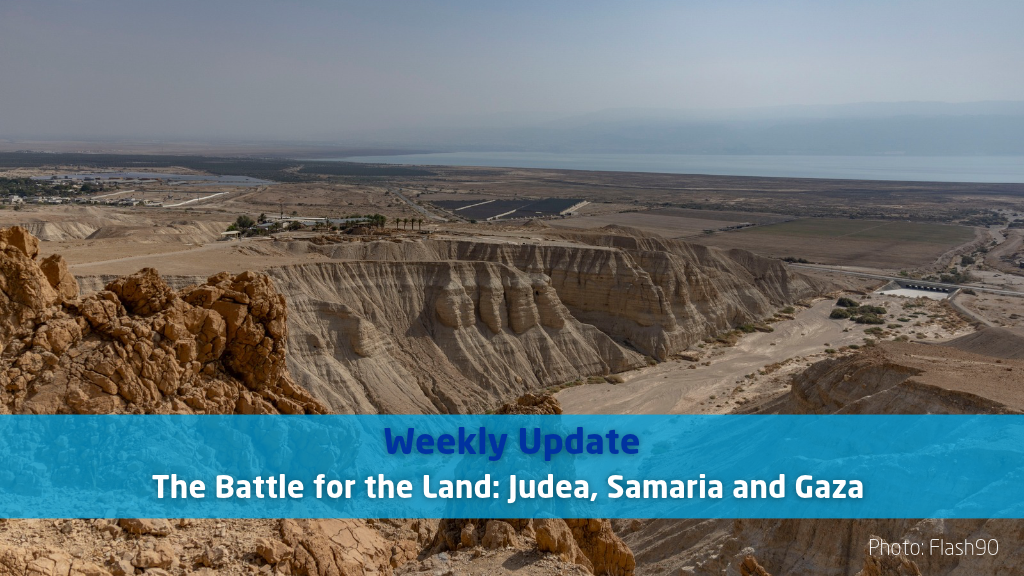
Israel’s operation Iron Wall is the IDF’s counter-terror operation running since January 2025 in the northern West Bank refugee camps. This week the IDF ordered extension of the closure of the Tulkarm, Nur Shams and Jenin camps through August–September 2026, affecting 34,000 Palestinians.
A story that dominated media coverage this week was the week-long “siege of Qusra village”, where three Palestinian families — about 15 people, including children — were reportedly trapped in their homes after Israeli settlers established a new outpost nearby in November and then, starting roughly August 9. Media report that the settlers cut their power and water while IDF troops reportedly stood by. OHCHR called it "criminal actions by the settlers, supported or acquiesced to by Israel"; Amnesty International went further, calling it "strategic terror."
Statements from the Israeli side split sharply between official silence at the top and pointed remarks from officials just below it — a gap multiple outlets flagged as the story in itself. Every outlet that covered this converges on the same point — the Prime Minister made no public statement condemning the siege at any point across the roughly week-long ordeal, despite Washington actively pressing him to. Times of Israel's own headline framed it as "US said pushing silent Netanyahu to publicly condemn settler violence in Qusra as PM keeps mum." Al Jazeera's analysis on the episode argued this silence reflects genuine political constraint rather than oversight — his coalition depends on settler-aligned partners, and Netanyahu had recently responded to earlier settler violence by promising to recognize more illegal outposts rather than crack down on perpetrators.
Yechiel Leiter, Israel's ambassador to the US, gave the most direct condemnation from within the government, calling the settlers involved a "gang of hooligans" who "wreak havoc with gratuitous violence, diverting energy from Israel's own military and law enforcement," and adding: "What we saw in the village of Qusra this week is not what it means to settle the land… The Land of Israel is not only a place we are commanded to inhabit. It is a place where we are commanded to live by justice." He called the conduct "a distortion, even a sacrilege" of that commandment. Yisrael Ganz, chairman of the Yesha Council (the main umbrella body for Israeli communities in the West Bank — not a government official, but the most prominent voice from the settlement movement itself), said: "The events in Qusra are severe and are not our way," adding that "there is no place to decide, individually, to establish a hilltop [outpost] in the courtyard of a home… and there is certainly no justification for violence toward bystanders or security forces." He paired that with a call for Israel to keep expanding settlement "in an orderly and correct way" — condemning the method, not the goal. US ambassador Mike Huckabee used the sharpest language — calling the perpetrators "Israeli terrorists" and coining the "settlers vs. unsettlers" framing to distinguish legitimate settlement from the Qusra episode — and he publicly praised Ganz's statement as coming from a "real settler."
The strategic E1 corridor
JNS reports that the Israel Lands Authority, which manages most of the lands in Israel, on Tuesday announced it would market to contractors and entrepreneurs the first 1,400 housing units of E1 (“East 1”), a strategically significant area in Judea and Samaria. Contractors who win the bids will construct the units. According to JNS:
-
“The importance of E1 lies in its location. The 12-square-kilometer (4.6-sq.-mile) area sits between Ma’ale Adumim, a Jewish city of about 40,000 in the Judean Desert, and Jerusalem. Once built up, E1 will connect Ma’ale Adumim to the capital, forming a larger metropolis, preventing the Palestinian Authority from surrounding Jerusalem with its own metropolis, which would include Ramallah, eastern parts of Jerusalem and Bethlehem. (The P.A. intends to wrest from Israel eastern sections of Jerusalem for its own future capital.) Israeli security analysts have long warned that Jerusalem will become a border town if the surrounding Arab settlement is allowed to continue unhindered. The answer, they say, is E1, which would protect Jerusalem, drive a wedge through the nearly contiguous Arab settlement enveloping it and ensure Jewish territorial contiguity eastward to the Jordan Valley.”
Israel justifies this as a legitimate step to protect Jerusalem and the security of the Jewish state. Israel’s opponents, of course, frame this as yet another Israeli attempt to destroy the Palestinians as a people and their right to a contiguous independent state.
-
“Both sides agree E1 construction threatens Arab geographic contiguity. At an on-site press conference held in Ma’ale Adumim on Aug. 14, 2025, to celebrate the government’s historic announcement, Israeli Finance Minister Bezalel Smotrich declared that E1 construction ‘buries the idea of a Palestinian state.’ The P.A. said the same thing. Wafa, its official news site, described E1’s chief objective as ‘undermining the establishment of a Palestinian state with Jerusalem as its capital.’”
Conclude
We live in an age of confusion. It is becoming increasingly difficult to distinguish between truth and lies. That in itself is a sign that we are living in the "last days", the time preceding the coming of Messiah. Paul wrote to Timothy about those times: "There will be terrible times in the last days. People will be lovers of themselves … They are the kind who … are always learning but never able to come to a knowledge of the truth."
As Christians we have a responsibility to discern the signs of the times: to carefully study events in the world in the light of the Bible. Do not believe everything that is pronounced as "truth" or "fact" by secular media outlets. Satan is the author of lies, and he is busy sowing the seeds of falsehood and deceit. Jesus Himself warned of this in Matthew 24, when speaking to His disciples about the last days: "For false messiahs and false prophets will appear and perform great signs and wonders to deceive, if possible, even the elect. See, I have told you ahead of time." Study the news carefully and if you are uncertain or confused, ask the Holy Spirit to help you discern truth from lies, light from darkness.
This week, pray for Israel and her leaders, that wisdom and unity prevail where division now reigns. Pray for the upcoming elections – that the people of Israel will elect a strong and wise leadership.
Pray for the enemies of the Jewish people, that hearts of stone would be turned to flesh.
Pray for an end to hostilities and violence in Judea and Samaria. Pray that the Israeli government will apply the law equally and fairly, protect all inhabitants and respect the human rights of all.
Pray that the question of sovereignty over Judea and Samaria be resolved, so that all – Jews and non-Jews – can live under strong, stable and equitable government.
Pray for the peace of Jerusalem, and for all who dwell within her borders — soldiers, reservists, hostage families, the displaced in the north and south alike.
And above all, pray for the speedy coming of the Messiah of Abraham, Isaac and Jacob, who alone can bring the peace no treaty, board, or ceasefire has yet managed to deliver.

'Israel markets first 1,400 units in strategic E1 corridor
The importance of E1 lies in its location: between Ma’ale Adumim, a Jewish city in the Judean Desert, and Israel’s capital.
U.N. ‘settler violence’ data faces questions over disputed incidents
“Judeacation” takes viewers to the heart of Judea and Samaria, where history, faith and modern Israel meet. Hosted by JNS Middle East correspondent Josh Hasten, the series dispels myths and misconceptions about life in the region the world calls the “West Bank,” but which Jews know as the cradle of their civilization.
Netanyahu: Syria was on verge of deploying Turkish troops—Israel warned against it
U.S. envoy Tom Barrack expressed “deep concern” over an attack in northwestern Syria, which the IDF has not commented on.
Kushner: Gaza demilitarization could begin within 30 days
“And hopefully filling in some of the tunnels as well in the next 60 to 90 days,” the Trump administration envoy said.
Iran says 60-day window for US talks has ‘lost its relevance,’ as MoU expires
Negotiating window expires without a deal as Washington maintains military and economic pressure.
Hezbollah funding survives US-Israeli crackdown
Security experts told JNS that the Iranian terror proxy has adapted to financial pressure through informal cash networks, complicating efforts to curb its rearmament and weaken its support base.
SCRIPTURE FOR THE WEEK: Psalm 116
1 I love the LORD, for he heard my voice;
he heard my cry for mercy.
2 Because he turned his ear to me,
I will call on him as long as I live.
3 The cords of death entangled me,
the anguish of the grave came over me;
I was overcome by distress and sorrow.
4 Then I called on the name of the LORD:
“LORD, save me!”
5 The LORD is gracious and righteous;
our God is full of compassion.
6 The LORD protects the unwary;
when I was brought low, he saved me.
7 Return to your rest, my soul,
for the LORD has been good to you.
8 For you, LORD, have delivered me from death,
my eyes from tears,
my feet from stumbling,
9 that I may walk before the LORD
in the land of the living.
10 I trusted in the LORD when I said,
“I am greatly afflicted”;
11 in my alarm I said,
“Everyone is a liar.”
12 What shall I return to the LORD
for all his goodness to me?
13 I will lift up the cup of salvation
and call on the name of the LORD.
14 I will fulfill my vows to the LORD
in the presence of all his people.
15 Precious in the sight of the LORD
is the death of his faithful servants.
16 Truly I am your servant, LORD;
I serve you just as my mother did;
you have freed me from my chains.
17 I will sacrifice a thank offering to you
and call on the name of the LORD.
18 I will fulfill my vows to the LORD
in the presence of all his people,
19 in the courts of the house of the LORD—
in your midst, Jerusalem.
Praise the LORD
Why Israel? by Rev. Willem Glashouwer
Order the book