Agreements alone do not bring peace
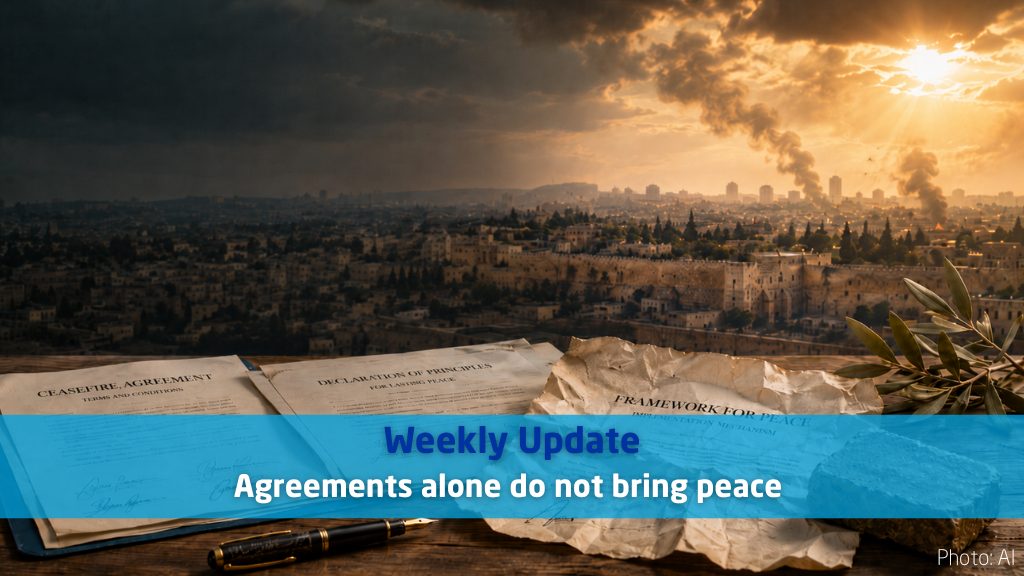
Across several fronts, a pattern is recurring: agreements are announced, framed as breakthroughs, and then stall in implementation while facts on the ground continue to shift in Israel’s favor militarily and territorially, even as its diplomatic standing erodes elsewhere. Washington’s attention moves quickly between fronts — Gaza aid one week, Hormuz shipping lanes the next — without a coherent strategy tying them together. For Israel, the practical result is continued military latitude paired with growing isolation on the world stage, a tension that shows no sign of resolving soon.
Gaza: Ceasefire in Name Only
The Gaza ceasefire declared in October 2025 under Trump’s 20-Point Plan remains formally in place but has not produced the calm it promised. Critics like Al Jazeera argue that Israel has violated the agreement at least 3,795 times between October 10, 2025 and July 19, 2026, with near-daily strikes continuing. In early August, Israel escalated attacks and pushed hardline demands, straining the US-backed roadmap; despite a “Board of Peace” body urging de-escalation, IDF strikes in Gaza killed two people as recently as August 3.
Netanyahu has avoided an open break with Trump by permitting limited aid increases while stalling on the core issue — a full military withdrawal — which he has tied explicitly to prior Hamas disarmament, something Hamas has so far refused.
The 15-point roadmap, published by Trump’s Board of Peace on July 30, was meant to operationalize phase two of the October 2025 ceasefire: a sequenced process where Hamas disarms, an international security force deploys, an independent Palestinian National Committee takes over governance, and Israel completes a full withdrawal from Gaza. Netanyahu rejected it on August 9, and the objections break down into a few distinct issues.
- Sequencing. This is the core dispute. The Board’s plan treats disarmament and withdrawal as parallel, phased steps — Israel pulls back as Hamas hands over weapons, not after. Netanyahu wants it the other way around: no movement past the ceasefire’s “Yellow Line” until Hamas has fully disarmed. He’s framed this as genuine versus “fictitious” disarmament, arguing a phased handover lets Hamas stall or fake compliance while Israel gives up ground for good. The Board of Peace actually sided with Netanyahu on this specific point on August 3, saying Israeli forces wouldn’t move beyond the Yellow Line until weapons are fully decommissioned — which makes the public rejection a bit more about optics and other provisions than this one alone.
- Dropped provisions from the original 20-point plan. Critics (including a Jerusalem Post opinion piece and ZOA’s Morton Klein) note the 15-point version quietly drops language that was in Trump’s original 20-point plan: explicit requirements to demilitarize Hamas and destroy its tunnel network and terror infrastructure, and any defined security perimeter for Israel. Instead it just refers to “complete Israeli withdrawal” without specifying how the security vacuum gets filled. There’s also no mention of deradicalization — nothing addressing Hamas’s ideological hold over Gaza’s population, which critics argue leaves the door open for it to reconstitute.
- Statehood trajectory. The plan’s stated end goal includes a “credible political path” toward Palestinian self-determination and statehood. Netanyahu reiterated flatly that “as long as I am prime minister, there will be no Palestinian state, neither in Gaza nor in Judea and Samaria” — a red line for his coalition regardless of how the rest of the plan is written.
- Domestic politics. Netanyahu is facing elections and pressure from his right flank, and his rejection hardened after days of mounting criticism of the plan from that base. That’s part of why the Board of Peace pushed back publicly on his framing, with officials telling reporters that Israel’s actual conduct on the ground looks more like implementation than rejection — suggesting the public “rejection” may be more rhetorical positioning for a domestic audience than a full walk-away from the process.
Hamas, notably, said it remains committed to the 15-point plan and has already dissolved its Gaza government to make way for the National Committee — so the plan isn’t dead, but it’s stuck on exactly the sequencing question Israel has fought over since the original ceasefire was signed.
Israel justifies its ongoing military incursions into the Hamas-controlled parts of the Gaza Strip on three grounds:
- Ceasefire enforcement / self-defense. The core official line is that strikes are responses to Hamas violations, not violations themselves. The October 2025 truce created a “Yellow Line” dividing IDF-controlled from Hamas-controlled Gaza, and the IDF says any armed crossing of that line, or gunfire directed at Israeli troops, is an explicit ceasefire breach that entitles it to respond. IDF statements have tallied Hamas violations repeatedly — 14 between February 5–20, 113 since the truce began, 22 more “since the start of the Iran war” — framing each Israeli strike as reactive: killing a specific gunman who approached a position, or striking “terror commanders and infrastructure” after rocket fire or an ambush. The military’s broader line, as an IDF spokesperson put it, is that “the terror organizations in the Strip systematically violate international law, while brutally exploiting civilian institutions and operating in the presence of the local population” — meaning civilian casualties get attributed to Hamas’s use of civilian cover rather than to the strikes themselves.
- Hunting October 7 perpetrators. Separately, Israel maintains an active, named target list of everyone who crossed into Israel on October 7, 2023, run jointly by the IDF and Shin Bet — reportedly having killed roughly 2,561 of the approximately 3,000 attackers. This is justified as ongoing self-defense against people who are still armed combatants, not a ceasefire-era operation at all; when Israel has agreed to broader disarmament or hostage arrangements, it has explicitly carved out an exception for October 7 participants, saying they won’t be included in any amnesty. Officials have invoked the post-Munich Mossad campaign as precedent — a “we will find you, wherever you are” logic aimed as much at deterrence and domestic political necessity as at removing an active threat, according to former Israeli intelligence officials quoted in reporting on this.
- Structural/legal framing. Underlying both tracks is Israel’s continued position, held since October 2023, that it is engaged in a lawful armed conflict against a non-state actor that embeds itself in civilian infrastructure, and that Article 51 self-defense doesn’t disappear just because a ceasefire document exists — a truce constrains offensive war, in this reading, not discrete responses to attacks on troops.
Lebanon: Disarmament Talks Without a Deadline
Lebanon presents a similar dynamic on a slower timeline. The June 26 framework ties Israel’s phased withdrawal from southern Lebanon to Hezbollah’s disarmament, verified by an international monitoring mechanism. A fresh round of talks in Rome, running through early August, produced a shortlist of countries that could contribute troops to verify Hezbollah’s disarmament — with the US expected to make the final selection, and with Israel and the US having already vetoed France’s inclusion. But the practical sticking points remain unresolved.
The Ali al-Taher Ridge dispute is emblematic: Israel wants the Lebanese army to certify that Hezbollah fighters and weapons are absent before any further Israeli withdrawal, and analysts broadly agree no significant pullback should be expected while that verification question stays open. Hezbollah, for its part, continues to reject the legitimacy of any negotiation over its own disarmament, arguing the entire framework serves Israeli and American interests rather than Lebanese sovereignty. The result is a ceasefire structure that exists on paper but has not yet translated into troops actually leaving positions on the ground.
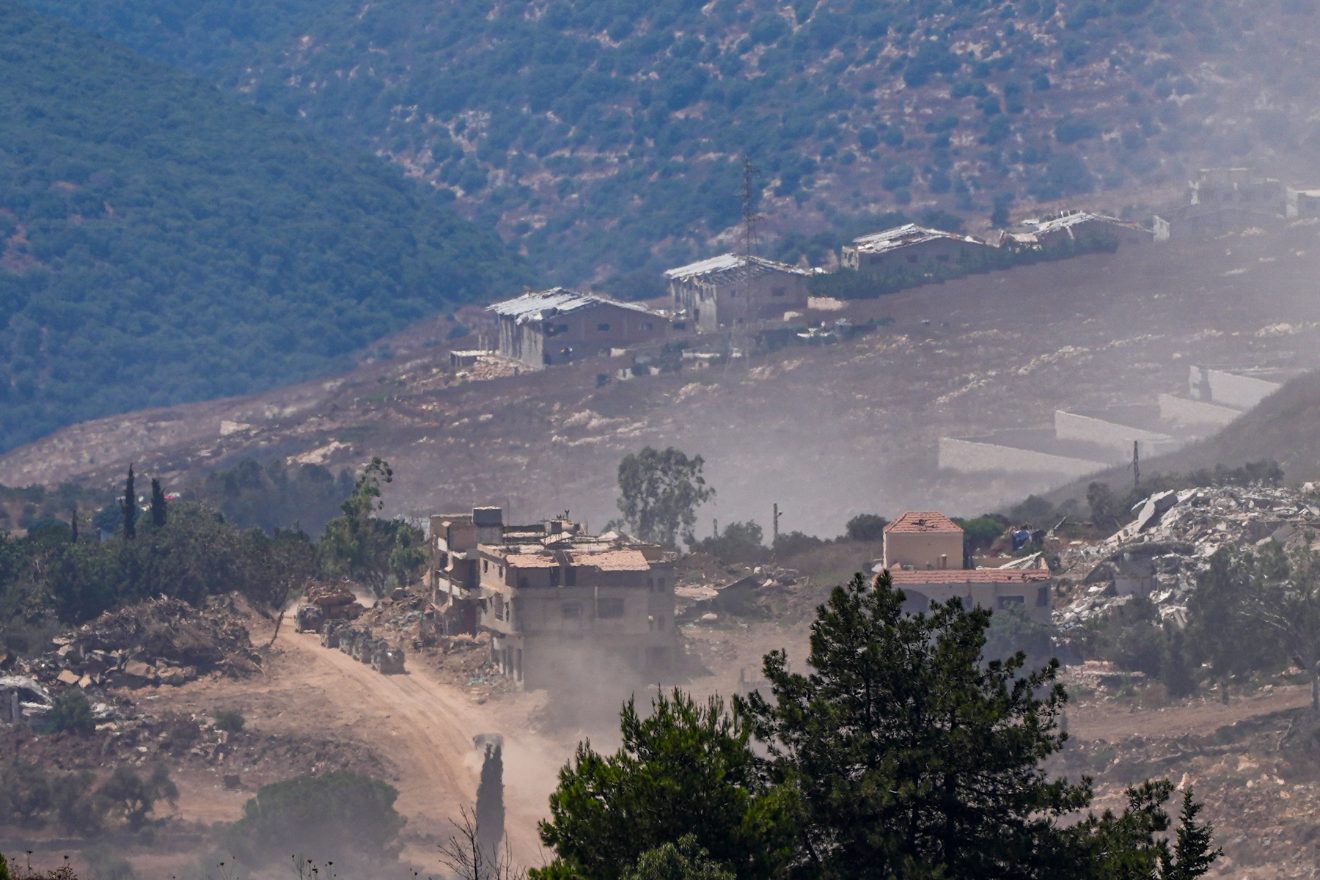
An Israeli army convoy seen in southern Israel | Photo: Ayal Margolin/FLASH90
Iran: Hormuz Diplomacy, Nuclear Brinkmanship
The Iran track has been the most volatile, oscillating within days between war footing and diplomatic breakthrough. Fighting since late February effectively closed the Strait of Hormuz, and much of August’s diplomacy has centered on a technical fix: Iran and Oman are reportedly nearing a deal on a safe shipping corridor through the strait, with Iranian officials describing talks as in their “final stages.” Trump has swung between threatening to strike Iranian power infrastructure and announcing pauses “for the future benefit of the world,” at one point saying the US was “locked and loaded” before standing down. He has also floated demanding reparations from Iran for damage inflicted in Lebanon and Gaza, layering a punitive economic dimension onto an already tangled negotiation. Iran’s chief negotiator has publicly mocked what he characterizes as Trump’s repeated reversals, and Tehran has so far declined to fold nuclear talks into the Hormuz discussion, treating the two as separate. Israel has been unambiguous that any settlement must halt Iran’s nuclear and ballistic missile advances, with officials stating Israel will act unilaterally “with or without an agreement” if Iran moves to resume enrichment.
Regional energy producers in the Gulf are increasingly resigned to the idea that Iran’s leverage over Hormuz may prove semi-permanent regardless of how the shipping-corridor talks conclude — a sobering read given how much of this crisis Washington has tried to manage through short-term ultimatums rather than a durable settlement.
Judea and Samaria
Away from the kinetic wars, Israel has continued a quieter but consequential shift in Judea and Samaria (referred to widely as “the West Bank”). A February cabinet decision allocated over 244 million NIS to build out a government mechanism for land registration in Area C — a bureaucratic step that critics argue functions, in effect, as annexation under Israeli law even without a formal declaration.
Some analysts and human rights bodies describe this as “annexation by practice”: settlement expansion, legal restructuring, and administrative absorption proceeding step by step rather than through a single dramatic proclamation. The UN Special Rapporteur and multiple governments have condemned the moves as violations of the Fourth Geneva Convention and the UN Charter’s prohibition on acquiring territory by force. Yet the diplomatic cost to Israel has been muted compared to past eras, largely because normalization agreements with several Gulf states have reduced the regional isolation that annexation moves would once have triggered automatically.
This issue underlines a major dispute between Israel and most other nations. Israel believes that it has superior sovereignty claims to the territories it captured in June 1967 (Gaza, East Jerusalem and the “West Bank” ie. Judea and Samaria). Israel claims full sovereignty over the whole city of Jerusalem (including “East Jerusalem” – ie. The Old City and the surrounding environs). Moreover, it argues that, due to its historic title as well as security needs, pending a final agreement with the Palestinians it is entitled to allow and even enable Israelis to live in the territory designated as Area C under the Oslo Agreements.
This approach collides head-on with the view expressed in many (non-binding) UN resolutions that all of the “occupied territory” belongs to the Palestinians. In July 2024 the International Court of Justice affirmed this approach, opining that Israel’s presence in this territory has become illegal, and it must remove all Israelis from the “occupied” territories as soon as possible. In the view of Israel and some other UN member states, the ICJ’s 2024 opinion was biased and poorly-reasoned, resulting from a one-sided political process, and should be ignored.
European sanctions and boycotts of products from the “occupied territories”
Most, but not all, EU member states support the UN/ICJ view that the whole of the “occupied territories” belongs to the Palestinians, and that Israel is primarily responsible for the fact that the Palestinians do not have their own state on this territory. Due to the lack of unanimity, the EU as a bloc has been unable to agree on a unified response to implement the 2024 ICJ Advisory Opinion. A number of countries (Ireland, Belgium, Spain and Slovenia) have imposed unilateral bans on import of products from these territories. (The UK, France, Germany and Italy have separately warned businesses over West Bank construction activity without going as far as a formal import ban.) The Netherlands has become the fifth EU state to impose a unilateral import ban.
The Netherlands will ban the import, purchase, and sale of goods from Israeli settlements in the West Bank (and Golan Heights) starting September 22, for a three-year period. The ban also covers intermediary services tied to settlement goods. Intentional violations become a criminal offense, carrying up to six years in prison or a €103,000 fine. The Council of Ministers approved it in May under PM Rob Jetten, and Dutch lawmakers confirmed it in July; the Council of State raised no legal objection but flagged doubts about enforceability.
Dutch ports and distribution networks handle roughly a third of all agricultural exports from Israeli settlements, and nearly half of settlement exports bound for the EU pass through the Netherlands. Affected goods are mostly agricultural — wines, avocados, dates, oranges, grapes, fresh herbs — so this hits a specific, sizeable slice of settlement trade rather than Israeli trade broadly (JNS notes it targets a comparatively tiny share of Israel’s overall exports).
The latest Dutch move traces back to August 2025, when then-Foreign Minister Caspar Veldkamp resigned after coalition partners VVD and BBB blocked his push for a settlement import ban and suspension of the EU-Israel trade agreement — a resignation that briefly splintered the caretaker government. D66 won the October 2025 election running partly on a tougher Israel line, and Jetten’s new coalition (D66, CDA, VVD), formed in February 2026, revived and passed the policy Veldkamp couldn’t get through.
The Dutch Foreign Ministry frames this as compliance with an “international legal duty not to contribute to the continuation of an unlawful situation” — language drawn from the 2024 ICJ advisory opinion on the settlements’ illegality, rather than a novel Dutch position.
Israel’s Foreign Minister Gideon Saar formally reprimanded the Dutch ambassador, accusing the Netherlands of converting “a long-standing friendship… into open hostility,” and suggesting the move was driven by domestic political interest rather than principle.
Pray for Israel and her leaders, that wisdom and unity would prevail where division now reigns. Pray for the enemies of the Jewish people, that hearts of stone would be turned to flesh. Pray for the peace of Jerusalem, and for all who dwell within her borders — soldiers, reservists, hostage families, the displaced in the north and south alike.
And above all, pray for the speedy coming of the Messiah of Abraham, Isaac and Jacob, who alone can bring the peace no treaty, board, or ceasefire has yet managed to deliver.

‘No holiday from antisemitism
For Jews and Israelis, the summer vacation season has become another arena of exclusion, intimidation and increasingly open hatred.
The new era of Israel-Japan intelligence cooperation
The Asian nation is building up its autonomy in the security sphere and diversifying its partnerships beyond the alliance with the United States.
Israel, Venezuela renew consular relations after 17 years
The nations agreed on a coordination mechanism for citizen services following Jerusalem’s prolonged humanitarian assistance deployment to the country.
IDF: Hamas intensifies Gaza torture
The terror group escalated abuses against civilians following a ceasefire late last year, according to the Israeli military.
SCRIPTURE FOR THE WEEK: Psalm 121
1 I lift up my eyes to the mountains—
where does my help come from?
2 My help comes from the Lord,
the Maker of heaven and earth.
3 He will not let your foot slip—
he who watches over you will not slumber;
4 indeed, he who watches over Israel
will neither slumber nor sleep.
5 The LORD watches over you—
the Lord is your shade at your right hand;
6 the sun will not harm you by day,
nor the moon by night.
7 The LORD will keep you from all harm—
he will watch over your life;
8 the LORD will watch over your coming and going
both now and forevermore.
Why Israel? by Rev. Willem Glashouwer
Order the book