The Battle for the Land: Judea, Samaria and Gaza
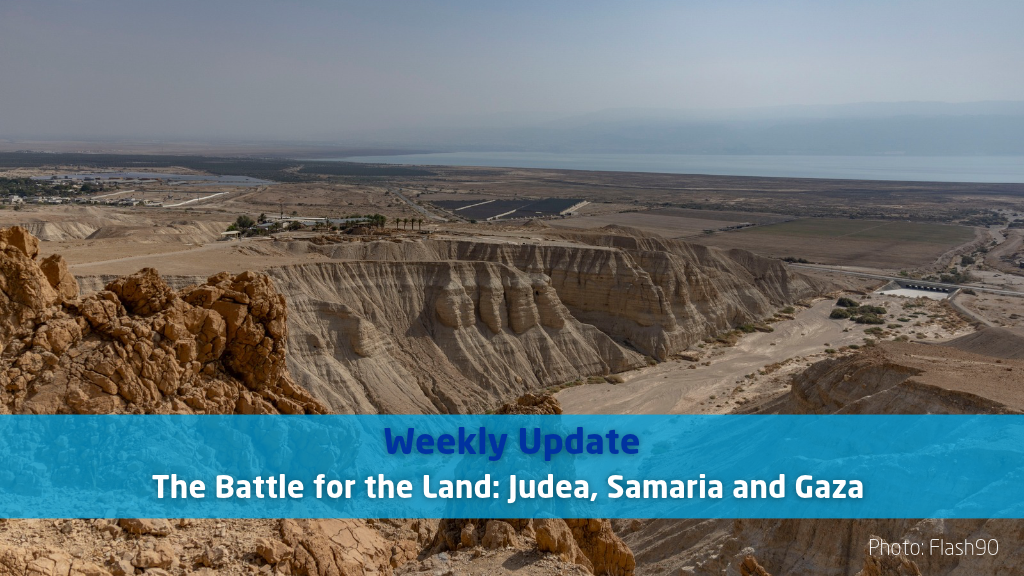
“You shall yet plant vines on the mountains of Samaria,” the Lord promised through Jeremiah (Jeremiah 31:5). The prophets foresaw a day when the scattered people of Israel would return to the hills of Judea and Samaria, and those mountains would “yield your fruit to My people Israel” (Ezekiel 36:8). This week’s update shows how fiercely that promise is contested.
In the biblical heartland, Israel is building at a pace not seen in decades, while the Palestinian Authority has assembled an army several times the size Oslo allowed and Iran smuggles weapons to terror cells. In Gaza, a year after the ceasefire, reconstruction has stalled and Iran-backed jihadist groups vow to fight on, echoing the ancient cry of Psalm 83: “Come, and let us cut them off from being a nation.”
With Israelis going to the polls on October 27, the pressures on the land and its people are great. Yet the psalmist reminds us that “He who keeps Israel shall neither slumber nor sleep” (Psalm 121:4).
“Again you will plant vineyards on the hills of Samaria; the farmers will plant them and enjoy their fruit.”
Jeremiah 31:5
The Battle for the Heartland — and the Army Next Door
Standing at the security barrier opposite Tulkarem on Tuesday, Prime Minister Benjamin Netanyahu warned Israel’s enemies not to test the Jewish state ahead of the October 27 Knesset election. Israel, he said, is ready for any scenario, including a “turning of barrels” by Palestinian Authority forces. “There will be no Arab army west of the Jordan River,” he vowed. “There will be the Israel Defense Forces.”
The warning comes amid an intense contest for control of the biblical heartland. According to figures from Finance Minister Bezalel Smotrich’s party, reported by JNS, the government has approved 60,000 housing units in three years and established 104 new communities and 160 agricultural farms. Smotrich says the aim is “to effectively kill the idea of a Palestinian state.” The PA, for its part, has pursued the Fayyad Plan, building a de facto state through illegal construction in Area C, where Regavim counts nearly 97,600 unauthorised structures. Demolitions have increased, but Regavim warns that illegal building has climbed back to levels not seen since 2023.
The greater danger may be the PA’s security forces. Oslo capped them at 12,000 in Judea and Samaria. Lt.-Col. (res.) Maurice Hirsch of the Jerusalem Center for Security and Foreign Affairs estimates that more than 50,000 now serve there, with tens of thousands of weapons. Hamas reached 22 kilometres into Israel on October 7; from Qalqilya to the Mediterranean is just 14, and a breakthrough there could endanger over 2.5 million Israelis. Defence Minister Israel Katz has threatened “all-out war” if the PA plans such an attack. The IDF says it sees no sign of one, but Hirsch warns that waiting echoes the “Oct. 6 conceptions.”
Hirsch sets out the case in detail in his July report for the JCFA, “Planning the Next October 7 Massacre: The New Palestinian Terror Army.” Oslo allowed the PA 4,000 rifles, 4,000 pistols, 120 machine guns and 15 armoured vehicles in Judea and Samaria. Instead, he argues, its forces grew relentlessly, from roughly 18,000 in 1995 to more than 65,000 by 2018, and now hold tens of thousands of weapons and dozens of armoured vehicles. What was established, he writes, “is not a police force but a full-fledged military array.” Its ranks have absorbed wanted terrorists and released prisoners, and its cadets are trained abroad, including in Pakistan. Yet with a relatively low crime rate in PA areas, there is little policing need for an army of this size.
Hirsch also maps the danger. A breakthrough from Jenin would threaten some 340,000 Israelis; from Tulkarem, 500,000; and from central and southern Judea and Samaria, around two million, including Jerusalem and Be’er Sheva. He urges Israel to halt arms transfers to the PA and recover weapons beyond the Oslo limits, tie foreign aid to cutting the force back to 12,000, set up independent inspections of PA depots and bases, and prepare the IDF for a “reversal of the rifles” as its central threat.
Iran is working to arm the same arena. A year ago this month, the Shin Bet revealed that it had intercepted an Iranian weapons shipment bound for terror cells in Judea and Samaria, after arresting a Ramallah-based arms dealer. The cache, reported by the Foundation for Defense of Democracies, included 15 anti-tank missiles, 29 claymore-type explosives, four drones (two of them explosive), an RPG launcher, 20 grenades and dozens of pistols, rifles and machine guns. The Shin Bet attributed the plot to the Revolutionary Guards’ Unit 4000 and the Quds Force’s Unit 18840, calling it “part of an ongoing Iranian effort to undermine security in the region.” Similar shipments had been stopped in March and November 2024. FDD’s Joe Truzman described the weapons as “game-changing” and “capable of inflicting mass casualties.” Tehran’s goal, said FDD chief executive Mark Dubowitz, is simple: to “arm Palestinian terror cells to kill Israelis.”
Israel has learned at terrible cost what happens when a hostile army is allowed to grow on its doorstep.
Gaza One Year On: Two Diagnoses of a Stalled Peace
A year after the Trump-brokered ceasefire of October 2025 brought home the last Israeli hostages, Gaza remains stuck between war and peace. Two articles published on October 8 agree on that, but differ sharply on why.
Writing in Foreign Affairs, Khaled Elgindy of the Quincy Institute paints a grim humanitarian picture. In January, Jared Kushner promised that water, power, hospitals and bakeries would begin to be restored within 100 days. Nine months on, he reports, there has been no reconstruction. Most of Gaza’s two million people live in squalid tent cities along a shrinking coastal strip, short of food, medicine and clean water, while Israeli strikes continue, killing some 300 children in the past year, he says. Board of Peace envoy Nickolay Mladenov has said that Israel’s commitments are “where we are little bit stuck right now.” Elgindy argues that the Netanyahu government’s real aim is to render Gaza uninhabitable and eject its population.
Khaled Abu Toameh, writing for Gatestone, looks at the other side of the ledger. Marking the third anniversary of October 7, Palestinian Islamic Jihad leader Ziad al-Nakhala pledged to continue “the path of jihad and resistance” by “all possible means,” called the massacre a “natural response” and paid tribute to Iran, Hezbollah and the Houthis. The US Treasury reports that Hamas still receives “hundreds of millions of dollars in state sponsorship from Iran.” The real question, Abu Toameh argues, is not whether the terror groups will accept a pause in fighting, but whether they will give up their weapons. Their own answer is no.
Read together, the two accounts describe the same deadlock. Reconstruction will remain elusive while Hamas and PIJ stay armed and backed by Tehran, yet Gaza’s civilians cannot wait indefinitely.
Prayer
Pray for Israel’s leaders and voters ahead of the October 27 election, that God would grant wisdom and raise up leaders who will govern justly and keep the nation safe (1 Timothy 2:1–2).
Pray for protection for the millions of Israelis living within reach of the Palestinian Authority’s forces, and that any plan for a “reversal of the rifles” would be exposed and thwarted before it begins (Isaiah 54:17).
Pray that Iran’s efforts to arm terror groups in Judea, Samaria and Gaza would continue to be uncovered, and for the soldiers and security services who stand guard day and night (Psalm 33:10; Psalm 127:1).
Pray that God’s purposes for the mountains of Israel would be fulfilled, and that Israel would stand firm under international pressure (Ezekiel 36:8–11).
Pray for the disarmament of Hamas and Palestinian Islamic Jihad, and for relief for ordinary Gazans caught in between, that many would come to know the God of Israel (Psalm 72:12–14). Pray for the peace of Jerusalem, and that those who love her would prosper (Psalm 122:6).

‘JCFA: Planning the Next October 7 Massacre
The Palestinian Authority’s security forces have expanded substantially beyond the personnel, weapons, and operational limits established under the Oslo Accords. The security forces have evolved from a civilian policing body into a military-capable organization with offensive capabilities, supported by foreign training, funding, and equipment. Current Israeli and international policies have enabled the continued growth and militarization of the Palestinian Authority’s security apparatus despite the original Oslo framework. Recommended policy measures include reducing the security forces to their original agreed size, ending military assistance and advanced training, increasing oversight, and strengthening Israel’s defensive preparedness.
The battle for Judea and Samaria, the Jewish people’s biblical heartland
“I am proud to lead a tremendous revolution in settlement in Judea and Samaria and to effectively kill the idea of a Palestinian state,” Israeli Finance Minister Bezalel Smotrich told JNS.
Netanyahu: Israel ready for any scenario, including attack by PA forces
PM warns enemies ahead of Oct. 27 elections, vows IDF will maintain security control “from the Jordan River to the sea.”
The PA’s Massive Army Threatens Millions of Israelis Within Just 22 Kilometers
The PA has built a 70,000-strong force that poses a strategic threat to millions of Israelis within a small radius. Israel must immediately dismantle it to prevent a catastrophe potentially far worse than October 7.
Iran Fueling Palestinian Jihad, Preventing Terrorists’ Disarmament
Three years after October 7, the international community should stop asking only what Israel intends to do next. It should ask what Hamas, Palestinian Islamic Jihad, and their Iranian patron intend to do next…. They keep reminding us. They intend to continue their jihad until the elimination of Israel.
The End of Gaza
A year after the Trump administration negotiated an agreement to end the war in Gaza, Palestinians are still waiting for the “day after” to arrive. The October 2025 cease-fire plan freed the last remaining Israeli hostages and ostensibly ended hostilities, but Israel continues to constantly strike targets in Gaza, often killing civilians, including some 300 children in the past year.
Maxim went to the Nova Music Festival expecting to stay for just a few hours. He returned home 738 days later.
In this deeply personal interview, he recounts surviving the October 7, 2023 attack, being taken hostage by Hamas, and enduring more than two years in captivity in Gaza.
He shares what life was like in the houses and underground tunnels where he was held, how faith and prayer sustained him, and how seeing people campaign for the hostages gave him strength.
SCRIPTURE FOR THE WEEK: Jeremiah 31:1-6
"At that time," declares the Lord , "I will be the God of all the clans of Israel, and they will be my people." 2 This is what the LORD says: "The people who survive the sword will find favor in the desert; I will come to give rest to Israel." 3 The LORD appeared to us in the past, saying: "I have loved you with an everlasting love; I have drawn you with loving-kindness. 4 I will build you up again and you will be rebuilt, O Virgin Israel. Again you will take up your tambourines and go out to dance with the joyful. 5 Again you will plant vineyards on the hills of Samaria; the farmers will plant them and enjoy their fruit. 6 There will be a day when watchmen cry out on the hills of Ephraim, 'Come, let us go up to Zion, to the LORD our God.' "
Why Israel? by Rev. Willem Glashouwer
Order the book